Page numbers are shown at the end of the page in blue. Page breaks in continuous text are indicated by //. Posting notes and explanations, added to the text of the author are shown in (blue italics) in parentheses and in blue boxes, or highlighted by blue headers.
THE TWO EAGLES (889-1019)
133
CHAPTER I
Emperor of the Bulgars and the Romans
By his wife, christened Maria, Boris had six children — Vladimir, Gabriel, Symeon, Jacob, Eupraxia, and Anna. [1] Gabriel probably died young, and possibly Jacob also; Eupraxia became a nun, and Anna no doubt married — it may be, into the Moravian royal house [2]; Symeon had entered the church; and Vladimir was to succeed his father on the throne.
Unnoted by S.Runciman, the traditional Türkic Lateral Succession laws prescribe a succession by the most senior surviving member of the male dynastic line. The succession cycles from the eldest brother to the youngest, and upon the death of the youngest falls on the eldest of the next generation, usually by that time the eldest son of the eldest brother, and the cycle starts anew. The succession sequence is intended to install the most experienced and wise as a supreme ruler. Any member of the sequence has a right to decline enthroning, and the opportunity descends on the next in line. The maternal dynastic line, represented by its leader who traditionally holds a post of a Prime Minister, has a right to accept or reject the eligible candidate, in that case the opportunity also descends on the next in line. Only the sons or grandsons of enthroned rulers are eligible for succession, the progeny of those who for any reason were not raised to the throne lose their eligibility. To avoid internecine conflicts, the rules are strictly followed. These rules preclude father-son succession, and safeguard the state from installing immature rulers. The drawback of the Lateral Succession is excessive production of ineligible princes called izgoi in Slavic, who tend to scheme to reach to the top, internecine conflicts and fractionation were perennial causes for the demise of the Türkic states. But notably, even the rulers who came to power by usurpation invariably reverted back to the traditional Lateral Succession, only the starting point of the dynasty was out of line. Historically, alien observers rarely grasped the Lateral Succession laws, distorted them in their descriptions, and only the Chinese and Byzantines learned to understand and use it for their advantage. It is highly unlikely that Boris did not have brothers, like any other Türkic noble Svinitse must have had numerous wives and numerous male offsprings, and in accordance with the Lateral Succession order, Vladimir stood in line behind all Boris brothers born from eligible female dynastic lines. Again, it is highly unlikely that Svinitse married only non-pedigreed wives, the descent was paramount in the Classical and Middle Age societies, and marriages were more political alliances than personal preferences. Only a deliberate act on the part of Boris to break off with the Lateral Succession tradition would allow him, against the will of his Türkic and probably to a major degree non-Türkic subjects, to appoint his son Vladimir as a Kağan or Great Knyaz. Traditionally, the Crown Prince occupied position of a Left Wing commander, and the other eligible candidates served in the Left Wing under his command. Thus, the Crown Prince was in practice ruling nearly half of the state. The positions in the Right Wing belonged to the heads of the maternal dynastic line, ineligible for succession, in practice they ruled the other half of the state. The Byzantine side had no regal traditions, no millennium-old dynastic line, and the endless sequence of Emperors and Co-Emperors lived by their own ambitions, slyness, and reactions to the external forces. Probably, some of the Byzantine royalty had some knowledge of the Türkic dynastic traditions, but likely most of them did not have a slightest clue, conditioned on the Byzantine superficial pageantry that served as a substitute for fundamental dynastic traditions. |
Vladimir had been a crown prince for too long. He must now have been nearing his fortieth year, for he had accompanied his father to the Serbian war in the old heathen (Tengrian) days. And, like all impatient crown princes, he was filled with the spirit of opposition to his father’s policy. Of the inward history of his reign we know little, save that he received an embassy from King Arnulf of Germany in 892. [3] It seems that no sooner was Boris safely hidden from the world in his monastery than the new Khan upset all his reforms. The old Bulgar aristocracy, that Boris had so firmly cut down, had grown up again to an effective height; and Vladimir fell under its influence. The boyars had disliked Boris’s Christianity, with its austere and autocratic tendencies (Boyars, like the members of national parliaments, probably were real patriots responsible to their tribes for the fate of their country, and also had personal interest in maintaining traditional structure of the society. On top of that, boyars and their local assistants were responsible for the wellbeing of their tribes granted by the Almighty, and no Greek priest could possibly substitute for that function of personal responsibility. In the traditional structure, boyars had numerous multifaceted functions, from sacral to mundane, and the communities expected boyars to perform those functions. Any Bulgar patriot, Slavic or Türkic, could rejoice from the demise of Bulgaria concocted by Boris).
1. The names of the royal family are given in the marginal notes to
the Cividale gospel as patronizing some monastery (Racki, Documenta Historiae Chroaticae, pp. 382-3). Vladimir is called there Rosate, probably his pre-Christian name
(S.Runciman stipulates a Türkic name without elucidation, but is
may be as well a Slavic version).
2. The Anonymous Hungarian historian says that King Salanus
(Svatopulk II) of Moravia was connected by marriage with the Bulgar king (at that time Symeon,
866–927). Such a
statement from him must naturally be taken with reserve; but if, as is quite likely, there was
such a connection, it would almost certainly be through one of Symeon’s sisters marrying the Moravian King.
It is unlikely that Symeon’s first wife could have been a Moravian princess (Anonymi
Historia Ducum Hungariae, p. xli.).
3. Annales
Fuldenses, p. 408. The envoys entered Bulgaria down the River Save. Vladimir is
called Landimir or Laodimir.
134
In contrast, Court life became extravagant and debauched, and there was even an official attempt to reintroduce the old pagan rites and idolatries (I.e. what was suppressed and done in closet came out into open).
But Vladimir and his boyars had reckoned without Boris. Immured though he was in his monastery, he knew what was going on outside. For four years he let them be; then, when he saw his life-work being too seriously endangered, he emerged. His prestige as a terrible saint was enormous; with the help of a few older statesmen he easily took possession of the Government. Once again in power, he sacrificed his paternal feelings for the good of his country. Vladimir was summarily deposed and blinded, and so passes out of history (A second bloody coup, this time against his own son). [1]
This was the last attempt of a pagan revival — its dying throe. It was doomed to fail; no one could expect the lower and middle classes to revert to a cruder and more oppressive religion at the behest of semi-alien overlords, and the overlords themselves were guided more by political than by spiritual motives. Boris had only to reappear to cause the whole business to collapse. But it was rather a delicate situation for Boris. In dethroning his son he had saved Christianity, but he had endangered its corollary. He acted warily. Summoning a congress from all his kingdom (how it was composed we cannot tell — probably of the Court nobility, the provincial governors or their representatives, the ecclesiastical authorities, and any other outstanding citizen), he justified his interference on the grounds of religion, and then bade them accept as their monarch his younger son, the monk Symeon (866–927). [2]
1. Regino, p. 580: Manegold, p. 364: Sigebert, p. 341: Theophylact,
Archbishop of Bulgaria, Historia XV Martyrum, p. 213; Chudo Sv. Georgiya, pp. 19-20.
2. Regino, loc. cit. Boris threatened Symeon that he would treat him
similarly should he relapse — a needless threat to a pious monk, but one probably calculated to show that
only on religious grounds could the monarch be deposed, and only Boris as an ex-monarch could
effect the deposition.
135
At the same time, he took the opportunity of the presence of the congress to complete his last great reform. The seed that Clement was sowing in Macedonia — work uninterrupted, it seems, by Vladimir’s reign — and that Nahum was sowing nearer to the capital, had taken root sufficiently; it was time to replace the Greek tongue by the Slavonic throughout the Bulgarian Church. [1] There were several reasons for doing this now; it is probable that there was a vacancy in the Bulgarian archiepiscopate; it is possible that the Greek clergy was too closely connected with the Court aristocracy; and certainly it was a good moment for a measure that might displease the Empire — Basil and Photius were dead, and the Emperor Leo and his brother the Patriarch were too indifferent and weak to oppose the fulfillment of a movement that even their great predecessors had regarded as inevitable. Moreover, Boris calculated, the enforcing of Slavonic as the one national language of Bulgaria would submerge for ever the conscious exclusiveness and superiority of the old Bulgars. The Children of the Huns were to lose their identity; Bulgarian was to mean now Slav and Bulgar alike, any subject of the Bulgarian monarch — who was the Sublime Khan no longer, but the Knyaz, the Slavonic Prince. With the change in the language, it is probable that the organization of the Bulgar Church was completed, to fit the new state of things. Some time about now the country was divided up between seven metropolitans under the Archbishop of Bulgaria — the metropolitans of Dristra, Philippopolis, Sardica, Provadia, Margum (or Morava), Bregalnitsa, and Ochrida. [2]
1. See Zlatarski, Istoriya i., 2, pp. 254 ff. It is inherently probable that the change was effected
now and his arguments are, I think, conclusive, though I think that the process
was more gradual than he allows; the Greek language did not fall entirely into disuse.
2. Zlatarski, op. cit., pp. 207 ff., dates their creation in 864; but
it seems obvious from Saint Clement’s career that Ochrida at least dates from later.
136
Most of their dioceses had been organized before, particularly those in Eastern Bulgaria; the diocese of Bregalnitsa was being organized in 889. [1] The diocese of Ochrida had probably not yet come into being — Macedonia was still too wild. But Clement’s missionary work had advanced now far enough for a bishopric to be created for him. He became bishop of the dual see of Debritsa (Drembitsa) and Belitsa, two small towns between Ochrida and Prilep. [2] Later their importance was overshadowed by Ochrida.
In connection with these ecclesiastical reforms another great change was made.
Joseph, the new Archbishop of Bulgaria, had his archiepiscopal seat not at Pliska, but at Preslav. [3] The capital was being moved. [4] Pliska, the Hunnish capital, with its memories of the great heathen (Tengrian) Khans, was no longer suitable. The Christian Prince should dwell at Preslav, close by the monastery of the Panteleimon and the Christian college of Nahum.
When all this was done, Boris returned to his cloister. His work was really finished now. Before, he had rested too soon; Vladimir had been a broken reed. But this time he was certain. He could devote himself for ever now to religion; nor would he help his country ever again save by his prayers. He had helped it enough already — enough to have his name everlastingly revered as the greatest of all its benefactors.
1. See above, p. 129. Boris’s transference of relics from the Greek
town of Tiberiupolis to Bregalnitsa was clearly incidental to the founding of the new diocese.
2. Vita S.
Clementis, p. 1228. Zlatarski (op. cit., pp. 269 ff.) identifies Drembitsa and
Belitsa. The Vita S. Clementis says that Clement was appointed by Symeon (who succeeds
Vladimir on Vladimir’s death, which is mentioned without comment), but that he was the first Slav
bishop — i.e. his was probably the first appointment made after the change of language, or else the
Archbishop Joseph was of Greek origin.
3. His name is supplied in the Sinodik Tsaria Borisa (ed. Popruzhenko,
Odessa 1899), pp. 74 -5, and in the Chudo Sv. Georgiya,
loc. cit. For the whole question see Zlatarski, Bulgarski Arkhiepiscopi Patriarsi, passim.
4. A note to a copy of the Book of Isaiah informs us that Symeon
moved the capital.
137
The new Prince, Symeon (866–927), was a far better son than Vladimir. He was about thirty years of age. [1] Much of his life had been spent at Constantinople, living, it seems, in the precincts of the Palace and studying probably not only at Photius’s Slavonic college but also at the University. Certainly he became a proficient Greek scholar, with a taste for the works of Aristotle and Demosthenes. Indeed, he was sometimes known as Hemi-Argus, the half-Greek. [2] Of recent years he had taken monastic orders, being, it may be, designed by his father for a Bulgar patriarchate, and was living in a Bulgarian monastery, probably with his father in the Panteleimon. His Christian zeal was undoubted. Nevertheless, there were some unfavorable comments when he renounced his vows and resumed a very secular life in order to ascend the throne. [3]
If the statesmen at Constantinople had hoped that the accession of the ‘half-Greek’ meant the revival of their influence in Bulgaria, they were sadly disappointed.
Symeon’s devotion to Greek literature only had the effect of making him wish for it to be translated into the vernacular. The decade following the official adoption of the Slavonic language and alphabet bore an amazing crop of literature. The Bulgarian people, long restricted in their writing to Greek characters and language or perhaps a few runic signs, [4] suddenly had found a means of expression. But the blossoming was not altogether spontaneous; a heathen (Tengrian) illiterate empire, however great, will not at once turn into a vigorous bed of flowering culture.
1. Nicholas Mysticus (Ep. xxix., p. 181) calculated in 923 that
Symeon was then over 60.
2. Liudprand, Antapodosis , p. 87.
3. Liudprand (loc. cit.) speaks of the incident with disapproval; but
he gathered his material about Symeon in Constantinople, after Symeon’s wars against the Empire.
4. Khrabr implies that the Slavs employed such signs, but certainly
no traces of them survive in the Balkans (The question of Slavic use of the Türkic
runiform script is a subset of the Slavic-Türkic symbiosis theme, which is still not acknowledged
in the Slavic historiography, and surfaced with specific substantiation only in the 1970s
with the publication of O.Suleimenov's “Az-i-a”, Alma-Ata,
1975, which was taken with incredulity and official reprehension, inciting an
avalanche of studies attempting to prove the opposite. The work of E.Shipova,
ignored and unappreciated to this day,
“Dictionary of Türkisms in Russian Language”,
Alma-Ata, "Science", KazSSR, 1976, with hundreds of words belonging to the most
basic Slavic vocabulary, came out at about the same time. Although references to
the Slavs using runiform script are numerous in the literature, no monograph on the
subject exists, and no codex of inscriptions has ever been compiled. Generally speaking,
our present knowledge is on the level of the 10th c. AD).
138
Bulgarian literature only became a natural growth a century later (Or 4-5 generations later), when Christianity and letters had had time to permeate through (The suppressed Türkic literacy, never formalized before, found a need to preserve its persecuted heritage, reflecting the mass resentment against alien spiritual and physical invasion. Initiated by creeping colonization, one form of the resistance movement were the much maligned Khudayar tenets, later known under its Slavic calque Bogomil that possibly produced the modern Türko-Slavic Pomak ethnicity. Only faded glimpses of the revolutionary events reached us, and that not in their social and ethnic aspects, but only in the form of Bogomil legends and the history of ecclesiastical brawl. Translated and preserved in Slavic, Khudayar/Bogomil ecclesiastical literature survived in bits and peices). [1] At present it was called into being by the active patronage of the Prince. Symeon wished his people to enjoy the treasures of Byzantine civilization; he encouraged translations to be made not only of holy and patristic works, but also of suitable romances. Consequently the first Bulgarian writers were mainly translators; and their work has that somewhat artificial air given when the matter is more sophisticated than the language.
Unaddressed by S.Runciman is the question of popular literacy and target audience of the translations. The Slavic literacy remained in single digits to the end of the 19th c., and there is no reason to believe that it was any higher in the 9th c. The Türkic literacy appear to be completely outside of the Greek proselytism. The audience of the translations was precious few, thus the condescending attitude that people's masses “were very stupid”. No wonder, they, the Slavs, were forcefully driven into the churches to listen to oral admonitions in Greek. No sane scholar would suggest that the Türkic ranchers of the horse herds could have been forcefully driven from their ranges into the churches to listen to Greek orations. They continued to be on their own. |
Nevertheless, it was a creditable beginning for any literature. Already, ever since he had settled in Macedonia, Clement had been busily translating. He had found himself greatly handicapped by the prevalent ignorance of Greek; and the people were very stupid. [2] The only hope lay in copious translations. But Clement was indefatigable. He could draw on the works of his great masters, Cyril and Methodius, and he supplemented them as best he could. By the end of the century he had made Ochrida one of the most renowned centers for the dissemination of Christianity and culture; and when he began to retire from active life his work was amply carried on by his old fellow-disciple, Nahum, who came over from Preslav to take on the bishopric of Ochrida. [3]
1. The Bogomil legends really represent the first spontaneous
Bulgarian literature.
2. Vita S.
Clementis, p. 1229.
3. Vita S.
Clementis, loc. cit. and ff.: Zhitya Sv. Naum, pp. 4 — 5: Zlatarski, Istoriya, i., 2, pp. 351 ff.
139
But at present Clement’s Macedonian school was overshadowed by the royal
school of Preslav. There translations were being made on all sides. Symeon
himself even superintended a collection of explanatory extracts from the Fathers; and
the preface paid a flattering tribute to his patronage, calling him the ‘new Ptolemy, who like the industrious bee
gathers the juice of all the flowers, to spread it over the
boyars.’ [1] A Bishop Constantine translated some homilies for holy days and the works of Saint Athanasius
[2];
the Presbyter Gregory translated the chronicle of John Malalas, and also a
romantic tale of Troy for the ‘book-loving Prince.’ [3] John the Exarch, at the behest of the royal monk Duks, brother of Boris, translated John Damascene and wrote a
Shestodniev, an adaptation of Saint Basil’s
Hexameron. John, writing probably a little
later than the others, was more adventurous, and wrote chapters of his own composition.
To his John Damascene he wrote a preface that gave a short history of Slavonic
letters and discoursed on the difficulties of a translator — what is one to do when the
words are of different genders in Greek and in Slavonic? — and to his
Shestodniev he added an epilogue praising the glories of Symeon’s Court at Preslav. [4] Even the royal family produced an author, Tudor (or Theodore), son of Duks
(Doks = Türkic Boar; it could be a title; o/u in Türkic are
interchangeable, they are depicted by the same grapheme
 ); but only a small
prologue of his survives. [5]
); but only a small
prologue of his survives. [5]
But all these translations were valueless unless the public could be persuaded that Slavonic was a suitable medium for literature. It was to justify its use that the first original Bulgarian work was written. Shortly after the adoption of the Slavonic liturgy the monk Khrabr wrote a little apologia on the Slavonic alphabet, in which he pointed out that though Hebrew, Greek, and Latin were the languages sanctified by their use in the Scriptures and by the Fathers, that did not exclude the permissibility of Slavonic; for, after all, the Greeks once used the Phoenician alphabet, and, anyhow, the Greek alphabet was created by a heathen (non-Christian), whereas the Slavonic was created by that Christian saint, Constantine or Cyril.
1. Sbornik na Tsar
Simeona, preface.
2. Given in Archbishop Antony’s Ep. Konstantin Preslavski. I do not think
that Constantine’s see can be identified; it cannot have been Preslav, which had other occupants.
3. Kalaïdovitch, Ioann Eksarkh, pp. 138 ff.
4. Idem, op. cit., p. 138: John the Exarch, Shestodniev, which gives full text.
5. Given in Pripiskata na Tudora Chernorizets Doksov, by Gorky i Nevostruev, pp. 32 — 3. His relationship to Symeon has been worked out by Zlatarski, Koi e bil Tudor Chernorizets Doksov (see Bibliography).
140
The treatise is a conscientious piece of polemic writing, occasionally naive in style and argument, and just occasionally bearing the mark of one who felt that the ice was thin. But it must have served its purpose well, making the advocates of the new alphabet feel that they had divine sanction in adopting it. [1]
There was, however, one more difficulty about the new alphabet; but it seems to have died a natural death. Saint Cyril’s ingenious brain had evolved two alphabets, those known today as Cyrillic and Glagolitic (Glagolic). The former was based on the Greek alphabet supplemented by the Hebrew, and probably represented his first attempt, destined for the Balkan Slavs near his home at Thessalonica. But when he arrived in Moravia, where anything suggesting Greek propaganda was deeply suspect, he found his alphabet a liability, and began again, arbitrarily distorting the Greek letters, to disguise their origin, and generally elaborating the whole affair. This was the alphabet to which Clement had been educated; he brought it to Bulgaria with him, and in it some of the earliest Bulgarian manuscripts were written. But in a land where Greek culture was not suspect, but, on the contrary, highly fashionable, there was no reason for the existence of Glagolitic (Glagolic). Cyrillic, the alphabet that was no doubt taught at the Slavonic college at Constantinople, was far simpler and far more practical.
1. Khrabr, in Kalaïdovitch, op. cit. pp. 190 — 2 passim. Zlatarski, Istoriya, i., 2, pp. 853 ff. discusses his identity, deciding that he was neither John the Exarch (Ilinsky’s theory)
nor a disciple of the school of Ochrida (Mazon’s theory). But his suggestion that he was Symeon in his
monastic days (ibid., p. 860) seems to me too fanciful. Also I think he is wrong in dating the work
before 893. It seems to me to have the unmistakable air of an apologia after the event.
141
Glagolitic (Glagolic) inevitably gave way before it; but whether the victory of Cyrillic was in any way hastened by official action we cannot tell. [1]
The literary richness was balanced by a growth of the arts and luxuries. Symeon had seen in Constantinople the aureole of splendor that surrounded the Emperor and emphasized his sanctity as the Viceroy of God; he understood its value for the cause of autocracy. In his new capital of Preslav, Great Preslav, the renowned, [2] he attempted to magnify himself likewise. The city began to blossom with churches and with the palaces built by the courtiers who followed the prince’s lead. But the royal palace was the centre of it all; the glory radiated from Symeon. The effect was the more overwhelming in that it was so suddenly created; nothing had ever been seen like it in Bulgaria before. John the Exarch, in the dedicatory chapter of the Shestodniev, attempted to describe the sensations of a visitor from the provinces, how he would be overcome by the sight of all the great buildings, with their marbles and their frescoes — ‘the sights of heaven adorned with stars, sun, and moon, earth with the grass and trees, and the fishes of the sea of all sorts, come upon him, and his mind is lost. He comes back despising his own home and wishes to build himself as high as heaven.’ [3] In the midst of it all sat Symeon, ‘in a garment studded with pearls, a chain of medals round his neck and bracelets on his wrists, girt with a purple girdle, and a golden sword by his side.’ [4] John’s eloquence breaks down under the strain of describing it /142/ all; he can only complain that he is guilty of understatement.
1. For the Cyrillic-Glagolitic
(Glagolic) question, see Appendix IX.
2. Preslav means renowned. The name was frequently given to cities
all over the Slav world.
3. John Exarch, Shestodniev, p. 47.
4. Ibid., p. 46.
142
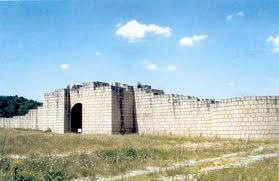
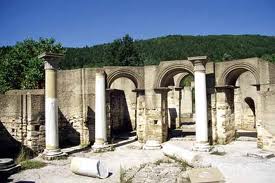
His visitor departs to exclaim to his friends that ‘it is impossible to tell of the splendor, beauty, and orderliness, and each of you must see it for yourselves.’ [1] Symeon’s object seems, therefore, to have been achieved; but it is doubtful if beneath this surface gorgeousness there was what to the eyes of Constantinople would have seemed a respectable standard of civilization and comfort. [2] Moreover, outside the capital there were no luxuries to be found; John the Exarch’s visitor lived in a house of straw. [3] Even in Ochrida the oldest stone-built churches date from a century later.[4] But that perhaps was not unintended. Symeon wished Preslav to be the centre of Bulgaria, even as Constantinople was of the Empire. His hope was forlorn; his capital, like his literature, had been artificially forced. Geography, that had made Constantinople the greatest port and market of the mediaeval world, had given no such lasting advantages to the little inland valley among the low mountains where Preslav lay. Today of that great city, which even three centuries later [5] covered an area far greater than any other Balkan town, only a few meaningless ruins remain.
 |
 |
|---|
1. John Exarch, Shestodniev, p. 46.
2. Certainly in 927 Maria Lecapena took all her furniture, etc., with
her to Bulgaria. See below, p. 179.
3. John Exarch, op. cit., p. 46.
4. Probably coastal towns such as Anchialus or Develtus, built and
still largely inhabited by Greeks and Armenians, had higher standards; and the formerly Imperial fortresses
inland probably retained a few buildings; the Red Church at Philippopolis seems to date at least
from the early ninth century. The first Ochridian churches date from Samuel’s reign.
5. In the days of Nicetas Acominatus (p. 486).
6. It was shaped roughly as a solid pentagon, its sides averaging
some 2 kms in length. The Great Palace or Inner City occupied about 1/8 th of the whole area. The walls
of both cities can be traced, the latter’s still in part standing.
143
Indeed, though the traveler today may still marvel at the greatness of the site, [6] it is hard for him to envisage its past glory. Of Symeon’s vast palace little has been unearthed, but what is bare reveals only foundations and a few marble columns.
The city has for centuries been a quarry for the Turks, just as it itself was probably built from old Roman cities, such as Marcianopolis. [1] The churches that have been excavated — Symeon’s in the outer city [2] and Boris ’s at Patleïna — bear greater traces of splendor. To anyone coming from Constantinople, their size is unimpressive and their decoration must have seemed coarse. It consisted of marble slabs and mosaics, applied, as far as can be judged, without much delicacy; but its main characteristic was the copious use of ceramic tiles, some plain, others ornamented with simple patterns singularly free from Byzantine influence, resembling rather peasant art as it is found throughout the world. But at Patleïna a ceramic icon of St. Theodore has been found, quite Byzantine in feeling and showing a high state of technique. today it stands unique, but whether it was always a unique climax of the art of Symeon’s Golden Age, we cannot now know. [3]
Though literature and refinement might need an artificial stimulus, Bulgarian trade and commerce were flourishing naturally. The main industry of the country was agriculture, and probably Bulgarian cereals and beasts helped to feed the Imperial cities of the coast and Constantinople itself. Mines were worked, and their produce swelled the royal revenues. Moreover, the Bulgarian dominions lay across great trade routes (S.Runciman completely underguestimates the productivity of the horse husbandry and trade value of its surpluses).
1. The marble is certainly from Asia Minor. Symeon may have added to his
stores in his raids on the suburbs of Constantinople.
2. Built, according to a MS at Moscow, in 907 (Moscow
did not exist in 907, Moscow official date is 1147, in 907 its was a tiny village Moskha
= Türkic “Cow”, after the local river).
3. Now in the museum at Preslav. The workmanship seems to me to be
certainly native. The circumstances of its discovery clearly indicate that it dates from the
first monastery on the site, i.e. before AD 900.
144
The busy trade that passed between the Steppes of Russia (i.e. Rus, but in 894 the incipient Rus had neither Steppes nor steppes, the reference is to Bulgarian ~ Ukrainian Steppes of Khazaria) and Constantinople went as a rule by the sea along the western shore of the Black Sea; but some of it must have travelled overland through Preslav and Adrianople or by a coast road, and some through Dristra to Thessalonica. There was another trade route, almost equally important, which could not avoid Bulgaria; this was the route from Central Europe, which entered the Balkan peninsula at Belgrade and, like the railway today, forked at Nish, one branch leading through Sardica (Sofia) and Philippopolis to Adrianople and Constantinople, the other cutting due south across to Thessalonica. This meant a steady flow of merchandise passing through Bulgaria, and enriching on its way the Bulgarian traders or the Greek and Armenian subjects of the Prince. [1]
Symeon watched with care over his country’s commercial welfare; and, early in his reign, his intervention in its interests set going a train of circumstances which for a moment seemed likely to destroy Bulgaria and all its new-born culture, and which in the end served to confirm for ever the Balkan destiny that Boris had planned for his country. Ever since Tervel’s day trade between Bulgaria and the Empire had been carefully organized, and by now the Bulgarians had their counters at Constantinople (probably in the Saint Mamas quarter, along with the Russian (i.e. Rus, although reference to the Rus counters before the Rus even existed is anachronic) counters) where they took their merchandise to distribute it to the Imperial merchants. In the year 894 [2] an intrigue in the Imperial Court resulted in two Greek merchants, Stauracius and Cosmas, securing the monopoly of the Bulgarian trade. They thereupon not only put heavy duties on the goods, but also insisted on moving the counters to Thessalonica — corruption was easier to manage at some distance from the capital. All this naturally upset the Bulgarians, and they complained to Symeon. He at once made representations before the Emperor.
1. The trade routes are given by Constantine Porphyrogennetus, De Administrando Imperio, pp. 79, 177. The Thessalonican routes must, however, be considered in connection
with the episode related below.
2. I discuss the date below.
145
But the dishonest Greek merchants were under the protection of Zaützes, the Basileopator, the all-powerful father-in-law of the Emperor; Leo therefore ignored Symeon’s embassy and the scandal went on. Symeon thereupon decided to have recourse to arms, and prepared to invade Thrace (This episode highlights the importance of the free trade, and principles of compliance with treaties and free trade for Bulgaria and its people, with their annual surpluses of horses and animal products. The episode also demonstrates that the cavalry army and military-trained nomadic population remained a backbone of the Bulgarian state). The main Imperial armies, under Nicephorus Phocas, the hero of the Italian wars, were away in the East fighting the Saracens; Leo could only send against the invaders unseasoned troops, under Procopius Grenites and an Armenian, Curticius. These, in spite of their numbers, Symeon had no difficulty in routing; the two generals were slain in battle, and the captives had their noses slit. The Bulgars then advanced through Thrace up to the capital itself.
Leo next tried diplomacy. He had sent that year an embassy to Ratisbon to King Arnulf — probably before the war broke out, as a counterblast to Arnulf’s embassy to Vladimir in 892 — but his ambassador was not well received. [1] But now he had a far better plan. Ever since the days of Omortag the wild Magyars had been established on the Steppes right up to the Bulgarian frontier on the River Dniester, if not by now to the Pruth (Magyars were driven out of Levedia by Kangars and Bosnyaks in 840 or 860, between 840/860-889/893 Magyars stayed in Atilkuzu “Mesopotamia”, i.e. southern Dnieper Right Bank Ukraine, through which flow five big rivers Dnieper, Boh, Dniester, Prut and Seret.). In 895 he sent the patrician Nicetas Sclerus to the Magyar settlements and proposed to the Magyar chieftains, Arpad and Kurson (Magyars were led by Türkic Kabar clan headed by Almysh's son Arpad, Kurson/Korcan/Kurszan may have been a head of the Kabar tribes), that they should invade Bulgaria; he promised that ships should be sent to convey them across the Danube. The Magyars gladly agreed, especially as they were feeling somewhat pressed on their eastern borders by an even wilder nation, the Petchenegs (Bechens/Besenyo/Bosnyaks); they gave hostages and the treaty was concluded. Leo then summoned Nicephorus Phocas from Asia and fitted out the Imperial fleet under the Admiral Eustathius.
Probably unbeknown to both, Shangun/Symeon and Arpad were grand-grandchildren of Attila and Kurbat, Shangun/Symeon removed by by 22-23? and 14-15? generations respectively, and Arpad removed by 21 and 13 generations respectively. |
1. Annales
Fuldenses, p. 410. The ambassador had only one audience, and left the same day. There
was a second and more successful embassy in 896, but it is doubtful if it had
any great bearing on the Bulgarian war (ibid., p. 413).
146
These latter preparations were really intended just to overawe the Bulgarians. Now that Symeon was going to have the Magyars to deal with, Leo would have preferred not to fight; he had no wish to magnify Magyar power at the expense of Bulgarian, and, besides, his tender Christian conscience made him dislike to fight fellow-believers.
He sent the Quaestor Constantinacius to warn Symeon of the coming Magyar invasion and to suggest a peace treaty. But Symeon was suspicious and truculent; he had learnt in Constantinople how subtle Imperial diplomacy could be, and probably he disbelieved in the story about the Magyars. Constantinacius was put in custody, and no answer was returned.
| Apparently, Symeon had a compact with the Magyar and Bulgar refugees to allow them to settle in the Danube Bulgarian Atilkuzu, and he did not believe in them treacherously turning against their host suzerain. The Magyars and Bulgars were expelled from the N.Caucasus and Levedia by the Kangars/Bosnyaks, after much devastation, and it was natural for the Danube Bulgars to offer shelter to their exiled kins Onogur Bulgars and their allied Magyars. |
Symeon was soon disillusioned. As he prepared to meet Nicephorus Phocas in Thrace, news came to him that the Magyars had arrived (895). He hurried north to meet them, but was defeated. In despair he retreated to the strong fortress of Dristra. [1]
The Magyars advanced, pillaging and destroying. At the gates of Preslav they met Nicephorus Phocas, to whom they sold Bulgarian captives in thousands. The Bulgarians were in despair. They sent to Boris in his monastery to ask for advice; but he could only suggest a three days’ fast and offered to pray for his country. The situation was saved by far less reputable means — by Symeon’s diplomatic trickery.
1. Dorostolum, the modern Silistria.
147
When he realized the seriousness of his state, he sent through Eustathius to ask the Emperor for peace. Leo was glad to comply. He ordered Phocas and Eustathius to retire, and sent the Magister Leo Choerosphactus to discuss terms. This was exactly what Symeon had wished. When the Magister Leo arrived he was detained under guard at the fortress of Mundraga: while Symeon, free of the embarrassment of half of his enemies, set out to attack the remainder, the Magyars (896). In a great battle he succeeded in defeating them and driving them back across the Danube. The struggle was so bloodthirsty that even the Bulgarians were said to have lost 20,000 knights (In the Bulgarian army, every cavalryman was a knight. The number of losses is suspiciously large, especially considering that the same army defeated Byzantine army shortly afterwards. Allowing for 40,000 cavalry, and 1 to 5 ratio, the army was gathered from ca. 200,000 of Türkic nomadic Bulgarian population. That demonstrates that the cavalry army and military-trained nomadic population, all the chatter to the opposite notwithstanding, remained a backbone of the Bulgarian state). Victorious over the Magyars, Symeon informed the Magister Leo that his terms now included the release of all Bulgarian captives recently bought by Phocas from the Magyars. The unhappy ambassador, who had not been able meanwhile to communicate with his Government, returned to Constantinople, along with a certain Theodore, a familiar of Symeon’s, to see what could be done.
Leo wished for peace, and was prepared to give up the prisoners. He had never regarded the war with enthusiasm, and just recently he had lost the services of Nicephorus Phocas, another victim to his evil genius, Zaützes. Symeon, discovering this, determined to fight on. He waited until all the prisoners were returned to him, then, declaring that some had been kept back, he appeared again in full force on the Thracian frontier. The new Imperial commander, Catacalon, lacked Phocas’s ability.
He came with the main Imperial army upon Symeon at Bulgarophygon, and was utterly routed (896). His second-in-command, the Protovestiarius Theodosius, was killed; he himself barely escaped with a few refugees. The battle had been so ghastly that one of the Imperial soldiers determined thereupon to renounce the world, and retired to receive beatitude later under the name of Luke the Stylite. [1] It was now the year 897.
1. Vie de Luc le Stylite, pp. 300-1.
148
Symeon was again master of the situation (897); and Leo Choerosphactus again set out to make the best peace that he could. It was a thankless task. Much of his correspondence with Symeon and with his own Government survives, and shows the trials that he had to face. Symeon was in turns cunning, arrogant, and suspicious; he felt, it seems, that his adversaries were his mental superiors, and so he mistrusted their every gesture lest it should hold some sinister further meaning that he did not see. His letters would contain phrases on the verge of being offensive; he declared that ‘neither your Emperor nor his meteorologist can know the future’ — a remark very galling to a monarch who prided himself on his prophecies (No wonder, the wise boss of the Christ's legate was sly and treacherous, under a cover of Christian sleaziness he perpetrated a devastation on the half of the country, irredeemable loss of a huge number of heads of the families in their prime, he created thousands of orphaned children, and treacherously seized hundreds of thousands of the same Bulgar subjects that he undertook to enlighten and reform. Symeon's attitude was a reflection of the popular mood in the country, he rightfully represented his people). [1] The chief difficulty was that Symeon was unwilling to give up, even at a price, the prisoners, estimated at 120,000, that he had recently taken. ‘O Magister Leo,’ he wrote, ‘I promised nothing about the prisoners. I never said so to you. I shall not send them back, particularly as I don’t clearly see the future.’ [2] But the prisoners were eventually returned, and the ambassador secured a better peace than might have been expected (898). The Emperor agreed to pay a yearly subsidy, probably not large, but we do not know its size, to the Bulgarian Court [3]; but Symeon, so far from making any new annexation of territory, gave back thirty fortresses that his lieutenants had captured in the theme of Dyrrhachium [4]; and the Bulgarian counters apparently remained at Thessalonica. [5]
1. Leo Choerosphactus, Ep. iii. (Symeon to Leo), p. 381. The
Emperor Leo prophesied correctly his brother’s reign, and had a great reputation for his predictions, whence
came his surname ‘The Wise.’
2. Ibid., Ep.
v. (Symeon to Leo), p. 382. This was the complete letter.
3. That this tribute existed we know from Alexander’s refusal to
continue the arrangement made by Leo (Theophanes Continuatus, p. 378, and Nicholas Mysticus, Ep.
vii., p. 57). He suggests that the arrears should be paid up.
4. Leo Choerosphactus, Ep. xviii. (to the Emperor Leo), p. 396.
5. In the De
Administrando (loc. cit.) the trade routes are calculated from Thessalonica.
149
The reason for this moderation was not far to seek. The contemporary Arab historian Tabari told a story of how the ‘Greeks’ were at war with the ‘Slavs,’ and the Greek Emperor was reduced to the expedient of arming his Moslem captives, who defeated the Slavs, but were thereupon promptly disarmed again. [1] The story is obviously fanciful; at most the Emperor may have provided arms for the duration of the emergency to the settlements of Asiatics in Thrace. Symeon was held in restraint by events from a very different quarter. When the Emperor called in the Magyars against him (895), Symeon decided that he too would draw on diplomacy, and he bribed the Petchenegs (Bosnyaks) that lay beyond to attack the Magyars in the rear (896). The result was not altogether what he had wished. When the Magyars, defeated in Bulgaria, returned to their homes (896) — the lands across the Dniester that they called Atelkuz — they found them occupied by the Petchenegs, the one race of which they were mortally afraid.
| S.Runciman distorts the sequence of events, omitting the decisive Battle of Southern Buh, which predated the battle of Bulgarophygon (896). Symeon led an army deep into the Magyar territory, cornering the Magyar cavalry army against the river, and crushed them. Bosnyaks were left to occupy the now defenseless Atilkuzu, but there is no hints that Danube Bulgaria seeded suzerainty over the Atilkuzu territory. Symeon signed a treaty with Bosnyaks, of the terms of which we are only told that “Symeon bribed Bosnyaks”, which distorts the significance of the pact. The army that marched from Preslav to the Southern Buh and back to the Bulgarophygon in such short and critical period could not be a sluggish infantry army of the Slavic peasants, it was the Türkic mounted army of the horse husbandry tribes, the backbone of the Danube Bulgar state. |
They had to migrate; and so with all their families and all their belongings they crossed the rivers once more and then moved to the west, over the Carpathian mountains into the Central Danubian plain, to the banks of the Theiss, the frontier between the Bulgarian and Moravian dominions. It was a suitable time for them.
The great King Svatopulk had died in 894, and his successors were effete and quarrelsome. Their opposition was easily overcome. By the year 906 the Magyars were lords of the whole plain, from Croatia to the Austrian marches and Bohemia.[2]
Symeon could not let this pass unchallenged. Transylvania and the valley of the Theiss were of no great importance to him, save for their salt-mines, whose produce was a great Bulgarian export. But no proud king can endure to lose vast provinces without striking a blow. But, though we know that his troops fought the Magyars, of the extent of the fighting we know nothing.
1. Tabari in Vasiliev, Vizantiya i Araby , vol. ii.,
Prilozheniya, p. n. Dvornik (op. cit., pp. 304-5) places credence in this story and follows Marquart (Osteuroäische
Streifzüge, pp. 517 ff.) in doubting the account given in the De
Administrando of the Petchenegs (Bosnyaks) — Dvornik doing so on the grounds that the Annals of Fulda do not mention it. But on diplomatic matters
Constantine Porphyrogennetus is by far the most reliable writer of the time.
2. Constantine Porphyrogennetus, De Administrando Imperio, pp. 168 ff.
150
According to the Magyars, the Greeks helped the Bulgarians, but they were both defeated. [1] Probably after a few unsuccessful skirmishes Symeon cut his losses and evacuated the land. His vast trans-Danubian Empire was reduced to the plain of Wallachia. [2]
The coming of the Magyars had far-reaching effects on Bulgaria and the whole of Europe. At the moment and for nearly a century their presence seemed to their neighbors — Slav, Frank, and Greek alike — an unmitigated nuisance; they were chiefly remarkable for their efficient and incorrigible raiding. But far-sighted Frankish and Greek statesmen could see them as a deliverance and a blessing.
Hitherto there had been a solid and prolific mass of Slavs spreading from Greece and Italy to the Baltic. Were they ever to unite — and that was not inconceivable — their predominance in Europe was assured. But now a wedge had been driven right in the midst of them; the Northern and the Southern Slavs were separated for ever.
| This kind of the nation-states with people being a polity, with associated paranoia and gigantomania, did not exist in the Middle Ages, the S.Runciman's speculation is grossly anachronistic. In the 10th c., most of the Slavs lived in the Slav-majority states ruled by non-Slav minorities, which had their own ambitions and dangers, totally divorced from what their Slav subjects may or may not aspire to. The later history demonstrated that the ideas of Pan-Slavism never took root, the mutual differences and hatreds between Slavs were always overcoming any attempts to amalgamate them in unified states. Hungary played fairly insignificant role in the fates of the Slavic peoples. |
They would each go their own way now. With this new enemy in their midst, they could not expand further. The neighboring races were saved.
But though the Slav world in the end was to lose by it, on Bulgaria the effect of the Magyars was as a stimulant. Boris had laid down that Bulgaria should be an Eastern Power. Now there was no alternative. She was cut off entirely from the middle Danube and the West; it was useless to sigh over hopeless ambitions there. Bulgarian ambassadors were no more to journey to Aachen or to Ratisbon; the road was blocked, and so they would forget it (This is a lame excuse, many roads connected Bulgaria with their northern brethren and Franks, the reason must lay somewhere else). Symeon’s longings for greater power must be realized now in the Balkans. He turned his eyes hungrily on Serbia and Croatia, and most of all upon the Eastern Empire. And certainly strange things were happening there.
1. Anonymi Historia
Ducum Hungariae, p. xli.
2. In the absence of any definitive statement, it seems best to
assume that Symeon only retained Wallachia, which he lost a few years later to the Petchenegs
(Bosnyaks). The Magyars
certainly acquired Bulgarian Transylvania and Pannonia; Moldavia, over which Symeon’s hold
was weak, probably fell to the Petchenegs.
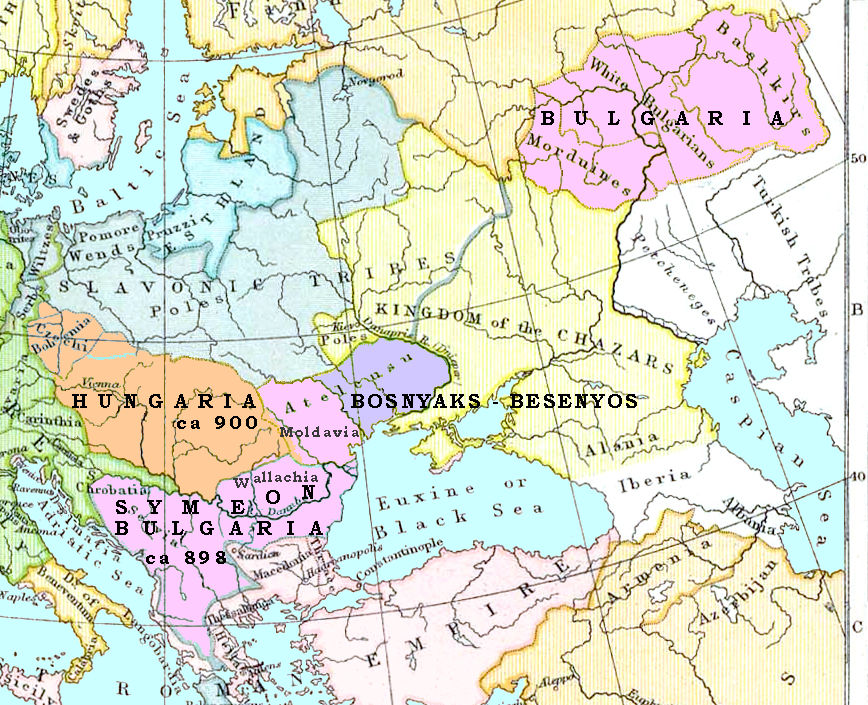
| Something very strange is happening on the pages of S.Runciman's book: Symeon
won shining victories diplomatically and in the field, and as a result lost nearly half
of his state to the Magyar - Bulgar coalition of seven tribes, plus a bulk of the Atelkiji
to the Bosnyaks; in addition soon he lost Moldavia to the Bosnyaks; as a result Symeon
retained only about 40% of the territory, people, and power that he inherited in 866 from
Vladimir; compared with Omurtag's inheritance, Boris lost 60% of his possessions during
his royal years (852-907). Such great changes must have resulted in great displacements, and inflow of the refugees from northern territories and Atelkiji to the Danube Bulgaria, which remain unaddressed, along with the fate of the Bulgarians that remained under Magyar and Bosnyak rule. |
(Most of N.Pontic and Balkans is Bosnyak "Pachanakia"; Atelcusu = Atelkiji;
Symeon's acquisitions at the expense of Byzantine are not shown)
151
The years immediately following the war were spent peacefully enough, in the adorning of Preslav and the literary blossoming that Symeon patronized; but the relations between Bulgaria and the Empire were at times somewhat strained. This was chiefly due to minor acts of Bulgar aggression in Macedonia. The Bulgarians obliged the Greek cities of the Macedonian plain to pay them tribute, and were accustomed to pillage the countryside if this was not forthcoming. [1] In the year 904 the Arab pirate, Leo of Tripoli, already famous for his raids on the coasts of the Aegean, suddenly descended upon the great city of Thessalonica. There was no time to organize a proper resistance; the city was taken and sacked, and vast numbers of the population killed or made prisoners. It so happened that at the time there were two officials passing through Thessalonica, the one the Cubicularius Rhodophyles, a eunuch, carrying gold to the troops in Sicily, the other the Asecretis Symeon, carrying gold destined for the Bulgarians, the tribute sent on behalf of the Macedonian cities. During the disaster they hid their gold. Rhodophyles was captured by the Saracens and ordered to reveal the hiding-place; but refusing to betray his trust, he suffered a martyr’s death.
1. John Gameniates, De Excidio Thessalonicae, p. 496.
152
Symeon was less heroic, but wiser. He offered the whole of the hoard to Leo of Tripoli on condition that he destroyed the city no further and sailed away. The bargain was successfully struck and kept, and the asecretis was rewarded by the Emperor. [1]
But the Bulgarians in Macedonia forwent their tribute. In revenge they moved down into the plain and began to settle. The Greek population had been enfeebled and reduced by its terrible experience; it appealed to Constantinople. The ambassador Leo Choerosphactus set out once more to the Bulgarian Court to protest. Symeon did not want a war just then, so he agreed to withdraw his people. [2] But he insisted on a fresh delineation of the frontier; the new line ran within fifteen miles of Thessalonica itself. [3]
This restraint on Symeon’s part may have been due to his father’s influence; but Symeon was soon to lose his advice for ever. On May 2nd, 907, Boris died. [4]
Outside Bulgaria no one noticed it; he had retired so long ago, and Germany, where men had told of him with awe, was far too far away now that the Magyars roamed between, and in Constantinople the busy Greeks thought of other things. Yet it was the end of one of the greatest lives in history. Clement survived his great patron for nine years, dying in harness in 916.
1. John Gameniates, op. cit., pp. 569 ff., 574 ff. Vita Euthymii , pp. 53 — 4: Theophanes
Continuatus, p. 368: Cedrenus ii., pp. 262-3. The story is a little muddled; only the
Vita Euthymii (which is, however, one of the most reliable authorities) mentions that Symeon was bearing
tribute to the Bulgars — he calls it ‘φιλικὴν
δεξίωσιν’ (filikin dexiosin = ?) — the others merely connect Symeon with
Rhodophyles, who was bound for Sicily. It seems clear that the two officials were travelling
together. The fact the Symeon was at Thessalonica shows that this was not the yearly tribute to Preslav, but a
local tribute which was, however, paid from Constantinople.
2. Leo Choerosphactus, Ep. xviii. (to Emperor Leo), p. 396.
3. This is proved by two columns, dated A.M. 6142 (AD 904), found
on the river Narish (22 Km. from Thessalonica). The columns were placed by the Olgu Tarkan Theodore.
(Uspenski, in Izviestiya Russk. Arkhaeolog. Inst. v Konstantinopolie, vol. iii., pp. 184 ff.).
Zlatarski (Istoriya, i., 2, pp. 340
ff.) gives a rough frontier-line, but bases it on the list of bishoprics in Leo VI’s
reign: which is not conclusive — e.g. Develtus is at this time included as an Imperial bishopric, though
it was certainly a Bulgarian town. Probably its Greek population used the Greek rite and so did not
depend on the Bulgarian archbishop, but directly on the Patriarch.
4. Tudor Doksov, pp. 32-3.
153
Nahum, who left Preslav to retire to a monastery that he founded at Ochrida, had died in 906. [1]
Peace lasted a few years more, varied only by a small Magyar raid through the west of Bulgaria to Dyrrhachium [2]; but meanwhile Symeon was watching with eager interest the curious happenings at the Court of Constantinople. The Emperor Leo the Wise was most unfortunate in his marriages. His first wife, a saint whom he disliked, had died without surviving issue; his second wife, the daughter of Zautzes and his mistress for many previous years, died leaving only a daughter. Of his two brothers, one, the Patriarch Stephen, had died in 893, the other, the co-Emperor Alexander, was childless and debauched. A third marriage was against ecclesiastical law, and Leo himself had denounced it in his codification; but under the circumstances he felt justified in considering himself above the law. But his third wife also died leaving no child behind; and soon, it seems, his only daughter followed to the grave. Leo, in despair, might have then resigned himself to the extinction of his dynasty — a judgment on its bloodstained, adulterous origin; but suddenly a new factor arose. He fell in love with a dark-eyed lady, Zoe Carbopsina, of the family of Saint Theophanes. At first he only took her to the Palace as his acknowledged mistress; but late in the year 905 she bore him a son, Constantine surnamed Porphyrogennetus. Leo found it now imperative to marry Zoe and so legitimize his heir. But in Nicholas Mysticus, the friend that he had placed on the Patriarchal throne, he met unbending opposition; Nicholas as Patriarch could not condone anything so outrageous as a fourth marriage.
1. Vita S.
Clementis, p. 1236. Zhitie Sv.
Nauma, ed. Lavrov, p. 41.
2. The Magyar leaders lost their way and never returned (Anonymi
Historia Ducum Hungariae, p. 46). Nestor, p. 19, mentions this raid as having reached the neighborhood of
Thessalonica.
154
At last he suggested a compromise. His terms, offering to baptize and recognize the boy on condition that the mother left the Court, were accepted, but broken by the Emperor. Three days after the baptism, in January 906, Leo quietly married his mistress and crowned her Augusta. This was a direct challenge; and Nicholas — proud, domineering, and fearless — took it up. All attempts to patch a peace failed. Leo secured the support of the Pope and of the other Eastern Patriarchs, all of them jealous of the see of Constantinople; but Nicholas remained obdurate, and on Christmas Day closed the doors of Saint Sophia in the Emperor’s face. Leo retorted a few weeks later by arresting him and sending him into exile. His place was taken by a gentler, more subservient monk, Euthymius the Syncellus.
Ever since the rise of the Judaism, the priests took upon their sacred duty to get into the private bedrooms as a third ever present participant and rule over procreation and associated activities. The feministic view on this unseemly involvement is that it was precipitated by a switch from female-based society to male-dominated society, with the associated replacement of the female Creator with a male Creator in fundamental religious dogmas. This now fossilized desire to control the bedroom affairs extended into Christianity and Islam, and uniquely distinguishes them from all other religions. The Reformation, spread of literacy, Enlightenment Period in Europe that ended in 1800s, and the 20th c. liberalization movements did a great damage to the enterprise of controlling individual thoughts by the device of controlling sexual practices even in most authoritarian societies, the few ugliest examples from the Middle Ages stand as historical monuments of forced societal masochism and popular resistance. Ironically, the ideas of puritanism and asceticism, carried by Manichaean refugees into Middle Asia, gained strong response form the Tengriists, to the degree that Uigur Kaganate adopted syncretic Tengriism/Manichaeism as a religion of its ruling Jalair clan. The spread of the Manichaean etiology was assisted by the ingrained Tengriist traditions of reverence and devotion, by open-mindedness and religious tolerance typical to all non-dogmatic religions, and by the syncretic nature of the Manichaeist teaching, which aimed to embrace of all religions and synthesize a community-based system of religious knowledge common to everybody. Thus, the puritanism and asceticism of the Tengrian religion had grass-roots foundation of free individuals, and lived without an enforcement mechanism necessary for hierarchical Churches. |
Leo had triumphed, but by force, in the face of pious opinion. There were many that believed that God’s viceroy the Emperor was above all law, but many others believed that even he was bound by the laws of God’s Church. Once more the whole question of Church and State was raised, and Constantinople was rent with controversy. Leo’s triumph was ephemeral and superficial. Nicholas’s exile to half the city was martyrdom, and his party was thereby heartened. Besides, Leo’s health was poor; he would die soon. Alexander, his brother, hated him and all his ways.
But he was sunk in dissipation; he too would die soon. Even the little boy on whom the future hung was very delicate. Wherever men looked, the sky was overcast; a storm was blowing up. [1]
Symeon, in the new-made glories of his palace at Preslav, was well informed of what was happening. He waited for the waters to be troubled; and schemes and ambitions flitted through his mind.
1. Theophanes Continuatus, pp. 360 ff.: Nicholas Mysticus, Ep. xxxii., pp. 197 ff.: Vita Euthymii, passim. I have dealt more fully with the episode in my Emperor Romanus Lecapenus,
pp. 40 ff.
155
On May 11, 912, the Emperor Leo the Wise died, and the Emperor Alexander took over the government of the Empire. Everything at once was reversed. Nicholas came back from exile and Euthymius was sent out in his place; a new martyrdom succeeded to the old, and embittered the conflict. The Empress Zoe retired from the Palace; her son was only saved from castration by friends insisting on the poorness of his health. All the ministers of the old regime were dismissed, some to die in prison. Meanwhile Alexander enjoyed himself, with drink and idolatry and gaming and his favorites (The reference to idolatry of the God’s viceroy should alert us to the sources and reasons for this derogatory defamation, and raise curiosity on the idols the God’s viceroy honored). [1]
A few months after Alexander’s accession a Bulgarian embassy arrived in Constantinople. Symeon, very correctly, was sending to congratulate the new Emperor and to ask for a renewal of the treaty concluded with Leo. Alexander received them immediately after indulging in an orgy, and, with drunken bravado, he sent them away, curtly refusing to pay any tribute. The ambassadors returned to Symeon to tell of their reception. He can hardly have been distressed; he had an excellent reason now to break the peace, and the Empire, under this dying drunkard, would never be able to withstand him. He prepared for war. [2]
There was no need to hurry; the Empire was going from bad to worse. Alexander died on June 4, 913, leaving the government in the hands of a Regency Council, dominated by the Patriarch Nicholas. [3] This was all to Symeon’s advantage.
Nicholas, fearless foe though he was to the Emperor, was always anxious to conciliate Symeon; he never forgot that he was Oecumenical Patriarch, spiritual father of the Bulgarian Church; he was determined to leave the patriarchate no weaker than he had found it. Clearly he would have therefore to pacify the Bulgar monarch and keep him from the temptations of independence or of Rome. It was to this anxiety that we owe the long series of letters, sometimes reproachful, but almost all pleading, that he addressed to the Court of Preslav — letters whose delicately varying temper form the main source of the history of these years.
1. Theophanes Continuatus, pp. 377 ff. : Vita Euthymii, pp. 61 ff.
2. Theophanes Continuatus, p. 378.
3. Ibid., p. 380: Vita Euthymii , pp. 69, 70.
156
In August 913, Symeon in full force invaded the Empire (A brief elucidation of what was the “full force” would reflect the structure of the Bulgarian state at that time, a picture that is badly missing from the monograph supposedly composed to describe the greatly diminished state). Nicholas, in vain, had tried to dissuade him, appealing to his better nature not to attack a little child, and to his worse nature by offering to send the arrears of the tribute at once to Develtus. [1] But neither appeal could move the Bulgar. His aims were far higher.
His invasion followed on the heels of a military rebellion, [2] and the Imperial Government was in no position to oppose him. Marching quickly through Thrace, he appeared before Constantinople and stretched his great army along the line of the land walls from the Golden Horn to the Marmora. But the sight of the city’s huge fortifications daunted him; it was the first time that he had seen them with the eyes of an enemy, and he realized how impregnable they were. He decided to negotiate.
Nicholas was delighted. There followed a series of friendly interviews. First Symeon sent his ambassador Theodore into the city to see the Regents; then the Regents and the young Emperor in person entertained Symeon’s sons at a feast at Blachernae [3]; and finally Nicholas went out to visit Symeon himself, and was received with marked respect.
1. Nicholas Mysticus, Ep. v. — vii., pp. 45 — 60, esp. pp. 53, 57.
2. The revolt of Constantine Ducas, Domestic of the Schools.
3. Scylitzes (Cedrenus, ii., p. 282) says that Symeon himself was
entertained at this feast, but the earlier chronicles agree that only Symeon’s sons came (see references
below). Byzantine etiquette rarely permitted foreign monarchs to enter Constantinople. Even Peter of
Bulgaria, who married Maria Lecapena, was only allowed inside the city for one brief interview
(see below, p. 179), and then only to the Blachernae Palace, adjoining the walls.
157
Meanwhile terms were discussed. Symeon was moderate in his demands; he received the arrears of the tribute and a great many presents, and a promise that the Emperor should marry one of his daughters. With these he returned to Bulgaria.[1]
These terms require a little explanation. Their key lies in the fact that it was now, I think, that Symeon first definitely formulated to himself the ambition that soon came to dominate him. He aimed at nothing less than becoming Emperor. Already his refusal to be contented with the usual tribute showed that he was hoping for greater things; and now, through this marriage, he was going to get a legitimate foothold in the Palace. The idea was not so fantastic as it might seem. The Empire was still a universal international conception; men of many diverse races had climbed on to the throne. None, it is true, had been already seated upon foreign thrones; but that surely would act to their advantage. And the present was so hopeful a time. With the Imperial family reduced to one delicate boy, the future seemed to lie with the strongest person at hand. And no one would be stronger than Symeon, with a daughter established in the Palace, the Patriarch as his friend, and his huge armies ready at any moment to descend upon Thrace; and, once Constantinople was his, the Empire would be his, for Constantinople was the Empire. His was by no means an impossible ambition. Fortune, however, did not favor him: though thereby Bulgaria was fortunate. For these dreams were a betrayal of Boris’s policy. Boris’s Bulgaria, with its national language and national Church, was too immature as yet to stand absorption with the Empire. A century later it was different; Bulgaria was an established nation. But now the various Slav tribes and the Bulgars would have fallen apart, and the Greek Imperial spirit would have triumphed. Boris’s work would have been undone.
1. Theophanes Continuatus, p. 385. Logothete (Slavonic version), p.
126. I discuss the marriage question (which certainly dates from these negotiations) below in
Appendix X.
158
But these speculations are idle; for Symeon made a miscalculation. He did not realize how precarious the Patriarch’s Government was. Nicholas was regent for a child whose legitimacy he could scarcely recognize, and, Patriarch though he was, he was only a party leader. The other party had a leader whose claim to the regency was far stronger and far more logical. The Empress Zoe, mother of the Emperor, though now she was temporarily in unwilling retirement as a nun, had a large following; and soon Nicholas’s fellow-regents, tired of his domination, came round to her side. Hardly had Symeon arrived back in Bulgaria, when Zoe emerged from her retreat and took charge of the Government. [1]
Zoe had none of Nicholas’s preoccupations. It mattered nothing to her if he lost his titular headship over the Bulgarian Church. And she was determined that her boy should not marry a barbarian. Nicholas remained on in the patriarchal chair, but he had no voice now in the Government. All Symeon’s moderation and cajolery were wasted. He had recourse to arms once more. In vain Nicholas wrote to him reminding him of his promise of peace. Symeon considered himself released from his obligations; the new Imperial Government carefully forgot the clause about the marriage. [2]
1. Theophanes Continuatus, p. 383: Vita Euthymii , p. 73.
2. Nicholas never mentions it in his letters to Symeon till after
Romanus’s accession, when .we hear that Symeon had been demanding it for a long time before.
159
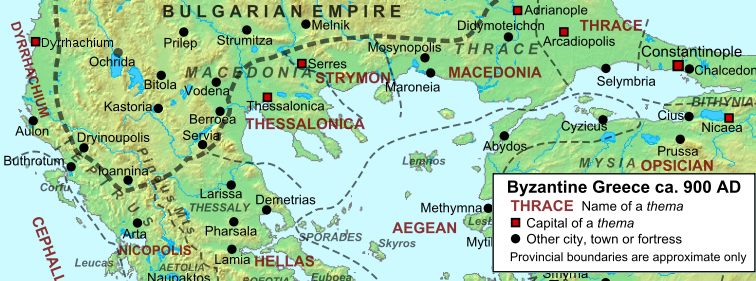
In September, 914, Bulgarian forces appeared before Adrianople; and the Armenian governor of the fortress was induced to betray it into their hands. But the Empress was a vigorous ruler. At once she sent men and money to recover it; and the Bulgarians found it more prudent to retire. [1] After this essay of the Empress’s temper, Symeon waited a little. The history of the next two years is very obscure. Symeon made no move against Constantinople; but, in 916, if not in 915, his troops were actively engaged in raiding the provinces farther to the west, by Dyrrhachium and Thessalonica. [2] In 916 they even penetrated as far as the Gulf of Corinth, and intermittently remained in the neighboring districts for about ten years. Their presence did not tend for comfort; even Saint Luke the Less, famed for his asceticism and mortification of the flesh, migrated for that period to Patras. [3]
But Constantinople was Symeon’s real objective. By 917 he was again amassing an army on the Thracian frontier. [4] He even attempted to win the support of the Petchenegs (Bosnyaks), his friends of the previous war; but his ambassadors were outbid by the Imperial agent, John Bogas, whose financial resources were no doubt larger. Under the circumstances the Empress decided to strike first. The time seemed well chosen; she was flushed with the triumphs of her troops in Armenia and Italy; and now there came the news that the Petchenegs (Bosnyaks) were prepared to invade Bulgaria from the north. Her fleet sailed to the Danube to carry them across, and the full Imperial army marched up through Thrace to the frontier. [5]
1. Theophanes Continuatus, p. 384. The governor was abetted by the
Archbishop Stephen Bees, Epidromai Boulgaron, pp. 368-9.
2. Nicholas Mysticus, Ep. ix., p. 76.
3. Vita S. Lucae
Minoris, p. 449. Saint Luke lived ten years in Patras, and only returned after Symeon
’s death. But I do not think that the ten years should be taken too
literally; for Bulgarian armies were busy elsewhere in 917 (when Diehl, in Choses et Gens de Byzance, pp. 3-4, dates
this invasion) over the Achelous campaign (Nikopolis theme,
immediately NW of Peloponnese; this penetrating Bulgar campaign deserves much more for
both Bulgaria and Greece than a dating in a footnote), and in 918 in Serbia
(Ditto the Serbian campaign). It seems better to connect the
invasion with the acts of aggression reported in 916 from Thessalonica
(Taken together, the 3-year Bulgar campaign of 916-198 from
Thessalonica to Serbia was a major event in the Balkans).
4. Nicholas Mysticus, loc. cit., p. 672.
5. Theophanes Continuatus, p. 387. For Zoe’s successful foreign
policy see my Emperor Romanus Lecapenus, p. 53, and elsewhere.
160
Symeon was caught. The Petchenegs (Bosnyaks) were far worse than the Magyars, and he could scarcely hope to repeat his cunning diplomacy of twenty years ago. But fortune favored him, so unexpectedly that we can hardly doubt that he supplemented fortune by bribery. John Bogas arrived at the Danube, guiding the Petcheneg hordes; but there he quarreled with the Imperial admiral, Romanus Lecapenus, and Romanus refused to transport the barbarians. They, weary of the delay, would not wait; after devastating and probably half-occupying Wallachia, they returned to their homes. Contemporary opinion suspected Romanus of some sort of double-dealing. Nothing was proved. Romanus was certainly ambitious and unscrupulous in his ambitions; one must suspect that Symeon’s gold also affected his actions. [1]
Saved from the Petchenegs (Bosnyaks), Symeon could face the future more confidently. He had probably, it is true, lost his last province across the Danube, but the loss was of very little consequence; the Danube made a far better frontier. Still, the whole main army of the Empire was nothing negligible. But fortune was kind to Symeon once more.
The Bosnyak and Magyar-related pages and the loss of Wallachia can't be slighted and reduced to the Empress Zoe's exploits and misfortunes. Kangars and their martial kins Bechens (Türkic form of their names) were expelled from their S.Uralic ranges by Oguz-Kipchak alliance, and had to capture new ranges west of Itil. Around 84-860s they devastated and expelled the Onogur Bulgar tribes and their allied Magyars, and occupied their ranges. We do not hear about Kangars fighting Khazars because Khazaria was populated by the Bulgar tribes, once Kangars overcame the Khazar border defenses, Khazars were a minor obstacle. No good blood could remain after the war, with Kangars seeing Bulgar as weaklings and kyshtyms (subordinates), and Bulgars and Magyars seeing Kangars as aggressors. The treaty made by Simeon with “Petchenegs” could as well be a treaty with their kin Kara Bulgar (Western Bulgar) tribes that fell into Kangar dependency, and be an aberration in the larger picture of the Kangar ascendance, where Kangars saw Bulgars like the 19th c. European colonists saw American Indians, as vulnerable possessors of desired treasure. That attitude, and the continued Oguz and Kipchak harassment from the east drove Kangars to roll over Bulgars in Atilkuzu, Pannonia, and Wallachia, and eventually to the Adriatic shores. The union of the Magyar and Onogur Bulgar tribes, in addition to their antagonism with the Kangar-Bechen union, also carried antagonism with the Kara Bulgars. That antagonism arose in the days of the Hunnic state's East and West Wings, when Köturgur Kanat (Cuturgur Wing) assailed the Utragur Kanat (Uturgur Wing) at the behest of the Byzantines. The bad blood between the two wings continued into the following centuries, they generally led separate lives, briefly united under Kurbat, but seceding under Shambat/Shamo and Asparukh. That antagonism, and preoccupation by each side with their own problems, allowed Vikings to wedge between Kara and Ak Bulgars and capture Kyiv, and then allowed Kangars to separately assail Ak Bulgars and Kara Bulgars, taking most of their land, population, and suzerainty. The problem that Simeon encountered appealing for Kangar help was rooted in the Kangar-Bulgar antagonism, Kangars saw Byzantines as their temporary allies to weaken Danube Bulgaria and gain dominance over it, the capture of Atilkuzu, Pannonia, and Wallachia were incremental steps toward that goal. Danube as a border barrier could not stop the Kangar advance, at the most it could delay their campaign to the winter, when Danube turns from a barrier to an ice bridge. The reasons that Kangars abandoned their campaign must lie elsewhere. Simeon's actions amply demonstrate that, he wouldn't venture far from the Danube if he did not know that Kangars were not in a position to strike him from behind. It should go without saying that the Bulgar tribes that fell under Kangar domination remained connected with Simeon, hoping for a better future. |
The Empress was a poor judge of a soldier. Her commander-in-chief, the Domestic of the Schools, was Leo Phocas, son of the great soldier Nicephorus, but quite without his father’s ability. His campaign was well enough planned. After the fiasco on the Danube, the Imperial fleet had come down the coast to Mesembria, the peninsula-port beyond the frontier-line, still held by the Empire. Thither Phocas directed his army, hoping probably for reinforcements before he struck inland to Preslav.
1. Theophanes Continuatus, loc. cit., and ff. There is no means of
telling definitely when Bulgaria lost Wallachia, but it seems to have been overrun by Petchenegs
(Bosnyaks) well before Symeon’s death, probably from now; in 917 the Petchenegs had, one gathers, to come some distance
to the Danube.
161
Symeon waited on the hills, watching for an opportunity. It came as the Imperial troops rounded the head of the Gulf of Burgas, and turned north-west towards Mesembria. There was a little stream called the Achelous, close to Anchialus. On August 20, Phocas halted there, leaving his troops carelessly disposed. Suddenly Symeon swept down from the hills on to the unsuspecting army. What exactly happened no one knew, save that there was a panic and almost the whole Imperial army was slaughtered. The bones lay bleaching on the field for half a century. Only Phocas and a few miserable fugitives ever reached Mesembria. Many of the soldiers had fled to the coast; but the fleet which should have been at hand to rescue them had sailed already for the Bosphorus. [1]
The triumph revived all Symeon’s ambitions. He came marching down through Thrace towards the capital. Zoe gathered together another army, but again she put it under Leo Phocas. Again Phocas led it to disaster. As it lay at Catasyrtae, in the suburbs of the city, the Bulgarians attacked it by night, and destroyed it. [2]
After this second victory Symeon might almost have attacked the city successfully, but he did not dare; and even the Greeks had confidence that their walls were impregnable. Negotiations were impossible; Symeon demanded what Zoe could not possibly give. And Nicholas, though for the sake of the patriarchate he dissociated himself from Zoe’s policy, seems to have regarded Symeon’s terms as being unthinkable. [3] But no further attacks were made just yet.
1. Theophanes Continuatus, pp. 388 ff.: Cedrenus, ii., p. 286:
Zonaras, iii., p. 465. Scylitzes (Cedrenus) says that Leo Phocas was bathing at the time, and his riderless horse
took fright and caused a panic among the troops, who thought their general dead. This is quite possibly
true. It is clear that the army was taken utterly by surprise. Leo Diaconus (p. 124) tells that the bones
were still to be seen in his day. The Slavonic version of the Logothete (p. 12) calls the river the
Tutkhonestia. It is foolish to assume that Achelous must be a mistake for Anchialus, just because there
is a river Achelous in Greece.
2. Ibid., p. 390. No date is given for the battle, but it apparently
followed close on the Achelous.
3. Nicholas Mysticus, Ep. ix., p. 69. He says that he was not consulted about the campaign, but he claims that it was justified. However, he seems to regard any prospect of
arriving at terms as impossible and is very despondent in tone.
162
It was very late in the year; and Symeon retired to winter in Bulgaria. The year 918 passed sadly and wildly in Constantinople. Zoe was falling from power. She had always had enemies, and now her disasters had cost her the love of the populace. There was a scramble to take her place. It would have been an excellent opportunity for Symeon to appear before the city; and in the atmosphere of disloyalty and intrigue he might easily have won admittance inside the walls. But Symeon never came. Zoe, despite her failures, had achieved one great triumph; she had entangled Symeon elsewhere. For over half a century Bulgaria had lived peacefully with her Serbian neighbors. During these years Serbia acquired the benefits of Christianity, and looked to Bulgaria as the source of her culture. Of late, under her Prince Peter, she had increased her territory in Bosnia (I.e. in what is Bosnia now?) and had reached a certain standard of prosperity. In 917, just after the Achelous, an embassy from the Empress reached Peter’s Court and pointed out to him the dangers of too great a Bulgaria. Peter was convinced by the argument, and undertook to attack Symeon unexpectedly in the rear (What was the ratio of forces? Where Peter could get a cavalry army? Or he put up a peasant infantry against professional cavalry? Does the story gibe?). But Peter had rivals; Serbia’s growth alarmed the cognate maritime principalities, now under the hegemony of Michael, Prince of Zachlumia, an unscrupulous pirate and brigand whose territory stretched along the coast to the north of Ragusa. Michael already once had shown his enmity to the Empire by capturing the son of the Venetian doge on his return from a visit of respect to Constantinople, and sending him to Symeon, from whom the Venetians had to ransom him. [1] Now he heard of the alliance, and at once passed the information on to Symeon. Symeon determined to strike first; accordingly, in 918, his Generals Marmaëm and Sigritze invaded Serbia.
(In the Hungary's “Turks or Magyars” who were the “Turks”? Kabars? Generic Bulgars? Avars?)

1. Dandolo, Chronicum Venetum, p. 198.
163
They succeeded in overrunning the country; and when Peter came to make peace with them they treacherously seized him and carried him off to Bulgaria. In his place they set up his cousin Paul, a prince who had long been a hostage at the Bulgarian Court. [1]
How long this Serbian war lasted we cannot tell; but apparently it occupied the whole campaigning season of 918. Symeon, with his troops engaged in the west, could do nothing against Constantinople. Possibly, also, he was being troubled by the Petchenegs (Bosnyaks); possibly he was ill-informed about the true, desperate state of affairs at the Imperial Court. Certainly it was not till the next year that he was able to march his armies southward again. And then it was too late. Romanus Lecapenus had won the race for power. In March 919 he took possession of the Imperial Palace; in April his daughter Helena was married to the young Emperor. He called himself Basileopator; later, in September, he would take the title of Caesar; and before the year was out he would be Emperor.
The war was lost. All Symeon’s victories availed him nothing. Romanus Lecapenus, a discredited admiral of peasant origin, had climbed on to the throne by the very steps that Symeon had hoped to use. [2] It would have been well for Bulgaria had Symeon admitted his failure and sought to make the best peace possible. Romanus would gladly have given very favorable terms; he eagerly wished for peace, so as to consolidate his own position. But Symeon no longer showed the moderation of his youth. Ambition, fed by his victories, dominated him now, and blunted his statecraft. He was very angry, and determined to revenge himself on the usurper; and so the war went on.
1. Constantine Porphyrogennetus, De Administrando Imperio, pp. 156 — 7.
Constantine does not date the war, but says that the Imperial negotiations with Peter took place at
the time of the Achelous (I.e. Bulgarian Achelous campaign). The negotiations may have been begun previous to the disaster, but it seems
to me impossible to explain Symeon’s inaction against Constantinople in 918, save by a Serbian war.
And even though Symeon did not go to Serbia himself (he never went campaigning in the west in
person), I do not think he could have sent an expedition to Serbia big enough to overrun the country
in 917. The three years’ intervals that Constantine gives between the Serbo-Bulgarian wars need
not, I think, all be taken as infallibly accurate.
2. Zlatarski (Istoriya,
i., 2, pp. 399 ff.) says that in 918 Symeon took an Imperial title
(Basileus or Tzar = Car) and raised the Bulgarian archbishopric to a patriarchate. I cannot discover on what he
bases this. It is incredible that we should have no reference to such an action in Nicholas’s voluminous
correspondence. Romanus’s letters to Symeon protesting against his Imperial title date from after
the two monarchs’ interview (924, see below, p. 172); and it is clear from Symeon’s offensive joke at
the interview (see below, p. 170) that he still regarded Nicholas as the official spiritual father of
Bulgaria. It is quite possible, as Zlatarski suggests, that the Archbishop Joseph died in 918, and the
Archbishop Leontius succeeded him; but, even though Leontius was created Patriarch by Symeon, we need
not assume that that happened the very moment of his installation. Leo Diaconus’s words about
Symeon taking the title of Autocrat (pp. 122-3) provide no chronological data.
164
In the late summer of 919 Symeon invaded Thrace once more, and penetrated to the Hellespont, encamping opposite to Lampsacus. Nicholas wrote offering, if his health permitted, to come out and interview Symeon; but the suggestion was not accepted.
The Bulgarians met with no opposition; after wasting the countryside, they returned to winter in Bulgaria. [1]
All through 920 Nicholas wrote anxious letters to the Court at Preslav, not only to Symeon, but also to the Bulgarian Archbishop and to Symeon’s chief Minister (Knowing who was chief Minister would allow to peek into the state structure), urging a peace. In July he wrote to tell Symeon of the end of the schism caused by Leo’s fourth marriage — he tactfully assumed that Symeon would be delighted to hear of this triumph of Romanus’s Government — and to point out that Romanus had no connection with the previous Government (Zoe’s) and was not responsible for its follies. [2] Next he reverted to Symeon’s old desire for a marriage-alliance; Romanus, he said, was very willing for such a union.
1. Nicholas Mysticus, Ep. xcv., p. 301, written to Romanus when he was Caesar (Sept. to Dec. 919):
Ep.
xi., p. 84, written to Symeon.
2. Ibid., Ep.
xiv., p. 100.
165
He affected to ignore the fact that the only marriage that Symeon desired was now impossible. [1] Symeon returned no answer. Nevertheless, he did not invade Thrace that year. His troops were engaged in Serbia once more. Romanus had sent the Serbian Prince, Zacharias, a refugee at Constantinople, to stir up trouble against the Bulgarian client, Prince Paul. Zacharias was defeated, owing to the intervention of the Bulgarians, and was carried off captive to Bulgaria, to be used against Paul, should he be insubordinate. [2] Encouraged by Symeon’s preoccupation with Serbia, Romanus talked of himself leading an expedition into Bulgaria; but nothing came of it. [3]
In 921, after writing to Nicholas that his terms involved the deposition of Romanus,[4] Symeon marched again on Constantinople; but at Catasyrtae, the scene of his victory four years before, Imperial troops under a certain Michael, son of Moroleon, took him by surprise. The Bulgarians probably suffered no great losses, but they decided to retire back on Heraclea and Selymbria. [5] In response to a further letter from Symeon, Nicholas offered to go out and interview him there [6]; but Symeon did not encourage him. He made it abundantly clear that he did not want gold, or costly gifts, or even territory [7]; he insisted on Romanus ’s deposition. It was something quite easy to do, he maintained, not like raising his Bulgar soldiers from the dead. [8]
1. Nicholas Mysticus, Ep. xvi., p. 112.
2. Constantine Porphyrogennetus, loc. cit. He says Paul had reigned three years,
but, in view of the sequence of events of these years, it would be more correct to say
that Paul was in the third year of his reign.
3. Nicholas Mysticus, Ep. xvii., pp. 113 ff. 4. Ibid., Ep. xviii., pp. 121 ff.
5. Theophanes Continuatus, p. 400.
6. Nicholas Mysticus, Ep. xix., pp. 125 ff. 7. Ibid., Ep. xviii., pp. 121 ff.
8. Ibid., loc. cit.
166
But Romanus was unlikely to consent to depose himself; and the Patriarch realized that he was being mocked. [1] After spending the summer in Thrace, Symeon went back to winter in his own country.
In 922 Symeon again appeared in the neighborhood of the city. Romanus was anxious to save from his devastation his palace at Pegae on the Bosphorus; he sent out an army to guard it; but as it lay in the narrow valley there, the Bulgarians swooped down and massacred it or drove it into the sea. After their victory Symeon lingered throughout the summer in Thrace; but, later in the year the Greeks made a successful sortie and destroyed his camp. [2] Again he had to retire, leaving nothing permanent behind him. During the winter his letters grew slightly more pacific in tone; he even asked Nicholas to send him an accredited ambassador. [3]
These gestures, however, were probably only the reflection of Symeon’s more despondent moments. Even while he made them he was arming himself. [4] In the spring of 923 he was ready to fight again, and laid siege to Adrianople. The great fortress was valiantly defended by its governor, Moroleon, but no relief force came from Constantinople; famine forced the garrison to surrender. Symeon, thereupon, gave vent to his disappointed anger against the Empire; Moroleon was brutally tortured to death. [5] But Symeon was unable to advance further. Trouble broke out again in Serbia. It was always easy for Greek diplomats to point out how unnatural was an alliance between Serbia and Bulgaria; and Prince Paul saw the truth of it. But his attempt to escape from Bulgarian tutelage failed; Symeon’s armies deposed him and set up Prince Zacharias in his stead. [1]
1. Nicholas Mysticus, Ep. xix., pp. 125 ff.
2. Theophanes Continuatus, pp. 401-3. No date is given for the sortie
but it almost certainly happened now. The Empress Theodora’s death, (Feb. 922), Sophia’s coronation (that
month), and the visit of the Curopalates (τηνικαῦτα) are inserted in the chronicles between the
account of the battle of Pegae and it, but probably the three social events were taken together to make a
paragraph, irrespective of their accurate dating.
3. Nicholas Mysticus, Ep. xxii., pp. 148-9.
4. Ibid, Ep.
xxi., pp. 137 ff.
5. Theophanes Continuatus, p. 404. Undated, but almost certainly
early in 923. It was probably during this year that Symeon captured the city of Bizya (Veza) in Thrace,
as is mentioned in the Vita S. Mariae Junioris .
167
The distraction made Symeon more amenable to negotiation, while at Constantinople men felt correspondingly more cheerful. Romanus had gradually come round to a new policy, well illustrated in his failure to try to relieve Adrianople. He would let Symeon invade Thrace as often as he pleased, confident himself behind the walls of Constantinople, and hopeful that in the end Bulgaria would exhaust herself by her efforts. Meanwhile, his main armies were sent to fight more profitably in the east; he would employ foreign troops against Symeon. The Serbs, it was true, were always being defeated, but he was negotiating, with every prospect of success, with the Russians (i.e. Ruses) (now firmly established almost as far south as the mouth of the Dnieper), the Petchenegs (Bosnyaks), and the Magyars. Under the circumstances he was less anxious for peace than the Patriarch. And even Nicholas, writing to tell of these negotiations and of the defeat of the Saracen pirate, Leo of Tripoli, adopted a new, patronizing air. [2] But, with Serbia crushed, Symeon reverted as usual to his old insolence. He asked for an ambassador, but he made clear that he clung to impossible terms. [3]
1. Constantine Porphyrogennetus, loc. cit., p. 157, dated three years
after Zacharias’s revolt. Henceforward my dating is radically different from Zlatarski’s (op. cit.,
pp. 427 ff.), as he dates the interview between Symeon and Romanus in 923 instead of 924.
2. Theophanes Continuatus, p. 405: Nicholas Mysticus, Ep. xxiii., pp. 149, 156. He says that it
was seventeen or eighteen years since Leo’s victory at Thessalonica. As he
was calculating roughly, there is no reason to prefer either seventeen or eighteen to nineteen. He also
says that it is only in deference to his wishes that the Emperors are not attacking Bulgaria themselves.
3. Ibid., Ep.
xxvii., p. 173. Symeon’s previous letters, answered by Nicholas (Ep. xxiv.-xxv., pp. 157 ff.), were apparently more encouraging.
168
Nicholas then tried a new method. Since Zoe’s fall relations between Rome and Constantinople had been strained, but in 923 the Pope was at last induced to send two legates, Theophylact and Carus, to Constantinople, and then to Bulgaria, to use their influence in favor of peace. Nicholas, in his anxiety, forgot his patriarchal pride so far as to welcome this intervention, and wrote to Symeon begging him to respect the Papal representatives. [1] But Symeon had his own scheme for dealing with the Pope. He knew the fragility of the alliance between Old and New Rome. So he greeted Theophylact and Carus amicably enough, but his conversations, as the sequence was to show, were very different from what Nicholas hoped. And meanwhile he was planning one more great attempt against Constantinople. [2]
The attack was timed for the summer of 924. [3] Symeon was wiser now; he realized that the land walls of the city were impregnable. But Bulgaria had no fleet; he was obliged to look round for an ally. The Fatimid Caliph of Africa was at war with the Empire and possessed many ships. Symeon sent an embassy to the Court of Mehdia, to suggest an alliance whereby the necessary sea power should be loaned to him.
1. Nicholas Mysticus, Ep. xxviii., p. 176.
2. According to Maçoudi (Prairies
d’Or, ii., p. 14), the Black Bulgars in 923 invaded the Empire as far as ‘Phenedia’ on the ‘Greek Sea,’ where they met Arab raiders from
Tarsus. If, as is probable, Phenedia was some Greek town on the Aegean, the Black Bulgars must have
passed through Balkan Bulgaria. But whether they came as raiders to Bulgaria also or as allies
to their distant cousins we cannot tell. The raid seems to have been of very little importance:
though it inspired Professor Vasiliev (Vizantiya i
Araby , ii., p. 222) to see Symeon in relations with the Arabs of Tarsus
(There should be no confusion, Asparukh Bulgars were mostly Kara
Bulgars or Köturgur Bulgars, i.e. Köturgur Kanat or Cuturgur Wing).
3. For my reasons for this date see my Emperor Romanus Lecapenus, pp. 246 ff. In
that discussion I omitted to mention Zlatarski’s argument that the date is proved by the
A.M. (Byzantine's Anno Mundi) date in Nestor’s chronicle, which by his interpretation of Bulgar dating
(What specifically?) (with which I
agree) comes to 923. But why Nestor’s A.M. should be right when no one else’s is and even his indiction is wrong, I do not know. I do not think it can stand against the external evidence.
169
The affair was successfully arranged without the knowledge of the Greeks, and the Bulgarian ambassadors were returning with the African representatives, when the ship in which they were travelling was captured off the South Italian coast by an Imperial squadron. The Emperor at once sent to the Caliph and offered him a profitable peace; which was gladly accepted — for the Africans had no desire to fight unnecessarily in the distant north-east; and he kept the Bulgarians prisoners. [1] But, at the same time, seriously alarmed by Symeon’s preparations, he sent also to Bagdad, to the other Caliph, to arrange a truce, so that his main armies could come back to Thrace. [2]
In September Symeon in his panoply arrived before the walls of Constantinople. Once more the sight of them daunted him. Probably only then did he learn that the African fleet was never coming, and that, instead, the Imperial army was marching from the east. Once more, as eleven years before, while the city awaited his onslaught, he merely sent to ask to see the Patriarch.
Hostages were exchanged and Nicholas hurried out to meet him. Symeon, enjoying this subservience, demanded now that the Emperor should come instead. And even the Emperor came, though Imperial Majesty would not hurry and elaborate preparations had to be made. A strong, fortified pier was built out into the Golden Horn at Cosmidium and a wall erected across the middle; over the wall the monarchs would converse. But the delay made Symeon impatient. To show how terrible he was, how little awed by the venerability of the Empire, he spent the time wasting the countryside, and even burning one of its holiest sanctuaries, the old Church of the Mother of God at Pegae (For a Christian King, as Symeon is depicted in the historical literature, burning of a holy Christian sanctuary does not signify an exemplary devotion to Christianity).
The interview took place on Thursday, September 9. Symeon came on to the pier by land, surrounded by a glittering escort, some to guard his person and some to test the works of the Greeks — for Symeon was mindful of Krum’s experience — and others as interpreters; for Symeon would not pay lip-service to the Empire by using the Imperial language.
1. Cedrenus, ii., p. 536, undated, but clearly just before the 924
campaign.
2. Ibn-al-Asir (in Vasiliev, op. cit., Prilozheniya , p. 106).
170
When hostages had been exchanged he advanced to the wall. The Emperor Romanus was waiting there. His coming had been in contrast; he arrived with the Patriarch by water, in his yacht, with a humble mien, clad in the holy cloak of the Virgin, and with few attendants — for he knew that he was attended by all the glory and tradition of Imperial Rome.
Over the wall the monarchs greeted each other. Symeon began to talk flippantly, teasing the Patriarch for being unable to keep his flock from quarrelling. [1] But Romanus brought the conversation to a higher level, addressing a little speech to the Bulgar. It was a kindly homily to a foolish inferior, telling of the duties of a Christian and the punishments in store for the wrongdoer. Symeon was growing old now [2]; 1 ‘to-morrow you are dust,’ warned the Emperor: ‘how will you face the terrible just Judge? ’ Moral considerations insisted that Symeon should cease from staining his hands with the blood of fellow-Christians; but at the same time Romanus hinted that peace would be made financially advantageous to the Bulgarian Prince. [3]
1. Nicholas Mysticus, Ep. xxxi., p. 189.
2. Symeon was over sixty, according to Nicholas (Ep. xxix., p. 151,
written in the winter of 923 — 4).
3. I quote the speech in full in my Emperor Romanus Lecapenus, p. 92.
171
Symeon was very much impressed. Indeed, peace was now the only practicable policy. He had won many victories; from the walls of Corinth and Dyrrhachium to the walls of Constantinople he controlled the countryside. But the city was strong and he had no ships. He had /171/ arrived at the furthest limit of success within his reach, and it was not enough. And, faced with the Emperor’s person, he was for a while overcome by the majesty of the Empire and the eternity of New Rome. Hemiargus, half-Greek, as he was, he learnt in his youth the magnificence, in conception and in execution, of the Imperial idea, which had lasted through the centuries before ever the Bulgars were heard of; but he realized now that he could never be more than half-Greek or half-Imperial. The other half was ineradicably Bulgarian, newly risen from barbarous heathendom (Tengriism).
Boris had been wiser and more fortunate; he never tried to be, nor could
have been, more than a Bulgarian prince; his aims were utterly opposite to Symeon’s,
national, not international. In his dealings with the Empire he was like a child,
but an unselfconscious child who hopes to grow up soon, and meanwhile means to help himself as best he can, by himself or through his elders. Symeon was like
a clever, naughty child, who knows what a nuisance he makes himself and how gladly
the adults would like him to keep quiet, who sees through their devices and understands their weaknesses and thoroughly enjoys annoying them, but who
all the while is conscious that he is a child and they are adult, with
something about them far beyond his grasp; and so he feels foiled and cheated and
resentful. Similarly, as a naughty child is awed by a dignified scolding, so Symeon
was awed by Romanus’s speech. But, after a little while, the effect wears off, and
the conscious naughtiness begins once more.
172
Meanwhile, as the monarchs conversed, Providence sent a symbol. High over their heads two eagles met and then parted again, the one to fly over the towers of Constantinople, the other turning towards the mountains of Thrace. The message was both to Symeon and to Romanus, to tell them that there would be two Empires /172/ now in the Balkan peninsula — for a while, at least; but eagles die. [1]
Forced now to recognize each other’s independent existence, Symeon and Romanus agreed on terms for a truce. Possibly they even discussed them in person at this conversation, but more probably the details were arranged by their diplomats. In return for a large amount of bullion and other valuable gifts and a yearly present of 100 scaramangia — robes richly embroidered, one of the most luxurious articles manufactured in Constantinople — Symeon agreed to evacuate Imperial territory, especially the fortified cities on the Black Sea that he had captured, Agathopolis and Sozopolis, and possibly even Develtus and Anchialus, so as to allow the Emperor a route by land to his city of Mesembria. [2] After these arrangements were made Symeon retired peacefully home.
To some extent the peace was permanent; Symeon never invaded Thrace again. But he showed himself to be in no hurry to hand over his conquests on the Black Sea. Romanus wrote more than once to demand their restitution, and even refused to hand over the large consignment of gifts till it was effected; he was, however, willing to pay the yearly scaramangia if Symeon withheld from invasions. Symeon was quite agreeable to this.
1. Theophanes Continuatus, pp. 405 — 7: Georgius Monachus, pp. 898-9:
Georgius Harmartolus, pp. 824 ff., etc.: Nicholas Mysticus, Ep. xxx., xxxi., pp. 185 ff.
2. Romanus Lecapenus, Ep. i., ii. (ed. Sakkelion, pp. 40-5): Zlatarski, Pismata na Romana Lakapena, pp. 8 ff., 10 ff. The names of the Black Sea fortresses are never given. The
simplest solution is to say that they were Agathopolis and Sozopolis, which may well have been captured by
Symeon in 924 or at some previous date since 917. But I am inclined to think that Develtus
and Anchialus were restored to the Empire in 927 (see below, p. 180), and they may well have been
mentioned now. That would give a more cogent reason for Symeon’s preferring to forfeit valuable
gifts rather than give them up. Agathopolis and Sozopolis had no importance for him; but from Develtus an
enterprising enemy could easily strike at Preslav.
173
His retention of the Black Sea fortresses was hardly more than a gesture; the moral effect of the interview was wearing off, and he wished to show himself unawed by the Empire. Actually his policy was being completely altered. He could only be a Balkan monarch, but at least he would be Emperor of the Balkans. Hitherto, as one who hoped to sit on the Imperial throne, he had been punctilious in his use of titles, and willing also to recognize the spiritual suzerainty of the Patriarch; his future Government would thus escape complications. But now he had no such restraint.
He decided to be Imperial even though he could not reign at Constantinople. Some time in 925 he proclaimed himself Emperor of the Romans and the Bulgars, [1] a title conceived to glorify himself and insult his enemies. The Emperor Romanus was extremely angry and wrote to protest; but Symeon did not answer. [2] Instead, he sent to Rome for confirmation of the dignity; and Rome, recently victorious over Greek interests in Illyricum, complied — the Popes had never quite lost hope of securing Bulgaria. In 926 a Papal legate, Madalbert, arrived at Preslav, bearing the Pope’s recognition of Symeon as Emperor. [3] This was the fruit borne by that visit of Theophylact and Carus, of which Nicholas had had such sanguine hopes. But Nicholas had been already disillusioned. The interview had shattered his belief in Symeon’s heart, and he understood that Symeon had no more use for him now. He wrote twice to Symeon after the interview, but both were the letters of an angry, bitter, ill old man.
1. ‘Βασιλεὺς καὶ αὐτοκράτωρ τῶν
Ρωμαίων καὶ Βουλγάρων’
(Vasileus kai autokrator ton Romaion kai Boulgaron =
Emperor and autocrat of the Romans and Bulgarians; autocrat = unlimited authority of a single individual,
which implies a dissolution of the Bulgar boyar parliament, an event not recorded)
2. Romanus Lecapenus, Ep., loc. cit.
3. Innocentius III Papa, Ep. cxv., pp. 1112-3, referring to the
fact that Symeon, Peter, and Samuel asked for and received Imperial crowns from Rome: Farlati, Illyricum Sacrum, iii., p. 103, telling of Madalbert’s embassy. Madalbert held a synod at Spalato in 927 on his way
home. See below, p. 176.
174
Then in May 925 a merciful Providence gathered him to his fathers, before he could learn of the further enormities that his once beloved son would commit. [1]
The Emperor of the Romans and the Bulgars, whose cumbrous title was shortened by his people to the Slavonic word ‘Tsar,’ [2] determined to have his own Patriarch also.
| The title “Tsar” ~ “Tzar, Czar, Car” (Sl. Царь) is a
Türkic title ultimately derived from Caesar and Kaiser; the
conclusion on its origin is supported by its links with terminology associated with the
Mongolian conquest that brought to Russia the Türkified title Czar which could not have originated
directly from the Caesar and Kaiser of the western influences (Karamzin N.M.), and by the Kanishka's title Kaisara on
the ca 403 AD inscription from Ars (Bongard-Levin G.M., Ilyin G.F. India in ancient
times, SPb., 2001)
Czar = “A Khan, with whom resided the Primate (the head of the Church), in the Steppe from olden times was called a Great Kagan. A Great Kagan had power over the Kagans (Lesser Kagans), he was respected as a supreme ruler of the Desht-i-Kipchak. But that was only during the time when the Primate lived with him, the Primate was ordaining him for this or that act” (Murad Adji, KIPCHAKS. An ancient history of Türks and Great Steppe, Saint George Publishing, 1999, ISBN 5-88149-044-4; also Karamzin N.M. History of Russian State //Reprint Edition 1842 - 1844, Moscow, “Kniga”, 1989, Vol. Vİ, p. 217) |
His negotiations with Rome delayed the appointment — for the Pope could scarcely be expected to approve — consequently it was probably not till after Madalbert’s departure, late in 926, that Symeon raised the Archbishop of Bulgaria, Leontius of Preslav, to the rank of a Patriarch. This presumption passed unnoticed at Constantinople. The Patriarch Nicholas was dead; his successor, Stephen, was the tool of the Emperor Romanus, who did not much care. [3]
| It is wonderful that S.Runciman pays so much attention to the Church hierarchies and their interplay in the politics of the time, even though their relevance to the subject of the book is much lesser than the demographic, economic, and ethnological processes inside and outside the Bulgarian state. The detail chatter on what S.Runciman is intimately familiar with substitutes for understanding and history of the Bulgarian people, who serve only as scene decorations to magnify the glory of quasi-secular and quasi-ecclesiastical monarchies. A valuable side benefits a collection of Türkic Bulgarian names that may be used for ethnological studies. |
Symeon’s new policy not unnaturally terrified the Serbs. It was obviously to the west that Symeon would now seek to expand. This was indicated by his failure to evacuate Northern Greece, where Bulgarian marauders remained till his death, raiding to the Adriatic coast and even invading and occupying parts of the Peloponnese. [4]
1. Nicholas Mysticus, Ep. xxx. and xxxi., pp. 185 ff.: Theophanes Continuatus, p. 410.
2. Tsar is derived from Caesar, but probably came into use among the
Slavs from the West when Caesar or Kaiser was the same as Emperor. At Constantinople it was a
lower title.
3. The foundation of the Patriarchate provides a difficult problem:
the Sinodik na Tsar Borisa clearly shows that Leontius was the first Patriarch and had his seat at Preslav;
but, according to the List of Bulgarian Archbishops, Damian of Dristra was the first. As I explain
below (p. 182), Damian was the first Patriarch recognized by Constantinople, in 927. Leontius must
therefore have been appointed by Symeon previously. But, in spite of Zlatarski’s conjectures, it seems
quite impossible that a Pope as well informed and aggressive as John X should have sent a legate to
Bulgaria and humoured Symeon’s desire for a crown, had Symeon already appointed an autonomous
Patriarch. The appointment must therefore have been made after Madalbert’s departure,
probably late in 926, but before Symeon’s death (May 927). Leontius thus only held his new post for
a few months.
4. See Bees, op. cit. passim, quoting a biography of St. Peter of Argos. He is also undoubtedly right in placing here the episode of the raid on the village of Galaxidi (on the
Gulf of Lepanto), which took place in the time of the ‘Emperor Constantine Romanus’ — i.e., the Emperors
Constantine VII and Romanus I. Sathas, Chronique de Galaxidi, places the raid in about the year 996 (see below, p. 230), but in view of the Emperors’ names, his arguments are unconvincing.
175
Under the circumstances very little Greek diplomacy was needed to induce Zacharias of Serbia to take the offensive, in 925 Symeon sent his generals, Marmaëm and Sigritze, the previous conquerors of the country, against him; but Zacharias was luckier than his forerunners. The Bulgars were routed, and the generals’ heads sent as a pleasant gift to Constantinople. Symeon was unaccustomed to such an experience, and he would not let it go uncorrected. There was still another Serbian Prince living as hostage in Bulgaria, Tzeesthlav (Cheslav) (Sl. “Known for vanity”, an apparent moniker), whose mother was a Bulgar (I.e. a Bulgar Princess, i.e. a kin of the Bulgar royalty, i.e. a prince already bound into submission by family connection to his royal or princely uncle. To grasp that relationship one must know aspects of Türkic familial relationships). In 926 a second expedition set out against Zacharias, accompanied by Tseesthlav. This time it was too much for the Serbian prince; he fled for refuge beyond the mountains to Croatia. The Serbian lords and zhupans were then summoned by the Bulgars to come and recognize Tseesthlav as their Prince. Under the promise of safe-conduct they came, only to be taken, prince and all, into captivity in Bulgaria. The Bulgar armies then set about unopposed the conquest and devastation of Serbia. The work was done thoroughly; the country became a wilderness and a desert. The inhabitants escaped if they could over the frontiers; those that remained were butchered. Symeon added a new but lifeless province to his Empire. [1]
| S.Runciman appears to recite a tendentious source, probably retained in the reports of Creek clergy forking as Greek informers. In Türkic eyes, the state is people, not territory, the territory belongs to the people, and they are the most precious attribute of the state, which is numerously confirmed by S.Runciman in his descriptions of the populations captured in the campaigns. Symeon was not that stupid to kill his own tax base and military force. |
It would have been well to stop now, but Symeon never knew when to stop. The annexation of Serbia brought him into direct contact with the Kingdom of Croatia.
Croatia was a well-ordered State, with a great army at its beck (back?); its king, Tomislav, was a figure of international importance. He had no quarrel with Symeon; his relations with Constantinople were cold, while he was closely in touch with Symeon’s new friend, the Pope.
| S.Runciman recites Constantine Porphyrogennetus dating in the De Administrando Imperio that Croats came to Balkan Croatia in the early 7th c., the competing hypotheses date the event between the 6th and the 9th cc. In written chronicles of Einhard the Balkan Croatia first appears as a Frankish vassal in 818, with Franksh and Türkic names of the rulers, it gains independence ca 840s, and is united by duke Branimir before 879. Tomislav was the first ruler of Croatia recognized as a king in a 925 letter from Pope John X. Symeon started his campaign immediately after that. Considering that Croatia (or Croats) belonged to Avaria, and that Krum inherited Avaria minus small chunks that Franks kept after defeating Avars, Symeon's pretensions on the Croatia are fairly well justified, and to have a sole Slavic-dominated neighbor on his borders was setting a bad example to the Bulgarian Slavs. In 925, the Slavs did not yet have a royal pedigree and a right to a native ruler, all the nationalistic histories composed in the last 200 years notwithstanding. |
1. Constantine Porphyrogennetus, op. cit., pp. 157 — 8. The generals in
command of the second expedition were called Cnenus, Hemnecus, and Etzboclia. No dates are
given, but 925-6 seems correct.
176
There might be a few Serbian refugees in Croatia, but they were not dangerous; the mountains made a satisfactory boundary-line. But Symeon, it seems, was jealous; he hated a neighbor to be powerful. His imagination had always been too grandiose, and now it verged on wanton megalomania. Determined to crush this rival, he ordered his general, Alogobatur, in the autumn of 926 to lead the Bulgarian armies into Croatia. Alogobatur crossed the mountains, but his war-worn troops were no match for the great Croatian levies. Their defeat was overwhelming; the general was slain with most of the army. A few fugitives survived to flee back and tell their fate to Symeon. [1]
The disaster came as a dreadful shock to Symeon. His health was failing, and his nerve began to go. With unaccustomed prudence he sought to make peace. The legate Madalbert was passing through Croatia on his return from Preslav, and he lent his services and goodwill. A peace was arranged, apparently on the lines of a status quo. [2] But Symeon never properly recovered.
Men believed at the time that everyone had an inanimate double [3]: that there was some object, a piece of statuary or a column, that was mysteriously bound up with each human life, so that any harm that befell it was reproduced in its living correspondent. In May 927 an astrologer told the Emperor Romanus that Symeon’s double was a certain column in the Forum (This is a Voodoo current in Christianity).
1. Constantine Porphyrogennetus, op. cit., p. 158: Georgius Monachus,
p. 904. Theophanes Continuatus, written later, connects the war with Symeon’s death (see
below, p. 177). The Croatian war apparently happened close after the conquest of Serbia, probably in
the same year, as Madalbert was able to make peace certainly before the second Synod of Spalato
(927), and apparently before Symeon’s death (May 927). It is pointless to explain the war as the
result of a Greco-Croatian alliance as Drinov (Yuzhnie
Slavyane i Vizantiya , p. 53), and Zlatarski (Istoriya,
i. 2, p. 500) and others do. Constantinople had no relations with Croatia during these years;
otherwise Constantine Porphyrogennetus would certainly have mentioned Tomislav. (I disregard
the modern Croatian historians that say that Constantine knew all about him, but were
mistaken about his name, as in that case Constantine must also have known the future a year or so ahead. (See
my Emperor Romanus Lecapenus, pp. 208 ff.) Symeon’s megalomania provides a quite
satisfactory reason. It is a well-known phenomenon for autocrats, particularly among races newly raised from
barbarism, to be intoxicated by their power and so to reach a stage of semi-madness
(The “barbarism” of Hunno-Bulgars ascends to the Zhou states of
the 16th c. BC, long before the emergence of the Helenes and Latins and the late European
clones. Their art of state organization was inherited by the subsequent Slavic states,
which awe the same very S.Runciman). For the name Alogobatur, see below p. 285.
2. Šišic. Prirucnik,
p. 222. Farlati, loc. cit.
3. The Greek word employed for this double was ‘στοιχεῖον’
(stoicheion)
177
On May 27 Romanus, with his patriotic, experimental mind, had the column decapitated. At that very hour the old Tsar’s heart gave out and he died. [1] It was as though the light had gone out, and Bulgaria was left fumbling in the dark.
Symeon had foreseen that chaos might follow, and had tried to make arrangements that would last. He left four sons, the issue of two marriages. His eldest son, the first wife’s child, Michael, he considered unsuitable to succeed him; possibly Michael’s mother had been of inferior birth, or possibly Michael himself resembled his uncle Vladimir. At any rate, he was compelled to retire into a monastery. Symeon’s successor was to be Peter, the eldest of the second family, a child still; his maternal uncle, George Sursubul (aka Sursuvul. The name is strikingly reminiscent of the Greek distortion of the name-title Sir Yabgu, which was rendered Silzibul, Dizavul, Sinjubu for Sir-yabgu, where Sir is a tribal name, and -yabgu is Yabgu, a second in command), was to act as regent for him and as of his younger brothers, John and Benjamin. Symeon’s testamentary wishes passed unchallenged; Peter mounted the throne, and George Sursubul (Sursuvul) took over the government. [2]
| This is a canonic Türkic regency tradition, the maternal uncle is a head of the maternal tribe, a Prime Minister (Tr. Yabgu), and a Supreme Judge, in times of need he becomes a regent (Tr. “kushtan”), like Bu-Ürgan (Gr. Organa) for Kurbat, and a guardian of his sister's family. The same rules apply across the society at all levels, tribal, clan, or family. A maternal grandfather is a traditional tutor of his grandsons, they are raised in his household to maturity. |
The Regent’s position was by no means enviable. So long as he lived, Symeon’s personality and prestige awed all his enemies abroad and silenced all opposition at home. But now everyone knew that the terrible Tsar could harm them no more; he was dead, and his Empire a corpse for vultures to feed upon.
1. Theophanes Continuatus, p. 412, which says that Symeon led his
army to its defeat in Croatia in person, and just escaped with his life, and died soon after his return.
Unfortunately none of the older chroniclers, e.g. Georgius Monachus, p. 904, nor the Logothete (Slavonic
version), p. 136, mention the story of the ‘στοιχεῖον’
(stoicheion), which must therefore be dismissed as a later invention.
2. Theophanes Continuatus, loc. cit. All the chroniclers tell us that
John and Benjamin ‘already wore the Bulgar robe’. The meaning of the phrase is very obscure. Possibly
‘Bulgar’ is used in contrast to the ‘Roman’ or Imperial robe worn by the Tsar, and the two princes wore
it as a gesture against Peter’s policy (The meaning of the idiom
is perfectly clear, no need to haze it, probably it is a calque of the Türkic expression
relayed by Greek ecclesiastical snoops, transmitted in English as “walking in his shoes”:
they were brought up by their dynastic maternal grandfather as Türkic Bulgarian princes,
they wore the same Türkic caftans that the Russian Peter I worked so hard to retire, they
wore the Türkic princely braid, and they did not satisfy the Greek observers who
preferred to deal with more lame Slavs).
178
The neighboring nations — Croats, Magyars, and Petchenegs (Bosnyaks) — gathered on the frontiers and threatened invasion; even the Emperor Romanus was said to be preparing an expedition. George collected troops and sent them to make a demonstration in Thrace; but after fourteen years of unbroken warfare, marching to and fro over the wild Balkan mountains, and after the disaster in Croatia so few months before, the Bulgarian army, though it committed several atrocities, [1] was no longer really imposing. The Emperor Romanus continued his preparations. George saw that he must sue for peace.
There was apparently still a war-party in Bulgaria. Probably the remnant of the old Bulgar nobility was chiefly occupied in holding military posts, and feared for its existence in times of peace. At any rate, the Regent moved cautiously, and sent his first envoy, an Armenian monk, in the utmost secrecy to Constantinople, to suggest a treaty and a marriage-alliance. The Emperor agreed, and a peace conference was summoned to sit at Mesembria. The Imperial embassy sailed there by sea, and met the representatives that George, acting openly now, had sent. A truce was declared and terms roughly arranged; then the conference decided to adjourn to Constantinople, where the treaty should be ratified by the Emperor and the Regent in person. The Imperial ambassadors returned by land, through Bulgaria, accompanied by Stephen the Bulgar, a relative of the Tsar; George Sursubul (Sursuvul), accompanied by the late Tsar’s brother-in-law, Symeon, the Calutarkan and Sampses, and many of his nobility, followed shortly afterwards. At Constantinople George was permitted to see Maria Lecapena, Romanus’s eldest granddaughter, the daughter of the co-Emperor Christopher. Well satisfied with her appearance, George summoned the young Tsar.
1. Vita S. Mariae
Novae, p. 300, which mentions the raid as being particularly barbarous.
179
Peter set out at once, and on approaching the city was met with honor by the Patrician Nicetas, Maria’s maternal grandfather (Some parallels between Türkic and Greek social traditions are striking). He was allowed in to the Blachernae quarter, where Romanus interviewed him and greeted him with a kiss.
The royal marriage took place on October 8, 927 (Things were swift in Bulgaria - a wedding during a mourning period just 3 mo after the death of the Peter's father, which traditionally is a year, and also prescribes a range of longer periods, is a strange, and not addressed, violation of the sacred social traditions, in a way a demonstration and a revolt), in the Church of the Mother of God at Pegae — the new church that replaced the victim of Symeon’s wanton barbarism three years before. The Patriarch Stephen conducted the service; the witness on the bridegroom’s side was his uncle the Regent, on the bride’s the Protovestiarius Theophanes, chief Minister of the Empire (This confirms that George Sursubul/Sursuvul was a Yabgu ~ Chief Minister of Bulgaria). At the same time Maria was rechristened Irene, as a symbol of the peace (This is also a reflection of the Türkic tradition of temporary names, as people progress in life, they adopt new names). After the ceremony the bride returned with Theophanes to Constantinople; the Tsar, on the other hand, was not allowed to come within the walls. But three days later there was a reunion; Romanus held a sumptuous wedding feast at Pegae, at which Maria rejoined her husband. When the feast was over, she said good-bye to her relatives; her parents and Theophanes accompanied her as far as Hebdomum, and there they left her to her husband’s sole care. The parting was very sorrowful; her parents grieved to see her go, and she wept to leave them for a strange country. But she dried her tears, remembering that her husband was an emperor and she the Tsaritsa of the Bulgarians. With her she took huge consignments of goods, luxuries and furniture, that she might not miss the comforts of her home. [1]
1. Theophanes Continuatus, pp. 412-5: Georgius Monachus, pp. 904-6:
Logothete (Slavonic version), pp. 136 — 7.
180
The marriage was a triumph to Bulgarian prestige. It was the first time for half a millennium that an Emperor’s daughter had married out of the Empire; Bulgaria was shown to be no longer now a barbarous State with whose people it was unseemly to be connected. Old-fashioned politicians in Constantinople regretted it as a degradation of the blood Imperial; but now that the Emperor had consented there was no more to be said. [1] The peace treaty, signed contemporaneously with the marriage, also increased Bulgarian self-importance and pride. Its final provisions, the work in the main of the Protovestiarius Theophanes, [2] fell under three headings — territorial, financial and titular.
The territorial settlement seems to have involved little change. Possibly the Bulgarians acquired a few towns in Macedonia, but the Empire recovered Sozopolis and Agathopolis and, apparently, the whole coastline to a river called the Ditzina, beyond Mesembria: though perhaps Develtus, right at the head of the Gulf of Burgas, remained in the Tsar’s possession (Two Türkic nearly synonymous words mysteriously penetrated Greek, then Latin, then European languages: liman and bugas/burgaz, the first is a long and wide lagoon near the mouth of a river, the second is a Türkic “throat” ~ narrow passage that connects an enclosed lagoon with the sea; thus the “Gulf of Burgas” is English-Türkic tautology). [3]
About the financial settlement it is even harder to discover the truth. The Emperor apparently undertook to send some sort of yearly income to the Bulgarian Court — possibly the gift of 100 scaramangia promised to Symeon. This was apparently paid till the days of the Emperor Nicephorus Phocas (r. 963–969), whose arbitrary refusal to do so gave rise to a war. But during that war the Bulgarians were not the aggressors; the Emperor attacked Bulgaria by means of his Russian (i.e. Rus) allies. [1]
1. Constantine Porphyrogennetus (De
Administrando Imperio, pp. 87-8) deplores the marriage, and says that it was due to Romanus’s lack of education that he permitted it;
it must not be repeated. Actually, however, it created a precedent; Constantine’s two
granddaughters were married similarly — one to Otto II of the West, the other to Vladimir of Russia.
2. Theophanes Continuatus, p. 413.
3. Constantine Porphyrogennetus (op. cit., p. 79): talking of the Russians (i.e. Ruses) sailing along the Black Sea coast to
Constantinople, says that from the Danube they ‘καταλαμβάνουσιν εἰς τὸν Κωνοπάν, καὶ ἀπὸ
τοῦ Κωνοπᾶ εἰς Κωνσταντίαν (Costanza), εἰς τὸν ποταμὸν Βάρνας (Varna), καὶ απὸ Βάρνας
ἔρχονται εἰς τὸν ποταμόν τὴν Διτζίναν, ἅπερ πάντα εἰσὶ γῆς τῆς Βουλγαρίας. Ἀπὸ δὲ τῆς
Διτζίνας εἰς τὰ τῆς Μεσημβρίας μέρη καταλαμβάνουσιν ...’
('katalamvanousin eis ton Ko̱nopan, kai apo tou Ko̱nopa eis
Ko̱nstantian (Costanza), eis ton potamon Varnas (Varna), kai apo Varnas erchontai eis ton
potamon tí̱n Ditzinan, aper panta eisi gí̱s tí̱s Voulgarias. Apo de tí̱s Ditzinas eis ta
tí̱s Mesi̱mvrias meri̱ katalamvanousin’ - 'sailed
unto Konopan and, from Konopa to Constantius (Costanza), unto the river Varna (Varna),
from Varna unto Ditzinan river, it is Bulgarian land. And from Ditzinas members of the
parties sailed to Messimvria) Clearly this implies that the
whole coastline from the Ditzina, north of Mesembria, was Imperial except possibly for
Develtus, which would lie out of the Russians (i.e. Ruses) ’ route.
Zlatarski (op. cit., p. 525) says that the frontier remained the same as in 896 and 904,
save that the Empire gave up Agathopolis, Sozopolis, and Develtus. He gives no
references, nor can I find any reason for such a statement.
181
Another account of that time, mentioning no specific war, says that Peter, after his wife’s death, sent humbly to renew the peace with Constantinople. [2] It is, therefore, probable that the gifts or tribute was only to be paid during the lifetime of the Tsaritsa — that it was a yearly income paid to the Imperial princess to help her to keep herself in the dignity that befitted her birth; and Peter was to put himself in the wrong by demanding the payment to be continued after her death. In connection with the financial settlement the Emperor received back a large number of prisoners.
Whether they were ransomed at a price we do not know; Constantine Porphyrogennetus implies that they were released by the Tsar as a gift to Romanus in return for his granddaughter’s hand. [3]
The arrangement of the question of titles was settled very satisfactorily for the Bulgars. The Imperial Court agreed to recognize Peter as an Emperor, and the head of the Bulgarian Church as an autonomous Patriarch. But it insisted on certain modifications. The patriarchal see must not be situated at Preslav, but at some other ecclesiastical metropolis. The Bulgarian patriarchate thus was to be dissociated from the Bulgarian Imperial Court, and so, it was hoped at Constantinople, would lose some of its national character and would, anyhow, escape a little from the lay control of the Tsar. It would even be possible to say that there were two patriarchal sees in the Balkan peninsula, not because Bulgaria insisted on spiritual independence, but because the increased number of civilized Christians necessitated such an arrangement. Thus Leontius of Preslav was degraded from his home-made patriarchate, and Damian of Dristra instead was elevated as a Patriarch, whose dignity and autonomy were recognized throughout the Eastern Christian world. [1]
1. Leo Diaconus, pp. 61, 80.
2. Cedrenus, ii., p. 346. I return to this question below, p. 199.
3. Constantine Porphyrogennetus, op. cit., p. 88.
182
A somewhat similar excuse could be given at Constantinople for Peter’s Imperial title. The Emperor Romanus Lecapenus was generous in his bestowal of the Imperial dignity. His son-in-law was an Emperor before him, but he elevated no fewer than three of his own sons, and contemplated elevating a grandson. There was no reason, therefore, why he should not elevate his grandson-in-law: and the fact that the grandson-in-law already was an important independent monarch could be treated as irrelevant. Romanus also considered himself justified in withholding the title should Peter misbehave; indeed, it is possible that later for a time he did so.[2] The Bulgarians, however, did not see it in that light. They only knew that he was the first and only foreign potentate to be recognized as Emperor at New Rome; and, even if he had confirmed the title by marrying an Emperor’s daughter, there was nothing derogatory in that.
A third concession was that Bulgarian ambassadors at Constantinople should have precedence over all other ambassadors for ever more. This was a natural corollary of the Imperial title; it much gratified the Bulgarians
1. This, as Zlatarski (Bolgarski
Arkhiepiskopi-Patriarsi, passim)
suggests, is the only explanation of the List of Archbishops of Bulgaria, in which Damian of Dristra is named
as first autonomous Patriarch, so recognized by Romanus Lecapenus, and as living till the time of John
Tzimisces’s conquest, and the and it cost the Empire nothing: though later it was to offend touchy
envoys from the Franks. [1] Sinodik na Tsar Borisa, in which Leontius, Demetrius, Sergius and
Gregory, as Patriarchs of Preslav. It 1 is unlikely that Damian could hold the office for forty-five years.
Probably on his death, at some earlier date, the Tsar restored the patriarchate to Preslav, but
Constantinople never recognized the Patriarchs of Preslav.
2. That Romanus recognized the title now is proved by the words,
almost identical in all the chroniclers, that Maria rejoiced on reflecting that she was going to
marry a ‘Βασίλεύς’. I deal with the more complicated question raised by the De Ceremoniis , as to whether the title
was taken away, in
Appendix XI.
183
Such were the fruits of Symeon’s long war. Bulgaria had gained little land and little material wealth, but she owed now spiritual allegiance to no foreign pontiff, and her ruler was an Emperor, the acknowledged equal of the anointed autocrats of Rome, ranking far above all other princes, even the Frankish monarchs, the soi-disant Emperors in the West. And that was all the fruit; was it worth while? An Imperial mantle is a cumbrous thing to wear for shoulders that are wasted.
For it had been won at a heavy cost. For fourteen years the war had lasted; for fourteen years Bulgarian soldiers had tramped from battlefield to battlefield, and at last to their death-trap in Croatia.
| The annual military campaigns of Bulgarians and every other nomadic polity are normal practice, described above for nearly each chronological year. That should lead a researcher to a number of conclusions: that the sustained campaigns were bloodless, with acceptable losses; that the population furnishing the army was not engaged in their subsistence production too heavily, having plenty of spare time on their hands; that the composition of the families was extended enough to allow the head of the family on long absences while keeping the herds fed and served; that the population was mentally well adjusted to seasonal military , and readily supported them. Unlike the armies of the sedentary states, which were expensive as standing armies and debilitating as levies, and which required an expensive permanent industry of weapons production, the nomadic troops came self-equipped and military trained. It was harder for the ruler to keep their nomadic horse pastoralists idle than to keep them engaged in the campaigns. Recall the famous reply of the Bulgarians' Hun brethren: “We live by weapons, by bow and sword, and nourish on various meat food” that captured the popular attitude, recorded by Pseudo-Zacharius in the 6th c. A loss of the army, as described by S.Runciman, is a different story, to lose a head of household for every family in a tribe is a tragic loss for the population, and for the country, and usually the Türkic rulers could not survive a disaster. |
What was left of Symeon’s armies was now almost ridiculous. [2] The war must also have stupefied Bulgarian commerce; for many seasons the merchants trading in the Black Sea ports or conveying their caravans from the Danube to Thessalonica must have been delayed and thwarted and driven out of business. The Empire, with its widely flung interests, could afford such losses; but Bulgaria needed all its trade. [3] And, now that peace had come, the whole land was weary and discontented. Symeon by the force of his personality had stamped his will on his subjects; for all his wantonness, not one of them had lifted a finger against him. But he was dead, his heir a child, the Regent only a regent, not even of royal blood (Not true, maternal dynastic tribe is of royal blood, as evidenced by episodic rise to power by their members: Kermikhions Ermi, Uokil); and it was apparent to everyone how profitless the war had been. Tsar Peter had a hard task before him. His father had bought him his honor at a very heavy price.
1. Liudprand, Legatio, p. 186.
2. George Sursubul’s (Sursuvul) demonstration in Thrace in 927 had been quite ineffective, and the Bulgars made no attempt to oppose the Serbian revolt in 931..
3. e.g. Symeon’s care for the trade early in his reign — going to war in its
interests.
184
CHAPTER II
Men of god and men of blood
For the rare length of forty years (I.e. 927-977 ?) there was peace in the Balkan peninsula. But it was not a peace teeming with happy, tranquil prosperity; it was the peace of exhaustion.
Bulgaria did not fight because she could not; while the Government at Constantinople was engaged in grandiose schemes far in the east. And so the years were punctuated by raids and risings that no one attempted to oppose. The foreign history of Bulgaria in Peter’s reign is a melancholy story.
But it might have been worse. Save on the side of the Empire, the frontiers were strong, mountains guarding the country from the Slav nations farther west and the Danube guarding it from the Magyars and the Petchenegs (Bosnyaks). The cardinal principle of Peter’s foreign policy was to keep on good terms with both the Empire and the Petchenegs. Everyone knew that the Petchenegs’ allies were inviolable, for everyone was in terror of the Petchenegs; even the Magyars quailed before them. But a breach with the Empire might too easily mean a breach with the Petchenegs. When it came to bribery the Empire could always outbid Bulgaria, and Bulgaria lay temptingly close to the Petchenegs’ homes. Even in Symeon’s day it had only been the incompetence and the venality of the Imperial officials that had saved Bulgaria; now the danger was far greater. Thus it was a deliberate policy as well as the influence of a Greek Tsaritsa that made the Bulgarians submit uncomplaining to their highhanded treatment by the Emperor. [1]
1. Constantine Porphyrogennetus, De Administrando Imperio, p. 71, tells how
determined the Bulgarians were to keep on good terms with the Petchenegs
(Bosnyaks).
185
Romanus indeed behaved often in a very unfriendly manner to his granddaughter’s husband, whom at times he even, so it seems, refused to call by his Imperial title. In the year 933 Prince Tzeesthlav of Serbia escaped from his Bulgarian prison and returned to Serbia. His coming encouraged all the Serbian exiles to emerge from their refuges and to rally round him in re-establishing their kingdom. The country had lain desolate for seven years, ever since the Bulgar conquest, and Tzeesthlav had a hard task in restoring it to life. But any chance that Peter might have had in crushing the revolt was spoiled by the Emperor’s actions. Romanus not only encouraged Tzeesthlav by gifts of garments and other articles of use or value, but he also accepted the suzerainty of the new State. Peter had to reconcile himself to the loss of Serbia. [1]
| The storyline seems fictitious, Tzeesthlav could only have come to a desolated country, and it takes much longer than 7 years to restore population to a fighting capacity, especially so if that capacity was inferior to begin with. We are missing on a major part of a fascinating story. |
For the rest, the story of foreign affairs is a story of raids into Bulgaria by raiders on the way to Constantinople. In April 934 (Only 7 years down the “forty years peace” period) the Magyars made a great incursion into the Balkans. Their goal was Constantinople, but they utilized their passage through Bulgaria. The details of the raid are hard to decipher, but it seems that they reached Develtus, and the number of their captives, who must have been chiefly Bulgarian, was so great that a woman could be bought for a silk dress. [2] In April 943 they came again through Bulgaria, journeying to Thrace. How much this time the Bulgarians suffered we cannot tell; the Empire at once concluded a truce with them. [3]
Map depicts picture quite different from “forty years peace” period and the 10 years before the “peace period”
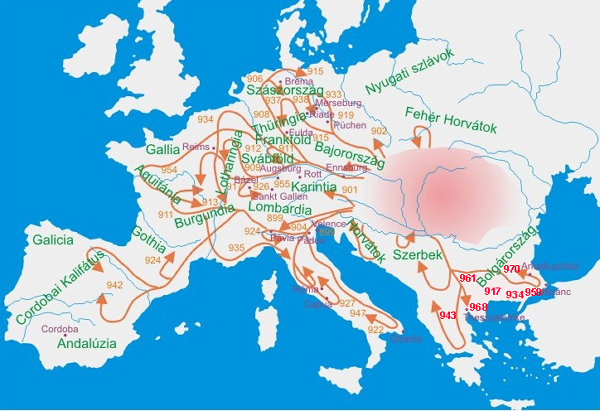
1. Constantine Porphyrogennetus, op. cit., pp. 158-9, dated seven
years after the Bulgar conquest.
2. I deal in my Emperor Romanus Lecapenus, pp. 107 ff., with the problem of this raid, mentioned vaguely by the Hungarians (de Thwrocz, p. 147: Petrus Ranzanus, Index
IV., p. 581), specifically by Theophanes Continuatus, p. 422, and other Greek chroniclers (dated April
934), and with details that cannot be ignored, though some are impossible (dated 932), by Maçoudi
(tr. Barbier de Meynard, ii., p. 58).
3.
Theophanes Continuatus, p. 430.
186
In 944 Bulgaria underwent a raid by the Petchenegs (Bosnyaks), set in motion by the vindictive restlessness of the Russians (i.e. Ruses). The whole incident showed the pathetic part now played by Bulgaria. The Russians (i.e. Ruses), from their southern centre at Kiev, were now steadily growing in power; they were a numerous nation, and they commanded the great trade route from the Baltic to the Black Sea. In 941 they had burst through the Petchenegs to make an attack by sea on Constantinople, but, though the Emperor passed sleepless nights in his anxiety, they had been heavily defeated. Their Prince, Igor, burned for vengeance. In 944 he induced the Petchenegs to accompany him in an enormous raid by land. News of it reached Bulgaria; the Bulgars were terrified, and sent the news on to Constantinople. The Emperor Romanus, with customary prudence, at once dispatched an embassy laden with gifts to the Danube, and successfully persuaded the Russians (i.e. Ruses) to negotiate. But the Petchenegs (Bosnyaks) refused to be cheated of a raid; so they crossed the river and paid a fierce and profitable visit to Bulgaria (944). Everyone was satisfied, except the Bulgarians, who did not count. [1] After that humiliating experience there was a respite for several years; but in 958 the Magyars returned, and again in 962, [2] till finally, in 965, Peter, remembering the ways of his forefathers, sought an alliance with Otto, the great King of Germany, as a means for keeping them in check. [3]
| Both Byzantine and Danube Bulgaria paid a hefty price for Boris' ambitions and Symeon's complacency. The country that the Tengrian Krum left to inherit was decimated, the people that constituted the army were decimated, it appears that massive impoverishment fell on the horse pastoralists who lost their herds, and their military might with them. The Slavic militia could never be mobilized in time to resist the invading cavalry, and was not equipped to resist any organized invader. The story with Bulgarian cavalry army decimated by peasant militia in Serbia sounds way too fishy, and the two undated incursions of the Magyar cavalry into Serbia may point to the real unstated events. As a minimum, the forced “conversion” demoralized the nomadic base of the state, disabling both the rulers and ruled, but the vague references to the popular resistance and its suppression raise doubts of the true events that debilitated and dismembered the country. |
How heavily these raids fell upon Bulgaria, we cannot say. We only know of them because they penetrated into the Empire and the ken of the Greek chroniclers. There may have been others directed solely against the Bulgarians.
1. La Chronique
dite de Nestor, p. 35.
2. Theophanes Continuatus, pp. 462-3, 480 — undated, but their position
in the chronicle suggests these dates, while the first is rendered almost certain, as in 943 a truce was
made for five years, after which Magyar Princes came to Constantinople to make a further truce, which
would naturally be for ten years. Both raids were checked by Imperial forces in Thrace.
3. Ibrahim-ibn-Yakub, quoted in Zlatarski, Izviestieto na Ibrahim-ibn-Yakub za Bulgaritie,
pp. 67-75.
187
This pitiable defenselessness was helped by the internal state of the country. Symeon, disastrous though his policy had been, was great enough and personified fully enough the aspirations of his people to carry them all with him and to suffer no insubordination. Under Peter the component parts of Bulgaria fell asunder. Peter’s character was pacific and pious, his health was poor, [1] and he assumed the government very young — for it seems that, once the peace had been carried through, George Sursubul (Sursuvul) retired from the regency; — he had not the personality to awe and command a nation disillusioned and divided by failure (George Sursubul my have retired from the regency, but to retire him from the Prime Ministership and his leadership over his tribe required a use of force, whatever lousy his personality may have been, which was demonstrated by fire-sale marriage during a mourning period). In the old days the Khan had maintained his position by playing off the Slav peasantry against the Bulgar nobility (In the old days the Khan was a benefactor both to the Slav peasantry and the nomadic Bulgars, in the new, Christian times the Khan was sowing a Christian dissonance and conflict between two parts of his own state).
Peter did not even succeed in that. Under his rule the Court party became a separate faction, distrusted by the rest of the country. Besides the Government at Preslav, it probably included the merchants, all naturally in favor of peace, and the official hierarchy, and no doubt took its tone from the Tsaritsa Maria-Irene, who, if she inherited at all the traits of her family, must have easily dominated her gentle husband. We know that she kept in close touch with Constantinople, at first often journeying there: though, after her father Christopher’s death, in August 931, she only went there once again, with three of her children. [2]]
The Bulgar nobility, so often crushed by the Khans, was not yet extinct; though probably it had by now lost its racial distinction, and was Slavonic-speaking and reinforced by the more powerful of the Slavs. Politically it appeared now as the war party. Its dissatisfaction with the Court was shown early in Peter’s reign, in 929, when he discovered a conspiracy engineered against him to put his brother John on the throne.
1.
According to Leo Diaconus, he died of an epileptic fit (Leo
Diaconus, p. 78).
2. Theophanes Continuatus, p. 422. A proof of the Tsaritsa’s
influence is that it was after her death that Peter fell under the sway of the war party.
188
The conspiracy was put down, and the nobles involved were severely punished. John himself was imprisoned and made to take monastic vows. Peter then sent to Constantinople to announce his happy escape. But the Emperor Romanus determined to profit by the incident; his ambassador came to Preslav and somehow, no doubt at a heavy price, secured the person of the rebel Prince. John was given a palace at Constantinople, and very soon the Emperor had him released from his vows and married him to an Armeniac bride. The Imperial diplomats liked to have foreign pretenders in their power; Romanus could hold John as a threat over Peter’s head. [1]] After this failure the war party kept quiet, till, at the close of the reign, it took control of the Government.
| The narrations about “peace” and “war” parties does not hold the water when the country is ravaged by incessant war raids, and is clearly falling apart, not only without the benefits of the dynastic marriage designed to reinforce the state, but in contrast with planted internecine conflicts. The country badly needed defense, labeled here the “war party”, but what the “peace party” could stand for, except for their own petty interests? Neither merchants, nor the official hierarchy could have been interested in this utterly defenseless and dangerous “peace”. |
The humbler classes were restless too. Occasionally they showed their sentiments in open lawlessness, as was shown by the career of another of the Princes. Michael, Symeon’s eldest son, chafed under the monastic restraint that his father had put upon him; and about the year 930 he escaped and made off to the mountains in the west of Bulgaria, where he was joined by large numbers of Slav malcontents (This supports the suggestion of S.Runciman that Michael was a son of a Slavic concubine, not eligible for succession. Half-Türkic, half-Slav, he was an “izgooi” prince, probably not worth much as a brigand; his story shows how ingrained was the veneration of the Türkic royal blood even among the Slavic societal outcasts that he was accepted and anointed a sinecure royal status). He lived there successfully as a brigand king; and after his death his band still held together, displaying power and prowess enough to make sudden descents into the Empire and sack the city of Nicopolis. [2]] And similar brigand companies probably existed all over the western provinces. [3] But the discontent of the main body of the populace took a very different and far more significant form.
1.
Theophanes Continuatus, p. 419. The incident is placed after the
great frost of 928-9.
2. Ibid., p. 420.
3. In 926, before peace was signed, the Italian ambassador,
travelling to Constantinople, fell in with Slav brigands on the frontier by Thessalonica (Liudprand, Antapodosis, p.
83). The peace probably hardly affected conditions there.
189
Those that are disappointed and weary and fearful for the future often take refuge in religion; and so it was with the Bulgarians. After Symeon’s wars, a wave of religious activity swept over the whole country. Amongst its pioneers was the Tsar himself, well-known for his piety and for the zeal with which he sought out saints. Many of his subjects followed his lead. Crowds flocked to enter the monasteries; others sought even greater holiness by becoming hermits and settling down to lives of bitter hardness. Foremost among these was a certain herdsman called John, who, as Saint John of Rila (Ivan Rilski), has attained the eminence of patron saint of Bulgaria. John of Rila for many years lived in sanctity in a hollow oak; but at last the oak blew down, and he had to retire to the comfort of a cave high in the mountains of Rila.
There he acquired considerable fame; and the Tsar, when hunting in the neighborhood, took the trouble to find out his retreat and to pay him a visit. Peter had been annoyed by a homily that the saint had addressed to his huntsmen; but, meeting him face to face, he was deeply impressed by his holiness and eagerly gave him his patronage. When John died in 946 his body was buried in pomp at Sardica (Sofia); but later it was moved back to the mountains, to the great monastery that now bears his name. [1]]
But this religiosity had another side. In its most perverted form it appeared in the case of the Tsar’s own brother, Benjamin, the only one to abstain from political intrigue. Benjamin’s life was given over to a study of the Black Arts; and he became so clever a magician that at will he could turn himself into a wolf or any other animal you pleased. [2]
1.
Zhivot Jovana
Rilskog (ed. Novakovitch), passim,
esp. pp. 277 ff. (the account of Peter’s interview): Ivanov, Sv. Ivan Rilski,
pp. 1 — 20, passim.
2. Liudprand, Antapodosis, p. 88.
190
Many of his fellow Bulgars took too great an interest in fortune-telling and in demon powers, [1] but few could hope to acquire a proficiency such as his; and so, though in himself he might be actively unpleasant, he never attracted a large following. Far more influential and deplorable, politically as well as doctrinally, was a humble pope or village priest called Bogomil.
| Here we go. The recital of nonsense accounts from Middle Age peasantry on magic and perversion is needed to derogate the upcoming Bogomil subject, of which S.Runciman knows next to nothing, although Bogomilism was live and kicking in the Danube Bulgaria in 1930s as much as it is now. The magic properties of turning into a wolf or any other animal are the properties of Alps, who in the Tengrian cosmogony play the role of Angels and Archangels of Judaism, Islam and Christianity, where the Angels' turning into visible and sometimes animated objects is a daily affair. The societal and state breakup became expressed in the language of the time, taking a religious form loaded with societal resentment. The movement also serves as a symptom showing the underlying impoverishment and despondency, which facilitate the religious response. The Türkic Hudoyar (Or Khudoyar) name is a composite of Hudai/Khudai = God, Lord, Almighty, and yar - veneration, sanctification, adoration, with their verbs and other grammatical forms. Its Slavic translation Hudoyar is Bogomil, composed from literal translation of the same words, the verb -mil could be transitive and intransitive form. In English, it would be “God-loving”, “God-revering”, in Greek “Theophyl”. Only in Christianity the “God-loving”, “God-revering” could become an obscene word. The Hudoyarism and Bogomilism were syncretic expressions of Christian and Tengriist religions, an attempt to internalize the new Christian faith with the old Tengrian faith, encompassing the distinct, fundamentally monotheistic, etiologically Tengrian concept that has already absorbed the Manichean vision of Good and Evil. |
Pope Bogomil, the greatest heresiarch of all the Middle Ages, is a figure lost in obscurity (Pope Bogomil, like the Pope Hudoyar, was invented in the course of demonizing the rebellious non-hierarchical teaching that appealed to a common-sense intellect, not fears). We cannot tell where or when he lived nor who he was. All that we know is that ‘in the reign of the Orthodox Tsar Peter there was a priest called Bogomil (I.e. a priest called God-loving or Theophyl, very popular names to this day, mammas break their legs running to name their kids Theophyls: “Godlover, please stop sucking your thumb”), who was the first to sow heresy in the Bulgar tongue’ (Here we shyly do not discriminate between the Slavic and Türkic Bulgars) [2] that, following the custom of his sect of taking a second name, he was also called Jeremiah, that he was credited with the authorship of several parables and doctrinal pronouncements, and that his heresy was flourishing before the year 956. [3] Even the doctrines that he himself taught are somewhat hard to decipher. Of the writings of the Bogomils themselves — as Pope Bogomil ’s followers were called in Eastern Europe — nothing survives except a few legendary tales of Bible characters or saints and liturgies so simple as hardly to smack of heresy at all. [4] For the details of their belief and practices we have to resort to the evidence of their enemies; but even most of these are of a later date — and heresies, like orthodox religions, may change and elaborate their tenets considerably in a century or two. There are, however, two exceptions, two documents written against Bogomil himself either in his lifetime or soon after his death (We must give a due credit to the Church, which brilliantly succeeded in destroying all written materials in the diabolic runiform alphabet, and all stray writings in every other alphabet, compounded with a prohibition to read the scriptures altogether. A rumor goes that Vatican depositories have preserved some runiform manuscripts and much more).
1. Kozma inveighs against the prevalent taste for fortune-telling,
etc.
2. Slovo Kozmy
, p. 4. The Sinodik na Tsar Borisa,
p. 32, contains one short similar sentence.
3. i.e. before the death of the Patriarch Theophylact of
Constantinople. See Ivanov, Bogomilski
Knigi, pp. 22 ff.
4. See Ivanov, op. cit., where the theologically important writings
are given; also Léger, L’Hérésie des Bogomiles, passim,
and La Literature Slave en Bulgarie au
Moyen Age: Les Bogomiles, where some of their more popular legends are given.
191
The Patriarch Theophylact Lecapenus of Constantinople, the Tsaritsa’s uncle, a prelate more often to be seen in his stables than in his cathedral, was sufficiently shocked by the growth of the Bogomil heresy to write about it to Tsar Peter — probably about the year 950; in 954 Theophylact had a severe riding accident, which incapacitated him during his remaining two years of life. [1] Theophylact was anxious that all the prevalent heresies should be anathematized, and so he did not distinguish between the Paulician teachings and those of Bogomil; but some of his remarks were clearly intended for the latter alone. More important is a work of considerable length, written probably about 975, by a Bulgarian priest called Kozma (Cosmas) purely against the heretics. [2]
From Theophylact and Kozma, as from all the later evidence, one fundamental doctrine appears. The Bogomil heresy was what was called at the time Manichaean[3]; though it only shared with Mani’s faith the basis of Dualism. The Bogomils were frankly Dualist, contrasting God with Satan, good with evil, light with darkness, spirit with matter, and considering both Forces equal, though, it seems, in the end God would triumph. [4] Dualism has always been a natural and attractive religion; but Pope Bogomil was inspired by the Paulicians who were settled in the borders of Bulgaria (The vision of religious thought only in the doctrinal forms, which so conveniently brings discussion on the terrain familiar to the hierarchical denominations, blurs the subject, and leaves investigator to dig only in the sanitized pile under a light pole. Paulicians may have added something to the Hudoyar/Bogomil thought, but the Hudoyar/Bogomil movement would have developed all the same if no Paulician ever contributed to it. Ditto Arianism and other doctrinal and misleading labels).
1. This letter, the manuscript of which is in the Ambrosian Library
in Milan, is printed in the Izviestiya ot. Russ. Tazyka i Slov ., vol. xviii., knig. 3, pp. 356 ff. Of its authenticity
there can be no doubt.
2. Slovo Sv. Kozmy
Presbitera na Eretiki (ed. Popruzhenko). Kozma refers to Peter’s reign as though it were over, but he was acquainted with the clergy of Symeon’s time.
3. Throughout the Middle Ages, in the West as in the East, Manichaean
is used simply as synonymous with Dualist.
4. Theophylact’s letter, p. 364: God’s ultimate triumph is foretold
in Secret Book (Taïna Kniga), Carcassonne MSS, printed in Benoest, Histoire des Albigeois, p. 295, and in
Ivanov, op. cit., p. 86.
192
The Paulicians were an Armenian sect who had strained the dualism inherent in the New Testament to its utmost extent, putting great faith in the words of St. John’s Gospel (xii. 31 and xiv. 30) which attributed to the Devil the rule of this world. They rejected the ordinances of the Orthodox Church or even the Armenian Monophysite Church, and instead had their own rites and their own ecclesiastical organization. [1] They had long been a source of annoyance to the Empire, at times even forming politically independent communities [2]; and one of the methods employed to deal with them had been to transplant them to Europe, especially to Thrace. But their migration never damped their ardor; already in the days of Boris their missionaries were working in Bulgaria. [3]
But the Paulicians were a sect of some education, versed in theology. Bogomil’s genius lay in his adaptation of this intricate Armenian religion to suit the needs of the European peasantry. Probably he taught Paulicianism as he understood it [4]; but his teaching was nevertheless something new, and something so suited to its purpose that before two centuries were over it had spread to the mountains of Spain. Besides the Dualist basis of their creed, it seems that the Bogomils believed that the Mother of God was not Mary, the daughter of Joachim and Anna, but the Upper Jerusalem, and that Christ’s life and death were but fantasy — for God could never take on anything so evil as a material body; they rejected the Old Testament, both the Mosaic law and the prophets, and they restricted their prayers to the Paternoster; nor would they cross themselves — for that would be a tactless reminder of the wood on which God seemingly suffered.
1. The Paulician tenets may be found in Conybeare, The Key of Truth ; also in Petrus Siculus’s diatribe.
2. e.g. their republic at Tephrice, which Basil I had difficulty in
capturing in 871. Basil’s own family had been transported from Armenia to Adrianople, and possibly was itself
originally Paulician.
3. Nicolaus Papa, Responsa, p. 1015.
4. ‘Μανιχαισμὸς γάρ ἐστι Παυλιανισμῷ συμμιγής’
(Manichaismos gar esti Pavlianismo symmigis - Paulicianism
focuses components of Manichaeism). Theophylact ’s
letter, p. 363. The taking of a second name, e.g. Bogomil’s assumption of the name Jeremiah, was copied
from a Paulician habit.
193
With regard to Satan, called Satanail or Samail, there were two schools of thought: had he always been evil or was he a fallen angel? The former was the Paulician theory, deriving from Zoroastrianism, and from the Paulician settlements it seems to have enjoyed a considerable vogue in the Balkans, especially in the Greek districts; the latter was what Bogomil himself taught (The popular and diffused Tengriism abounded in adventurous myths that never directly stated, but implied that supernatural Alps were creations of the Almighty to rule aspects of the mortal world. None of the Alps were evil, but all of them combined elements of good and evil. Judging by the Türkic names of the leading personalities, Adam and Eve, both versions of the creation myth in the Book o Genesis came from or are a recital of one of these myths. Plenty of them survived and are recorded in the ethnological literature, and they can't be singularly attributed to a particular ethnos: what is rated as a Kipchak myth can be found among non-Kipchaks, while Kipchaks have a series of considerably different versions. Recited at a campfire for 160+ generations, syncretized over many different contributing ethnicities, and recombined with the later historical events, little is left from the versions recorded in the Gilgamesh or the Hebrew Bible).[1] There were some theories that Satan was either the elder or the younger son of God and brother of Jesus. There was equal divergence in their views of the origin of Adam and Eve, whose date incidentally was 5500 BC: were they fallen angels transformed into human beings, or created by God or by Satan? It was also said that Eve was unfaithful; Abel was her son by Adam, but she bore Cain and a daughter, Calomela, to Satan. [2] Out of these stories arose a cycle of popular legends. Pope Bogomil himself is said to have pronounced on such subjects as ‘how many particles became Adam ’ and ‘how Jesus Christ became a pope’ or ‘how he labored with the flesh’; and he may too have been the author of the story that tells how Saint Sisinni met the twelve daughters of Tsar Herod on the shores of the Red Sea, and they told him that they were come to bring disease into the world. [3]
1. The Constantinopolitan Bogomils appear to have been followers of
the more Paulician school, which was probably the so-called Dragovitsan Church after the village of
Dragovitsa, near Philippopolis, in a Paulician district. The same divergence appears to have separated the
Cathari and the Paterenes in the west.
2. Theophylact’s letter, pp. 364 ff.: Slovo Kozmii, passim: Sinodik na Tsar Borisa,
pp. 34 ff.: Euthymius Zigabenus, Contra
Bogomilos, passim: Euthymius of Acmonia in Ficker, Die Phundagiagiten, passim: The Secret Book (in Ivanov, op. cit.). Summaries can be found in Ivanov, op.
cit., pp. 24 ff., and Léger, La Littérature Slave..
3. Quoted in Léger, op. cit.
194
Thus far the Bogomil heresy (Heresy is a bad word, from the viewpoint of Judaism, the Christianity is a heresy; the situation is totally analogous with the word “paganism”, it is a particular point of view characterizing the speaker instead of the subject), distressing though it was theologically, need not have troubled the lay authorities. But a faith that teaches that all matter is evil is bound to have serious social consequences. Many of the Bogomils’ habits were admirable; in contrast to the Orthodox Bulgarians, who danced and drank and sang to their gouslas all day and all night long, they were modest, discreet, silent, and pale with fasting; they never laughed out loud nor talked of vanities; food and drink came from Satan, they said, so they took both in extreme moderation, touching neither meat nor wine. But when they shut themselves up in their houses for four days and nights on end to pray, [1] employers of labor might well look askance. Moreover, convinced as they were of the evil of their bodies, they firmly discouraged marriage or other less lawful methods of propagating the race. Indeed, their abstention from women was so marked that among their later disciples in France, often called the Bougres, from the Bulgar origin of their doctrine, it aroused the prurient suspicions of the Orthodox; and their name in its English translation still preserves the meaning of an alternative form of vice (Thus propagating Tengriism to the very foundations of the American colonies and ultimately the USA). Pope Bogomil was not hopeful enough to expect the whole of his followers to commit racial suicide; so, following the practice of the Paulicians, he set aside certain persons known as the Elect, whose abstinence from sexual intercourse was complete, and from bodily nourishment and comforts as nearly complete as possible; they were the aristocracy among the Bogomils, and their spiritually feebler brethren ministered to them. [2] Their democratic instincts made them averse to authority (What an intolerable vice in the eyes of the secular and ecclesiastical hierarchies. They dared to think for themselves. Hence the democratic institutions in the American colonies and ultimately the USA). In their early days they even had no clergy — Bogomil and his chief disciples, Michael and Theodore, Dobr, Stephen, Basil, and Peter, had no official position — but later they seem to have recognized the orders of deacon, priest, and bishop [3]; and by the thirteenth century there existed in Bulgaria a spiritual potentate known throughout Christendom as the Black Pope himself (The concept hated for intolerance of institutions is blamed for institutionalizing by institutionalized clergy - only in institutionalized denominations can such perverted claim be concocted). [1]
1. Slovo Kozmy
, pp. 36 ff.
2. Ivanov and Léger, loc. cit.: Ivanov, p. 123 n.
3. Ivanov, op. cit., pp. 29-30. The names of the heresiarchs
(Hierarchy of heresy - viva the great noble Hellenic language) are
given in the Sinodik na Tsar Borisa,
loc. cit.
195
But what made the Bogomils an inevitable menace to the State and necessitated their persecution was their view, based on their dislike of things that were temporal, that it displeased God if a servant worked for his master or a subject worked for his prince (Yeah, this is really heretical, especially in the societies that still enjoyed the fruits of slavery - and needed an accommodating religious doctrine to sanctify it. In fact, the Christian-sanctified serfdom and slavery survived beyond the WWII. In the nomadic societies, the forced labor and dependency is not an issue - you can't put shackles on a nomad and his herds, hence people only confederate, never bind). [2]
The method and extent of the persecution employed by the (Newly Christian) Government to combat so dangerous a heresy are unknown to us, as are most of the details of Bulgarian history during these years. The Patriarch Theophylact had recommended the employment of secular authority in crushing them, and his advice was no doubt followed (A Tengrian ruler can't do that, religious tolerance is a backbone of syncretism). But Bogomilstvo was a faith for which its adherents would gladly suffer martyrdom; and it increased in strength. Its success was greatly helped by the political and social atmosphere of the country. It was the expression of discontent by the poorer classes, the Slavs, members of a race that has always had a democratic bias. The people had long been opposed to the aristocracy, which still was for the most part alien by birth, if no longer in speech; they had lost touch with their old ally the Khan, who now as Caesar was bravely imitating the autocracy and luxury of New Rome. The orthodox Bulgarian clergy were proving unsatisfactory; they were probably under the control of the Court, whose interests they pursued, and, unlike the Greeks, whose culture and learning had at first dazzled the Bulgarians, the average priests were lazy and debauched and little better educated than their congregations — the Bogomils called them blind Pharisees — while the higher clergy were out of touch with the people.
1. He is mentioned in a letter of the Legate Conrad written in 1223,
(Gervasii Praemonstratensis, ep.
120, p. 116). But his actual existence is uncertain — it was generally
misunderstood in the West that every Eastern village priest was called a pope
(In Türkic, priest is “papan”, in Slavic “pop” = “pope”,
but without a connotation of the Catholic Pope; that
terminology coalesced upon encountering with Christianity, a Manichean priest is not
called “papan”, the head of the congregation was called Kagan, or Ev-Kagan = Kagan of the
House, with ev = “house, yurt, premises” [See Zuev Yu.A.,
“Ancient Türkic social terminology in Chinese text of the 8th c.”//Problems of Kazakhstan Archeology, Issue 2, Almaty-Moscow, 1998, pp. 158-159]).
2. Slovo Kozmy
, pp. 40 — 1.
196
The Bogomil Elect provided a remarkable and impressive contrast, just as the ordinary Bogomils — so Kozma had to admit — compared very favorably in their manners with the orthodox laity (If religion is supposed to improve people and make them suitable for the admittance to the Heaven/Paradise, that is what Bogomilism did, and what the organized Church tried to defame and destroy). It was scarcely surprising that the best of the crushed and disillusioned peasantry should feel the world to be an evil place and all its matter the work of Satanail, and should follow Pope Bogomil, who was of their number and understood their souls (S.Runciman blindly follows propaganda about the fantom Pope Bogomil, of whom he admits he knows nothing). Nor could so well suited a faith long remain confined by the frontiers of Bulgaria; it spread southward to Constantinople itself and the provinces of the Empire, it spread eastward to Serbia and to Bosnia and Croatia, and across to Lombardy and the Alps, finding its second great home in the land of Languedoc, between the Cevennes and the Pyrenees: till at last that poor land was cleansed and purified by the blood-baths of de Montfort and the fires of Saint Dominic. [1]
But the history of the Bogomils in France and Italy in centuries to come, or of their baneful influence (Harmful to make people favorably impressive?) on the Balkan lands that was to last till the Ottoman conquest, is outside of our limits here (Many Bogomils joined Islam, as consistent with their basic tenets of good and evil). In Peter’s time and in the years that followed close after, they had not yet reached their full notoriety; but, though they worked invisibly and humbly, their work was that of a worm gnawing at the heart of Bulgaria. The decline and fall of her first Empire came very largely from the unceasing labors and increasing strength of the followers of Pope Bogomil.
For the rest, life in Bulgaria under Peter seems to have passed without much incident. Trade probably returned with peace and flourished, and the mines were no doubt worked.
1. The descent of the Albigeois heretics from the Bogomils is
sometimes denied; e.g. H. Lea, in his History of the Inquisition in the Middle Ages (i., p. 90), dismisses
the Bogomils in a footnote as a side-track. However, mediaeval writers (e.g. Reinerius Sacchoni and Moneta)
trace the Albigeois from them, and certainly the Languedoc heretics looked to Bulgaria as the
source of their faith. Some historians like to consider any traditional opinion as being therefore
wrong; but any doubt on this question must vanish before a comparison of the Slavonic Bogomil
literature with the Latin-Languedoc literature of the Cathars and Paterenes, as is given in Ivanov,
op. cit.
197
That churches and palaces and monasteries were built throughout the country is certain: though we can assign no extant building confidently to these years. Of the arts in detail we know nothing; nothing has survived. Literature was extremely fashionable; the priest Kozma complained bitterly that everyone wrote books instead of reading them (That is the most eye-opening description of reality, unless S.Runciman's assertion on fashionable literature is grossly inaccurate. Of the two groups, Bulgars left traces of considerable literacy, the surviving inscriptions point to literacy at the level of stone-cutters and construction workers using Türkic runiform alphabet. The Slavic illiteracy famously extended to the 20th c., the 1897 census showed illiteracy in European Russia at 77.1%, and that included non-Slavic populace like Jews and Tatars whose literacy level was nearly 100%. These two points allow to suggest that in ethnical terms Kozma's complaints pertained to Bulgars, not to the Slavs, whose alphabet was taught at Slavonic college at Constantinople, whose manuscripts are chiefly coming from two points in the Ochrida and Rila districts, and whose alphabet in 975 was barely 90 years old. An example of the “wrote books instead of reading them” has survived in the poetical myth “Shan Kyzy Dastany” written down by Mikhail Bashtu in Kyiv in 882. In any fashionableness contest, “Shan Kyzy Dastany” would win hands down over anything written up in the Kozma's monastery, and its wide circulation ensured its long-term survival).
These books were mostly translations of Greek religious works or romances; but Kozma’s own writing shows the advance in Slavonic literature that had been made in the last half-century. Not only was it the first original work of any length written in the (Slavic) Bulgarian vernacular, but it has a maturity of form and flexibility of language far in advance of the writing of Symeon’s day, of Khrabr or John the Exarch. [1]
Moreover, the Bogomils introduced a popular literature, telling legends that sooner or later were written down. These too were mostly translations or adaptations from the Greek, some even showing traces of Indian mythology, but others were original compositions. But, in spite of this activity, the general standard of culture and comfort was low. Even at the Court it did not probably extend far beyond the furniture and trappings that the Greek Tsaritsa would bring with her on her journeys from her home. When, after her death, her daughters visited Constantinople, they travelled not in the litters that would convey any lady of quality in the Empire, but in chariots whose wheels were armed with sharp scythes. The Bulgarian ambassador at Constantinople in 968 was even less civilized; he shaved his head like a Hungarian and wore a brass belt, apparently to keep his trousers up, and was quite unwashed.
Thanks to unwitting S.Runciman, we can peek into Bulgarian ethnological traits. The Greek religious mythology was definitely out of reach for the Hudoyars/Bogomils, it was a suppressed literature, and must be an empty phrase; but what is hidden under the “Indian mythology”, with no connections between India and Danube Bulgaria whatsoever, we were even told that still much closer Bulgarian brethren under Franks were out of reach for Danube Bulgaria. What S.Runciman is really saying that the legends had no connection to the Greek or Slavic mythology, they were purely Türkic Bulgarian myths carrying background of Tengriist cosmogony, like in the example of the “Shan Kyzy Dastany”. The idea of pole-bearers carrying a litter on a long trip across terrain is totally out of this world, that can only happen to the people living within confines of a small city with level streets. Unless the Greek Tsaritsa's daughters were incarcerated at the court, they have already travelled in princely corteges paying visits and touring around, using traditional means of transportation for which Bulgars, as any other horse pastoralist nomadic peoples, were famous for. Anyone can appreciate the difference between a long travel in a wheelchair vs. a coach, and we have nice descriptions on the conveniences afforded by horse-drawn nomadic coaches. Probably, the carriages did not change much from the beginning of the Iron Age, when iron became a construction material to substitute for less reliable materials. Arming the royal wagons with sharp scythes might have allowed Bulgar rulers to cut through attackers and flee to safety on their long ways from the Central Asian steppes to Danube. Probably, the princesses wagons were the same wagons that carried royal commanders in their raids on Greece, Magyars, and Slavs. It appears that the Bulgarian scythe-armed wagons are a hapax, not mentioned in literature or found in graves, and they deserve a closer attention. The description of the Bulgarian ambassador at Constantinople in 968, wearing Türkic princely haircut, trousers, and an attracting attention brass belt should have reminded S.Runciman the line in Nominalia he analyzed in Appendix II, the line “ruled with shorn heads on the other side of Danube for 515 years” is too familiar to the author to accuse him of ignorance. Once again, it is nice to learn from S.Runciman that some of the Hungarians, maybe the princes from the line of Bulgarian Kabars, had the Türkic royal haircut, but in the context of the Danube Bulgarian history, the Türkic royal haircut and Türkic caftan girded with metallic belt was worn by a Bulgarian prince serving as an ambassador, with all Türkic princely attributes demonstrating his dignity, and it can be confidently projected on the princely and royal appearances in the Preslav Court, which severely contrast with the false images presented to the Bulgarian population later. The derogatory references to the trousers, apparently written by still trouserless observer, and to the bad hygiene serve to highlight the necessary part of the Türkic male and female costume, and the haughty attitude of the observer, who however is more direct and honest than the obfuscating S.Runciman. Independent references describe the “surprising” hygiene of the Türkic nomads.
|
||||||||
1. Kozma probably wrote after Peter’s death (see above, p. 191), but
I treat of him here, as he considered himself a disciple of the Preslav school of Symeon ’s day.
198
Bishop Liudprand of Cremona, ambassador of Otto I, was furious at such a creature having precedence over him — and yet the North Italians themselves were none too clean in the tenth century. [1] But probably this ambassador was a member of the war-party — a boyar who would despise the decadent cleanlier habits of the Court. Thus for close on four decades Bulgaria lay in this weary parody of peace. At last, in 965, the Tsaritsa Maria-Irene, eponymous leader of the peace party, died. Years had brought Peter no greater strength of character, and almost at once, deprived of his wife’s pacific influence, he fell under the control of warlike boyars, who counseled him to show a brave, aggressive front against Constantinople. Things had changed in Constantinople. The Emperor Romanus Lecapenus, Symeon’s adversary, had fallen long since, and had died a repentant monk; Constantine, the Porphyrogennetus, restored to his rightful place, was dead now too; even his son, the second Romanus, grandson of old Lecapenus, had died. The Imperial crown was now worn officially by two little boys, the sons of Romanus II — the younger an indolent child called Constantine, the elder called Basil, who would later bear a surname dreadful to Bulgarian ears. Their mother, the lovely Empress Theophano, warned by the fate of Zoe Carbopsina, had maintained herself in power by a second marriage; her husband had been the Imperial Commander-in-Chief, Nicephorus Phocas, grandson of the first Nicephorus Phocas and nephew of the victim of the Achelous. Nicephorus, from his prowess and from this marriage, was now firmly seated with his stepsons on the Imperial throne, co-Emperor and Regent of the Empire.
1. Liudprand, Legatio, pp. 185-6. Ibrahim ibn Yakub describes the Bulgarian ambassador at Otto I’l Court in 965 as wearing a similar costume. See above, p. 186
(Apparently, the modern nationalistic scholars do not have any use for
the obsolete writings of the old Ibrahim ibn Yakub, or of the old Bishop Liudprand of
Cremona, even in the renditions of the old obsolete S.Runciman).
199
It would have been wise not to provoke the warrior-Emperor who had conquered Crete from the Infidel and was conquering in the east. But the Bulgarians hoped that Nicephorus would be too fully occupied in his schemes against the Saracens not to yield to the demands of Bulgaria, should she show a warlike spirit. And so, when Nicephorus revisited Constantinople for the winter of 965-6, fresh from his capture of Tarsus, he was accosted by an embassy from the Tsar, sent to receive the ‘customary tribute’. [1]
This tribute was the old income that the Empire had agreed to pay, by the peace of 927, during the lifetime of the Tsaritsa (Actually, the tribute was permanent, with minor interruptions and rebellions, the size of the tribute was renegotiable and renewable; it ultimately started with Roman tribute to Alans, and then was inherited by every successor state on both sides; Asparukh gained a right to tribute in 679, and by 965 the Byzantine tribute to Danube Bulgaria had a 286-year tradition). Peter’s demand for it after her death was an act of unwarrantable aggression; and to call what was practically a dowry paid in installments tribute was an intolerable insult. The ambassadors’ reception was short and painful. Nicephorus was furious; rhetorically he asked his father, the Caesar Bardas, what could they mean by demanding tribute from the Roman Emperor. He then turned on the ambassadors and poured abuse on them, calling their race one of filthy beggars, and their Tsar, not an emperor, but a prince clad in skins. [2] His refusal was categorical; the unhappy Bulgarians, amid blows from the humbler courtiers, were dismissed from the Presence. It was an audience almost unparalleled in the history of Imperial etiquette, similar only to Alexander’s reception of Symeon’s envoys in 913.
1. I give my reasons for my disentanglement of Nicephorus ’s wars
with Bulgaria in Appendix XII.
2. Leo Diaconus, p. 62.
200
But Peter was not Symeon; nor was Nicephorus Alexander. His rage was real, not the product of drunken bravado, and he did not confine himself to words. At once he moved with a large army to the frontier, and even captured a few of the Bulgarian forts that still guarded the Great Fence; but he had no wish to go campaigning in Bulgaria, that difficult country where so many Imperial lords and soldiers had been slain — he still had work to do in the east. He thought of an easier way to deal with Bulgaria, a method dictated by the traditions of Byzantine diplomacy. The Russians (i.e. Ruses) were a vigorous race and lay beyond Bulgaria. They could do his work for him. But for the moment there was no work to be done. Peter was terrified by the result of his bellicose gesture. Hastily he sent to make peace, withdrawing, we may presume, his demand for ‘tribute,’ and handing over his two sons, Boris and Romanus, as hostages to the Emperor — an act that was not as humiliating as it might seem; the young men were simply going, as Symeon had gone, to finish their schooling at Constantinople, the one place where they would receive an education worthy of civilized princes. That they were there in the Emperor’s power could be regarded as a side-issue.
The episode gave Nicephorus food for reflection. For close on forty years the Empire had ignored Bulgaria; but Bulgaria had not lost her warlike temper. It was only weariness that kept her tranquil; if she were allowed time to recover, the age of Symeon might come back again. Nicephorus proceeded with his negotiations with the Russians (i.e. Ruses). [1]
The Imperial ambassador sent to the Russian (i.e. Rus) Court was the Patrician Calocyras, son of the chief magistrate of Cherson, the Imperial colony in the Crimea, the starting point of most of the missions into the Steppes. Calocyras, who had lived most of his life in his native district, was admirably fitted to deal with the savage neighboring tribes, knowing their languages and their habits well (What languages are the languages of the “”savage neighboring tribes”? Gothic and Bulgarian Türkic? Or S.Runciman knows something else?). Moreover, he took with him a sum of money enormous even in those days of the wholesale bribery of nations — 1,500 lb. of gold.
1. Zlatarski’s suggestion that
Nicephorus called the Russians (i.e. Ruses) into
Bulgaria to keep them from attacking Cherson is, I think, unnecessary. Cherson could be defended
easily still by calling in the Petchenegs (Bosnyaks).
201
The Russian (i.e. Rus) monarch, the heathen (Tengrian, but S.Runciman would discriminate between Türkic and Norman religions) Varangian (Viking) Prince Svyatoslav, fell an easy prey to the ambassador’s bribes and blandishments. He was a young man, only recently released from the tutelage of his stern Christian mother, the Grand Princess Olga (i.e. Helga, a Dane Viking); already he had waged wars successfully against his neighbors on the Steppes, and he was ambitious and eager to show his prowess further afield. By the summer of 967 the Russians (i.e. Ruses) were ready to descend upon Bulgaria.
Prince Svyatoslav was no Varangian or Viking, and he did not preside over Russia, but over a future spec of incipient Rus. Both the description of his appearance, with Mongolic eyes and Türkic princely braid on shaved head, and his tamga testify that he was a Türkic Bulgarian prince. Bulgarian annals call him by his Türkic name Barys. His mercenary army was dominated by mercenary Vikings in his retinue plus freelance mercenary Vikings. His pretensions to the Danube Bulgarian throne point to his descent from the Bulgarian dynastic lines. The whole affair with the conquest of the Danube Bulgaria was a family feud. The Varangian pedigree and Rus-Bulgarian antithesis was a later invention, by 967 the Danube Bulgaria was a formed and recognized state with 300-years history and a long line of 21 consecutive rulers, while the Rus just gained independence from the Khazaria and was not yet a state but a small aggressive princely possession. 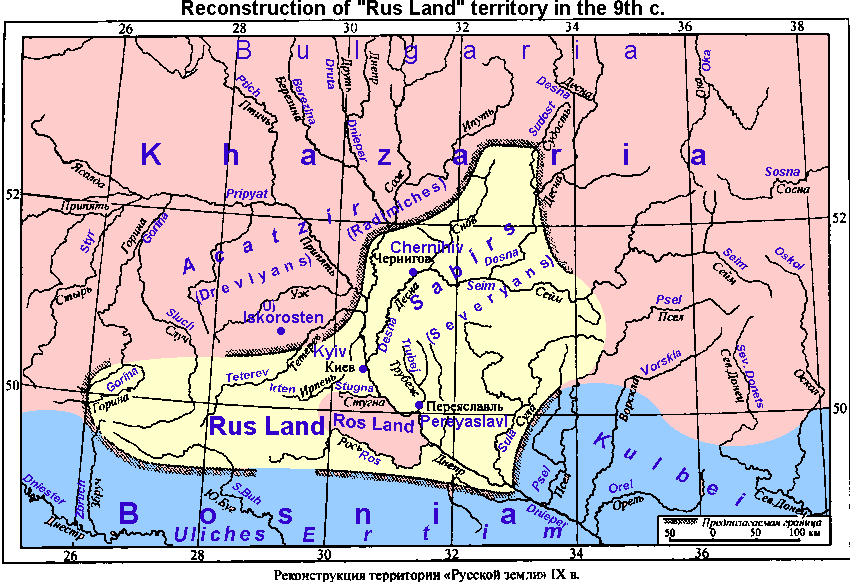
|
In June 967 the Emperor Nicephorus marched to the frontier to inspect its defenses — a useful precaution when war was to be let loose beyond it. At the same time, he wished to salve his conscience for calling in heathen (non-Christian) barbarians against a Christian country with which he was at peace. So from the frontier he wrote to the Tsar accusing him of having so often allowed the Magyars to cross the Danube and penetrate to the Empire. Peter had no answer. He would gladly have prevented the Magyars from raiding in his country, but he had not been strong enough; but naturally, when they did invade, he encouraged them to pass on as quickly as possible into the provinces of some other ruler. His reply was inevitably unsatisfactory; and so Nicephorus could consider himself justified. [1] Confident that the Russians (i.e. Ruses) would do his work thoroughly, he turned his attention again to the east.
1. Zonaras, iii., p. 512-13, says that Nicephorus was actuated by a
Magyar invasion. Cedrenus (Scylitzes), however (ii., p. 372), on whom Zonaras based his chronicle,
implies that it was a general pretext. The invasion in Zonaras is clearly due to his misinterpretation
of the passage in Scylitzes.
202
In August Svyatoslav crossed the Danube with Calocyras to guide him and sixteen thousand men. The Bulgarians had been warned, and sent twice that number to oppose his landing on the southern bank; but they were badly defeated and fled to the fortress of Dristra. Svyatoslav overran the north of the country, capturing twenty-four towns, and established himself for the winter in that very district of Onglus where Asperuch the Bulgar had lived, holding his Court in Preslav-on-the-Danube, Little Preslav, the fortress that commanded the river delta. Thither the Emperor sent him additional subsidies [1]; and next spring he invaded southward again, devastating the land even more fiercely than before.
The Bulgarians were in despair. The Tsar Peter’s health was affected by the disasters; he had an apoplectic fit from which he never properly recovered. His Government, however, kept its head sufficiently to apply the only possible remedy; it called in the Petchenegs (Bosnyaks). The Petchenegs were only too glad to intervene; the Russian (i.e. Rus) power was rivaling their own, and already their prestige was diminishing compared to the better ordered hordes of the Varangians (Vikings). Moreover, Svyatoslav had violated their territory in marching to the Danube; for they still roamed over the Wallachian plain and the Steppes on the Black Sea coast. They banded themselves together in the summer of 968 and marched in full force against Kiev. The Grand Princess Olga (i.e. Helga) defended the city as best she could, but her forces were outnumbered and famine intervened. The news at last reached Svyatoslav, and reluctantly he saw that he must return. He arrived back in time to save his capital: while his people reproached him for adventuring in foreign lands and neglecting his own. But, though Bulgaria thus won a respite, his heart was set on going there again.
The ailing Tsar took a second precaution. That same summer he swallowed his pride and humbly sent an ambassador to Constantinople — the unwashed Patrician whose precedence so vexed Liudprand of Cremona.
1. This is clearly what is meant by ‘Nestor’s’ assertion that the
‘Greeks paid him tribute there’.
203
Nicephorus received him non-committally; he was as yet undecided in his policy. But as the year wore on alarming news came from Russia (i.e. Rus). The Patrician Calocyras had succeeded only too well in winning Svyatoslav’s confidence; he now was planning to use it against his Emperor. Continually he urged the Russians (i.e. Ruses) to invade the Balkans again, hoping either to be carried on Russian (i.e. Rus) arms to the Imperial throne itself, or more probably so to divert the Emperor that he could return to his native Cherson and establish himself there independently. Svyatoslav fell eagerly in with his plans.
The south tempted him; he wished to hold his Court for ever at Preslav-on-the-Danube; for there, he said, was the centre of his lands; there all the riches came, from Greece, silver, stuffs and fruits, and varied wines, from Bohemia and from Hungary, silver and horses, from Russia (i.e. Rus), skins and wax and honey and human slaves. [1] It was indeed a fine site for a capital, so near the mouth of the great river and commanding the gate to the rich Balkan world. It was all that his mother Olga (i.e. Helga) could do to restrain him, to keep him with her at Kiev (Kyiv) till she died; for already she was very ill. [2]
Nicephorus learnt from his spies that the situation was really serious; he himself thought that war with Russia (i.e. Rus) was unavoidable. He hastily sent to fortify the Imperial possessions in the Crimea, [3] and at the same time instructed the Patrician Nicephorus Eroticus, and Philotheus, Bishop of Euchaita, to proceed to the Bulgarian Court and propose an alliance. The Bulgarians received them delightedly; the need for Imperial help, they said, was very urgent indeed.
1. Chronique dite
de Nestor , pp. 53-4.
2. Ibid., loc. cit.
3. It is this fact that makes me believe that Cherson was at first
Calocyras’s objective.
204
Everything was arranged for a common defense of the peninsula. At Nicephorus ’s suggestion the alliance was to be further cemented by a marriage between two little Bulgar Princesses [1] and the two young purple-born Emperors. This clause was enthusiastically accepted; and the two princesses set out in scythe-wheeled chariots to Constantinople, to be trained in their future high duties. But these marriages never took place; and we only hear of them once again. Early on the December night on which the Empress Theophano had her husband Nicephorus murdered, she came to talk to him about the upbringing of these foreign girls, and left him to make some arrangement for them. [2] After that nothing is known of them. They soon lost their political importance; probably they were given as brides each to some respectable gentleman of Constantinople (Would not that be a greatest affront to the allied state, its people, and the princesses' royal parents and grandparents? S.Runciman interprets the unknown like it is a pair of broodmares contracted to mate a prize stallion and instead mated with mules). [3]
In the midst of these arrangements the Tsar Peter died, on January 30, 969. [4] He had reigned nearly forty-two years, a good man, but a bad king. His task had been almost impossible; he had inherited a weary kingdom, and he had not been strong enough to hold it together. If he kept the peace he aroused the irritation of his boyars ; but his show of warlike temper at the end was even more disastrous. And all the while he had to face the passive but increasing hostility of the peasant heretics.
1. It is uncertain who these Princesses were. They can hardly have been the
children of Peter and Maria, as is generally said, for they were married forty-one years
previously, whereas the Princesses were clearly quite young. They were probably the
children either of Boris II (though one gathers that Boris was hardly old enough), or of
some elder but now dead son of Peter’s.
2. Leo Diaconus, p. 86.
3. Such was the fate of the Princesses of Samuel’s family (see below,
p. 257).
4. The date (Jan. 30) is supplied by the Office of Tsar Peter (see
Ivanov, Bulgarski Starini, p. 83).
For the year, see Zlatarski, Istoriya, i., 2, p. 589. As he shows, 969 must be correct, though I disagree with
some of his other dates.
205
His had not been a happy life; even in his youth he was a disillusioned man, murmuring to Saint John of Rila that, however great your longing for riches and for glory may be, they will not bring you peace. [1] And Peter had not even lived gloriously. Death alone was kind to him, for it spared him the woes that were coming to his country.
On Peter’s death the Emperor sent his sons back to their homes from Constantinople; and the elder, Boris, ascended the throne. Boris was probably in his middle twenties.
In character and ability he was alike mediocre; the only thing about him that was really remarkable was his thick red beard. [2] His accession brought with it no new policy. Indeed, under the circumstances, there was nothing to be done, save to put the country into some state of defense, and then await the inevitable onrush of the Russians (i.e. Ruses).
The storm broke in the early autumn of that year (969). [3] The great Princess Olga (i.e. Helga) died during the summer, and Svyatoslav now had nothing to retain him at Kiev. He set off at once with an army of Russians (i.e. Ruses) and Petchenegs (Bosnyaks) and Magyar subjects or mercenaries (How could he get the Magyar subjects or mercenaries? He maintained relation with his cousins Kabars?) for his new capital of Preslav-on-the-Danube, and from there marched into the heart of Bulgaria. Whatever defenses Boris may have organized, they fell utterly to pieces before the Russian (i.e. Rus) hordes. [4] They swept down through the northern provinces, on to Great Preslav itself; after a sharp battle the capital fell into their hands, and in it they took prisoner the Tsar, his brother Romanus, and all his family. [5] From Preslav they moved to Philippopolis, the greatest town of the south.
1. Zhivot Jovana Rilskog, p. 279.
2. Leo Diaconus, p. 136.
3. For the dating see Appendix X.
4. ’Nestor’ says that the Russian
(i.e. Rus) army was only 10,000 strong (p.
56); the later Greeks, however, considered it thirty times as large (300,000; Zonaras, iii., p. 524:
308,000; Cedrenus, ii., p. 384). ‘Nestor’s’ number probably represents the pure Russians
(i.e. Ruses, i.e. Viking mercenaries); but there were the additional Petcheneg, Magyar, and, later, Bulgarian auxiliaries
(What Bulgarian auxiliaries? From where?). Probably Leo Diaconus’s
estimate (p. 109) of 30,000 is fairly correct.
5. Cedrenus, ii., p. 383: Chronique dite de Nestor , p. 55. Here I
think Pereia-slavets is Great Preslav, not, as before, Preslav-on-the -Danube.
206
Philippopolis, it seems, made a brave but feckless show of resistance; Svyatoslav in revenge impaled twenty thousand of its inhabitants. [1] By the fall of winter the Russians (i.e. Ruses) had overrun and held firmly the whole of Eastern Bulgaria, as far as the Thracian frontier of the Empire. There they paused to winter, Calocyras still with them and urging them on. His ambitions were boundless now; the Russians (i.e. Ruses) should carry him in triumph to Constantinople, and there, as Emperor, he would reward them with his province of Bulgaria. [2]
There was great alarm in Constantinople; and it was not allayed by a grand tragedy in the Palace. On December io, 969, the Emperor Nicephorus was murdered by the order of his wife Theophano and her lover, his best general, John Tzimisces. In the retribution that followed the Empress was deserted and dispatched into exile; and John, doubly traitorous, became Emperor. [3] John was an excellent soldier and an able statesman, younger and less scrupulous than his predecessor. The Empire had no reason to regret his elevation. But for Bulgaria it was less felicitous.
John at first attempted to negotiate with Svyatoslav. He sent to him offering to complete the subsidies promised by Nicephorus — their payment had presumably been stopped when Nicephorus allied himself with Bulgaria; and he requested him to evacuate what was, he said, a rightful possession of the Empire. Those words must have fallen strangely on the ears of the Bulgarian captives at the Great Prince’s Court.
But Svyatoslav’s reply was to order John to cross into Asia; he would only consider a peace that gave him all the European lands of the Emperor, and if he were not given them he would come and take them. Despite this ferocity, John sent a second message, sterner but still conciliatory, probably to gain more time.
1. Leo Diaconus, p. 105.
2. Cedrenus, loc. cit.
3. Leo Diaconus, pp. 84 ff.
207
Again Svyatoslav issued an insulting message to the Imperial ambassadors. So both sides settled down to war. [1]
It was a war that was miserable for Bulgaria. The Bulgarians, weary and disunited, had at last met the fate for which diplomats at Constantinople so long had plotted; they had succumbed to barbarians from the Steppes (To call sea- and river-faring Vikings “people from the Steppes” is perplexing. “Barbarians from the Steppes” is codeword for Türkic horse nomads, not the Viking boat people. There must be a hidden context for this slip). And now they had to watch the barbarians and the Imperial armies fighting over their lands, knowing that, whichever might be victorious, neither would give them back their independence.
They were a melancholy sight — the Tsar a captive in his palace, his soldiers taken off to swell the ranks of the Russians (i.e. Ruses), while the merchants and the farmers watched the ruined tracks of war and the heretic peasants sulked in passive indolence. Only in the west, where the Russians (i.e. Ruses) never penetrated, was there still some active national life and feeling: which would bear fruit later.
In the summer of 970 the Russians (i.e. Ruses) advanced into Thrace. The Emperor sent his brother-in-law, Bardas Sclerus, out to meet them. After preliminary skirmishes there was a great battle at Arcadiopolis, the Lule-Burgas of today. It was a long-drawn-out contest, full of heroic hand-to-hand combats; but in the end the Russians (i.e. Ruses) were beaten, and swept back, with their numbers sadly reduced, to Bulgaria (Hand-to-hand combat is patently non-nomadic, non-cavaly, non-archer and lasso, non-people from the Steppes combat). But the Imperial army did not follow up its advantage. Probably the year was too well advanced; and John Tzimisces wished to make fuller preparations before adventuring an army into the Balkan mountains. [2]
1. Leo Diaconus, pp. 105 ff., after giving a rough and inaccurate
history of the early Bulgars: Chronique dite de Nestor, pp. 55 ff., giving it all in a light flattering to
Russian
(i.e. Rus) pride: Cedrenus ii., pp. 383 ff.
2. Ibid., pp. 108 ff.: Cedrenus, ii., pp. 384 ff. The attempts of
Russian historians (e.g. Drinov, Yuzhnye Slavyane i Vizantiya , p. 101) to prove that this was really a
Russian
(i.e. Rus) victory are a scandalous piece of misguided patriotism, as Schlumberger (L’Epopée
Byzantine, i., pp. 57 — 9) has shown: though, of course, the figures given by Greek chroniclers of the casualties have
been exaggerated owing to similar patriotism.
208
But the delay was made longer than the Emperor had hoped. Throughout the autumn of 970 and the winter he assembled troops and prepared his fleet; but in the early spring of 971 news came to Constantinople of the serious revolt at Amassa of Bardas Phocas, the late Emperor’s nephew. John’s armies had to march to Asia instead of to the north. Thus the season was lost, and the Russians (i.e. Ruses) remained, keeping their heavy yoke upon Bulgaria. As the year moved on they recovered some of their confidence, and in the autumn conducted some raids round Adrianople. Their task was made the easier by the gross incompetence of the local Imperial governor, the Emperor’s cousin, John Curcuas, a man abnormally fond of eating and drinking. [1]
By the new year of 972 the rebel Bardas Phocas was defeated, and the ships and the soldiers were almost ready for the Bulgarian campaign. When spring came the Emperor set out from Constantinople, blessed by the holiest of the city ’s relics, at the head of a huge, well-trained, and richly furnished army. Meanwhile his fleet of fire - shooting galleys sailed to the Danube, to cut off the Russians’ (i.e. Ruses) retreat. Russian (i.e. Ruses) spies in the guise of ambassadors waited on the Emperor at Rhaedestus, but he let them go free. He marched on through Adrianople, and in the last days of Lent crossed the frontier and began to wind his way through the Pass of Veregava and the other defiles of the Balkan mountains on the road to Preslav. By a strange good fortune the Russians (i.e. Ruses) had left these passes unguarded. Whether, as John himself suggested, they had not expected the Emperor to go campaigning in Holy Week, or whether, as is more likely, the Bulgarian population was restive and the Russians (i.e. Ruses) had not enough troops to spare, they certainly neglected the one satisfactory opportunity of checking John’s advance.
1. Leo Diaconus, p. 126. This John was probably the grandson of
Romanus I’s general, John Curcuas, John Tzimisces’s great-uncle: his father was called Romanus.
209
On Wednesday, April 3 (972), the Emperor arrived before Great Preslav. The city was defended by Svyatoslav’s third-in-command, Svengel, a Varangian (Viking) of immense stature and bravery, [1] and by the traitor Calocyras. Svyatoslav himself was at Dristra, on the Danube, probably trying to keep open communications with Russia (i.e. Rus) in the teeth of the Imperial fleet. The Russians (i.e. Ruses) at once gave battle, but after a terrible and long-undecided conflict they were severely defeated and fell back behind the city walls. Next morning, on Holy Thursday, reinforcements reached the Emperor, including his latest machines for shooting fire. Thereupon he gave the order for assault of the city to begin.
During the night Calocyras, who had noticed the Imperial insignia among the attacking force, and who knew what his fate would be were he captured and recognized, slipped out of the city and fled to Svyatoslav’s camp at Dristra. Svengel, however, defended the walls as best he could; but the Russians (i.e. Ruses), weakened by the previous day’s battle, could not man the huge enceinte properly against the outnumbering assailants, and they were no match for the Greek Fire. After a few hours’ desperate fighting they retired, as many as could, into the inner city, the fortress-palace of the Tsars.
The Emperor’s troops burst into the outer city and overran it, slaying what Russians (i.e. Ruses) they met. Many, too, of the Bulgarian inhabitants perished, guilty or suspected of having helped the heathen (non-Christian, but this iss not a religious war) barbarians. In the midst of the butchery they came upon Tsar Boris and his wife and two children, for over two years the prisoners of the Russians (i.e. Ruses).
1. ‘Σφέγκελος’
(Sfenkelos). Drinov (op. cit., p. 104) identifies him with ‘Nestor’s’ Svienald, a Varangian (Viking) chief who had served under Igor
(Ugyr) and who was mentioned in the peace of 972, but, according to Leo Diaconus, he was killed before Dristra.
210
This miserable family was brought before the Emperor. John deigned to receive them graciously, saluting Boris as Prince [1] of the Bulgars, and saying he was come to avenge the injuries inflicted on Bulgaria by the Russians (i.e. Ruses). But, though he released Bulgarian prisoners, his actions put a curious interpretation on his words.
Meanwhile, his soldiers besieged the Palace, a vast, well-fortified group of buildings forming, like the Great Palace at Constantinople, a town within the city. The Russians (i.e. Ruses) resisted with some success till the Emperor brought fire to his aid. Flames swept over the palace buildings, burning the Russian (i.e. Rus) warriors or forcing them out to the open, to their deaths. Svengel, with a small bodyguard, fled through the Imperial army to Dristra. Thus by the evening all Preslav was in the Emperor’s hands.
Good Friday morning broke on a mass of smoldering ruins and streets choked with corpses. It was the end of Great Preslav, the city that so few years before had been the largest and wealthiest of all the cities of Eastern Europe, save only Constantinople.
The Emperor John spent the Easter weekend there, restoring order and refreshing his army, and sending a curt embassy to Svyatoslav at Dristra, to bid him either lay down his arms and beg for pardon, or meet the Imperial armies and be slain. A few days later he set out in full force for Dristra. Before he left, he rebuilt the fortifications of Preslav and re-christened it after his own name, Ioannupolis. Henceforward it should be a minor provincial city of the Empire, distinguished only for the vastness of its ruins.
1. ‘ Κοίρανον’
(Koiranon), not ‘βασιλέα’
(Basilea) in Leo Diaconus (p. 136). However, Leo speaks of him as ‘βασιλεύς’
(Basileus), and Cedrenus says that John called him ‘βασιλέα’
(Basilea) (ii., p. 396).
211
Svyatoslav at Dristra heard of his troops’ disaster in a wild fury. There were large numbers of Bulgarian hostages or unwilling auxiliaries at his camp, and on them he gave rein to his rage. Suspecting treachery from their compatriots, knowing that even Imperial rule was better in their eyes than his, and, determining to terrorize them into alliance, he threw the Bulgarians in his power into chains, and beheaded all the magnates and the boyars, to the number of three hundred (Exaggerated or not, annihilation of the most able and educated upper crust of society is an unrecoverable damage that changes the fate of the whole people. Taken in proportion, it would quite compare with the worst crimes of humanity, equating to killing 50,000 of British top strata or 300,000 of USA leaders of all spheres). [1] Later, as the Emperor approached, he released the humbler Bulgarians and enrolled them in his armies; but he ordered his Petcheneg allies to mow them down without mercy should they attempt treachery or flight.
From Preslav John marched to Pliska, the ancient capital, and thence, by way of a town called Dinea, to Dristra. He arrived before the city on Saint George’s Day; and at once the two armies met in battle on the plain outside the walls. It was another hard, heroic contest, but by nightfall the Russians (i.e. Ruses) were driven back with heavy losses behind their fortifications. John could not, however, proceed at once with the siege; his fleet had not yet arrived to cut the Russians (i.e. Ruses) off on the river side. He spent April 24 in fortifying his camp on a hillock close by, but on the 25th impatiently ordered an assault. This attack failed, as also a rival sortie of the Russians (i.e. Ruses); but in the evening the Emperor saw his great fleet come sailing up the Danube. On the 26th, after a third great battle, the siege of Dristra began. John had hoped to take the city by storm, but almost at once he realized its impossibility. Restraining his army’s ardor, he waited, closely guarding every access to the city.
The weeks passed by, full of stirring episodes. The Russians (i.e. Ruses) made many murderous sorties, but they never could break right through the besiegers’ circles; nor could their arrows keep the Greek Fire from burning their ships.
1. The number is supplied by Scylitzes (Cedrenus, ii., p. 400), who,
however, has an unfailing habit of exaggerating numbers. He also says that the Bulgarian prisoners in
Dristra numbered 20,000.
212
The Bulgarians recognized that it was only a question of time now. Many of their northern cities, including Constantia (Kostanza) sent deputations to the Emperor’s camp, handing over their keys to him and offering him help. Nevertheless, while John sat before Dristra, fortune almost upset his whole career; the restless and vindictive family of the Phocae once more rose in rebellion, in Constantinople itself; and only the energy of the eunuch Basil the Paracoemomenus, son of Romanus Lecapenus and a Bulgarian woman, saved John his throne.
As July wore on, the Russians (i.e. Ruses) grew desperate. They had lost many of their finest heroes, including Svengel, the defender of Preslav, and their food was running short.
Finally, on July 21 (972), Svyatoslav held a council with his generals, at which, after long discussions, they decided, at the Great Prince’s exhortation, to make one last attempt to fight their way to freedom. On the 24th [1] they burst out of the city with all the force and courage of despair. So furious was their attack that the Imperial forces almost gave way before them; and for a moment their fate hung in the balance.
In Constantinople everyone waited eagerly for news from the Danube. On the night of the 23rd a pious nun had a dream; she saw the Mother of God herself, protectress of the city, summon Saint Theodore Stratilates, the soldier, and bid him go to the aid of their beloved servant John. At Dristra during the battle men noticed a noble warrior on a white horse dealing destruction amongst the pagan hordes (This hateful language continuously betrays the non-scholar stance of the author, compounded with uncritical citations on dead saints running around killing people). When, afterwards, the Emperor sought him out to thank him, he could not be found. Saint Theodore may have saved the Empire.
1. Leo Diaconus (p. 152) dates it Friday, July 24; but in 972 July 24 was a
Wednesday. In Cedrenus (ii., p. 405) the day before Svyatoslav’s council of war is dated July 20; the
attack would therefore fall on July 22. I follow Leo’s monatal
(monthly) dating, as he is usually the more
reliable, but, considering that he is self-contradictory, the whole thing remains unsatisfactory.
213
The battle certainly was full of strange incidents; John even offered to settle it in single combat with Svyatoslav. But the Imperial victory was in the main due to John’s adoption of the old Parthian tactics of a feigned retreat (That indicates that Byzantine army enlisted unstated help of unnamed nomadic army under professional command, able to feign a retreat and take advantage of it without being wiped out). By nightfall the Russians (i.e. Ruses) were routed, this time beyond all hope of a recovery.
On the morning of the 23rd, Svyatoslav bowed to fate and sent envoys to the Emperor. He only asked now to be allowed to cross the river without an attack from the terrible fire-shooting ships, and to be given a little food for the starving remnant of his men. [1] In return he promised to hand over all the prisoners that he had made, to evacuate Dristra and all Bulgaria for ever, and never to invade Cherson. He also begged that the previous commercial treaties and arrangements about the Russians (i.e. Ruses) in Constantinople should be renewed. John Tzimisces, almost equally weary of fighting, accepted his terms; and so the war was ended. Bulgaria had no voice in the treaty.
Before the Varangian (Viking, but in this case the Türkic Svyatoslav) prince retired to his northern country, he asked for an interview with the Emperor. The monarchs met on the edge of the great river. John rode down clad in his golden amour, with a splendid retinue; Svyatoslav came in a little boat, rowing with the other rowers, distinguished from them only in that his plain white robe was slightly cleaner than theirs; and he wore one golden earring, set with two pearls and a carbuncle, and from his shaven head fell two long locks, signifying his rank. For the rest, he was of medium height, very well built, with fair hair, blue eyes, an aquiline nose, and long moustaches — a true Norseman (Not too many Normans would agree with this funny description of a “true Norseman”).
with an earring and two Türkic princely locks on a shaven brachycephalic head.
After ruling by 675 for 515 years “on the other side of the river”, they kept ruling there for another 890 years.
We can bet our shirts that his papa Igor/Ugyr/Ingvar had the same genes, appearance and trimmings,
but the case with his grandfather Oleg/Helgi is mysterious, unless Saint Theodore Stratilates also interfered with his magic wand
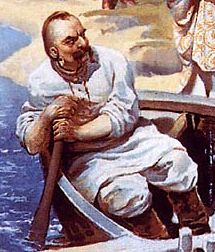
1. Leo Diaconus (p. 156) says that
22,000 Russians (i.e. Ruses) remained, 38,000
having perished in the war. These numbers might well be true (It
is inconceivable that Svyatoslav could hire so many Viking mercenaries for his campaign,
they were too expensive. Allowing for liberal 5,000 Viking mercenaries, 45,000 of his
army mast have come from local Türkic nomadic population, probably a mixture of mounted
Oguz, Bosnyak/Besenyo (i.e. Kipchak), and Bulgar (i.e. Ogur) tribes, which would explain
his impressive successes).
214
Their conversation was very short, but the two mortal enemies were enabled to see one another — the Swede (As we can see, rather a Swedish Türk or a Türkic Swede, possibly via his mamma Helga) that ruled over Russia (i.e. Rus) meeting the Armenian Emperor of the Romans, after this long contest for the land of the Bulgarians. [1]
And so Svyatoslav returned sadly towards Kiev, sailing in his little ships down the Danube and along the coast to the mouth of the Dnieper. Then he began his laborious journey up the river through the territory of the Petchenegs (Bosnyaks). Winter overtook him there, and cold and hunger added to his humiliations. Meanwhile the Petchenegs (Bosnyaks), forgetting the troops that they had sent to help him, and rejoicing in his downfall, waited hungrily by; they could not believe that he was bringing back no treasure from the war (To bring booty to be divided between participants of the campaign was his mortal obligation to each and every nomadic tribe that he had engaged in the campaign). The old Imperial ambassador, Philotheus of Euchaita, was at the Court of Kouria, chief prince of the Petchenegs (Bosnyaks), making a separate peace in which they promised never to cross the Danube. But when he asked them in the Emperor’s name to be merciful and let the Russians (i.e. Ruses) through, they angrily refused. In the early spring Svyatoslav moved on up the Dnieper. At the great Cataracts the Petchenegs (Bosnyaks) lay in ambush, and as he came they fell on him and slew him. Of his skull they made a drinking-cup, even as Krum had done with the skull of an Emperor. [2]
John’s return home was very different. He rested in Dristra, rechristening it Theodorupolis, after the saint that fought by his side; then he journeyed southward in glory, the royal family of Bulgaria following in his train.
1. The main source for the campaign is Leo Diaconus (pp. 105-159),
whose account is very full and who himself was alive at the time. Scylitzes’s account (Cedrenus, ii.,
pp. 392 — 413) is less detailed, but provides one or two additional facts. Zonaras merely recapitulates him
(iii., pp. 523 — 32). La Chronique dite de Nestor (pp. 53-59) is crude and over-patriotic, but brings
out facts such as Olga’s (i.e. Helga) restraining influence. There is an excellent modern critical account of the war in
Schlumberger’s Epopée Byzantine, vol. i. chapters i-iii.
2. La Chronique
dite de Nestor, pp. 59 — 60, saying that the Greeks provoked the attack. Cedrenus ii.,
p. 412, shows that the opposite was the case. Philotheus of Euchaïta is called here
Theophilus of Euchaïta.
215
All Eastern Bulgaria lay in his power, from Preslav-on-the Danube and the new Theodorupolis, to Philippopolis and the Great Fence frontier to the sea. Soon, he hoped, he might confirm his rightful power over the turbulent poorer provinces of the west. In the meantime he celebrated his triumph in Constantinople. A long and splendid procession wound from the Golden Gate down the Triumphal Way to Saint Sophia. After rows of warriors and captives, there came a golden chariot in which was borne the most precious of all the spoils, the icon of the Virgin of Bulgaria.
Whence this icon came we do not know, but the Emperor revered it exceedingly and draped it in the Imperial mantle of the Tsars. Behind it rode the Emperor John on his white horse; and after him, on foot, there came the Tsar of the Bulgarians. At the cathedral John laid the icon and the crown-jewels of Bulgaria on the altar of God’s Wisdom; the crown itself was a thing of marvelous richness and beauty. The Court then moved to the palace, and there, before all the dignitaries of the Empire, Boris of Bulgaria abdicated his throne. [1]
Vengeance had fallen on the seed of Krum and of Symeon. The Empire in the end had conquered. The Emperor treated the fallen monarch kindly; he was given the title of Magister, and took his place amongst the Imperial nobility. His brother Romanus was made a eunuch (Castrated to prevent pretensions, in a loving Christian spirit). [2] The abdication of the Tsar had released the Empire from its legal obligations; the Emperor could declare Bulgaria to be forfeited to himself. At the same time he abolished the independence of the Bulgarian Church.
1. Leo Diaconus, pp. 158-9: Cedrenus, ii., pp. 412-13.
2. Ibid., loc. cit. When Romanus was captured and when he was
castrated are alike unknown. He appears as a eunuch a few years later (Cedrenus, ii., p. 435), having
been castrated by the Paracoemomenus Joseph. Boris’s two children were probably daughters, as
we hear no more of them.
216
A quiet end was given to the patriarchate of Preslav, whither the see had been moved after the death of Damian of Dristra. [1] Bulgaria, like any other province of the Empire, should depend on the Oecumenical Patriarch of Constantinople.
In Eastern Bulgaria, by the old capitals of the Balkan invaders, men were too warworn to protest. But Bulgarians still lived on the slopes of Vitosh and of Rila, and in the valleys and lakesides of Albania and Upper Macedonia. There the Russians (i.e. Ruses) had never come spreading desolation, nor the Emperor in all his might to combat them, and to reap the harvest that they had sown with blood. There the Bulgarians were proud and unconquered, scorning the decrees that were issued on the Bosphorus.
The house of Krum had faded in ignominy; but, even as the afternoon was passing into night and the shadows had gathered, the sky was lit up in the west with golden and with red.
Danube Bulgaria suffered the Rus' Svyatoslav occupation for 3 years, 969-972, and Byzantine occupation for 14 years, 972-986
Samuel restored Bulgarian control over the whole Bulgarian territory in 986
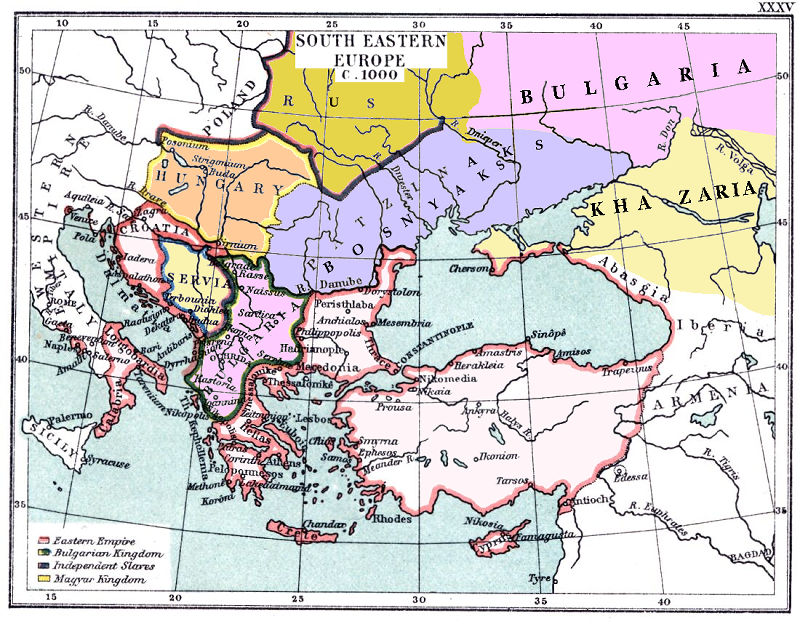
1. See above, p. 182, and references given there.
217
CHAPTER III
The end of an empire
In the west of Bulgaria, at the time of the Russian (i.e. Rus) invasions, there lived a count or provincial governor called Nicholas. By his wife Rhipsimé he had four sons, whom he named David, Moses, Aaron, and Samuel; to the world they were collectively known as the Comitopuli, the Count’s children. [1] Of what province Nicholas was governor we do not know, nor when he died. By the time of the abdication of Tsar Boris, his sons had succeeded to his influence; and to them the Western Bulgarians looked to preserve their independence.
Of the history of this revolution we know nothing. The Emperor John Tzimisces was apparently unconcerned by troubles in Bulgaria after his victory at Dristra. His attention was mainly turned to his eastern frontier. We only hear that, following the old Imperial policy, he established large numbers of Armenians, Paulician heretics, round Philippopolis and on the borders of Thrace. [2] This would dilute and weaken the Slavs; but it weakened them chiefly in the one way which as a pious Emperor he might regret — it increased the vigor of the Dualist heresy. To the provinces further to the west he paid no attention.
| Time to time S.Runciman pays a lip service to nationalistic distortions and falsifications, but that does not prevent him from trotting the same paths. No doubt that the wars and blows weakened the Danubian Türkic Bulgars, but to pretend that they evaporated from the face of the earth, and that in the 10th c. Danube Bulgaria was a Slavic state is exactly the same distortion, contrasted by the facts S.Runciman unwittingly supplies. |
1. In Drinov (op. cit., p. 88) and Jirecek (Geschichte,
pp. 173, 186, 189), and other works, we hear of a certain Shishman who was the father of the Comitopuli. His existence is
deduced solely from a list of the Tsars of Bulgaria interpolated probably as late as the eighteenth
century, in the Register of Zographus (see Zlatarski, op. cit., pp. 638-9). The Charter of Pincius (see Farlati’s Illyricum Sacrum,
iii., pp. 111-12), calling the Tsar ‘Stephen’ in 974, is equally suspicious
(Zlatarski, loc. cit.). The names Nicholas and Rhipsimé are given in a deed of Samuel’s (op. cit., p. 637),
and in Bishop Michael of Devol’s MS of Scylitzes (Prokic, Die Zusätze in der Handschrift des Johan.
Scylitzes, p. 28.)
2. Cedrenus, ii., p. 382.
218
It was only after his death, in January 976, that statesmen at Constantinople fully realized the fact that, not only were there large numbers of Bulgarians quite unconquered, but they were restively and aggressively airing their independence.[1]
Already they had looked around for foreign support. At Easter time in 973 the old Western Emperor, Otto I, was at Quedlinburg, receiving embassies from many varied nations; and among them were envoys from the Bulgarians (Which Bulgarians, Danube Bulgarians, Pannonia Bulgarians, Khazar Bulgarians, Itil Bulgarians, or non-affiliated Bulgarians?). But Otto was dying, and his son had other cares. Nothing came of this mission. [2]
Meanwhile, at home, Samuel, the youngest of the Comitopuli, was establishing himself in sole supremacy. How the brothers organized the independent kingdom is uncertain; possibly they each took over a quarter of the country and ruled it as some form of a confederacy, with David, the eldest, as their head. [3] Fortune, however, favored Samuel. David was soon killed by Vlach brigands at a spot called the Fair Oak Wood, between Castoria and Prespa, in the extreme south of the kingdom.
Moses set out to besiege the Imperial town of Serrae (Seres), probably in 976, on the news of the death of the terrible Emperor John; there a stray stone cast by the defenders ended his life. [4]
1. Cedrenus, ii., p. 434, says that the Comitopuli revolted on John
Tzimisces’s death; but we know that they were independent in 973 (see below). Probably the West
Bulgarian question lay dormant, till on John’s death the Bulgarians became actively aggressive. Drinov’s
theory (loc. cit.) of an independent Western Bulgaria that seceded in 963 depends on the existence
of the mythical Shishman and on a paragraph in Cedrenus, ii., p. 347, which has clearly
been interpolated out of place. Drinov has, however, been copied by Jirecek and Schlumberger and
the Cambridge Mediaeval History (Maybe not adequately
supported by written accounts, the rise of Comitopuli is consistent with the historical
trends, when a demise of a ruling house brings a rise of previously autonomous rulers.
The related examples are numerous, and the production of the isgoi lines under Lateral
Succession order furnishes an abundance of suitable candidates with royal blood:
the rise of Shambat/Samo, the rise of Kurbat, the rise of Asparukh, the rise of
Krum, the rise of Svyatoslav line, the rise of Almush - they all follow the
same scenario).
2. Annales Hildesheimenses, p. 62. An embassy from Constantinople arrived at the same time.
3. Zlatarski (op. cit., p. 640) definitely divides up the country
between them. I think that rather too confident.
4. Cedrenus, ii., p. 435. He mentions Aaron’s death at the same time
as David’s and Moses’s, though actually it occurred later. The legend of David’s retirement, as the
sainted Tsar David, into a monastery, given in Païssius (Istoriya
Slaveno-bolgarskaya , pp. 33, 63, 66, 70), and in Zhepharovitch’s Stemmatigraphion (eighteenth-century works, though compiled from
older sources), is obviously of no historical value. See Zlatarski (op. cit., pp. 646-7)
(Consistent selective discounting of the sources is perilous for
the investigator, that's how the enthusiastic re-writers of history operate).
219
Aaron had a gentler temperament than his brothers, it seems, for it was his pacifism that was to prove his ruin in the end. At the moment he was content to play second fiddle to Samuel, who probably by the year 980, if not before, was enjoying the title of Tsar. [1]
From the Peace of Dristra till his death in 976 the Emperor John had ignored the west, though probably he intended to deal with it later, when an occasion should arise. On his death the young Basil II, already for thirteen years a nominal Emperor, succeeded to the full authority. But for four years Basil’s hands were tied by the great rebellion of Bardas Sclerus in Asia. Even till 985 his position was insecure; he himself was gay and careless, while all his ministers and generals plotted against him.
These years gave Samuel his opportunity. Already in 976 the Comitopuli had been aggressive enough to attack Seres; and, though that attack failed, under cover of such action they were able to establish themselves over all of Peter’s former Empire west of a line drawn south from the Danube considerably to the eastward of Sofia; though Philippopolis lay to the east of it. At the same time Samuel sought to add prestige and spiritual force to his dominion by refusing to acquiesce in the extinction of the independent patriarchate.
1. For Aaron’s career see below, pp. 230-1. With regard to Samuel, I
think that he already called himself Tsar by the time of Boris’s and Romanus’s escape (see below, pp.
220 -1); but Constantinople never recognized the title (Which is
little relevant to his title. Relevant is the undisclosed procedure of raising to
the throne, that traditional procedure of selection, voting, and raising on a felt carpet
was the anointment that made supreme leaders; also is left in the shade the role of the
maternal dynastic tribe led by the Prime Minister, who represents the people of the
country. That the traditions were followed and they provided legitimacy is demonstrated
in the previous generation, with bypassing ineligible Michael and the prominence of the
maternal dynastic tribe led by the Prime Minister George Sursubul. In metamorphosed form these traditions survived as Szlachta
traditions well into the 18th c.).
220
The old seats, Dristra and Preslav, were no longer available; but, it seems, a Patriarch, called Gabriel or Germanus, was established first in Sofia, and later moved to Vodena, and thence to Moglena and to Prespa; on his death his successor, Philip, had his seat at Ochrida. [1] These peregrinations probably coincided with the movements of Samuel’s Court, which, after visiting Sofia and Vodena, settled for about the last fifteen years of the century at Prespa, and soon after 1000 moved to Ochrida, the holy city of Clement and of Nahum, the real centre of Western Bulgarian civilization. [2] The presence of a patriarchate under his close control must have greatly strengthened Samuel’s hands, especially as Samuel, unlike Peter, could not be suspected of leanings towards the Greeks. But Samuel also seems to have dealt tactfully with the Bogomils. We have no direct evidence; but throughout his career he seems never to have come into collision with the people. Probably the aristocracy of his realm was more Slav than Bulgar, and therefore there was less cause for friction than there had been in Peter’s reign, round the old Bulgar capitals. Possibly, too, the Bogomil heresy never penetrated far into Macedonia, where Clement had established the orthodox faith on more popular foundations. Samuel’s consolidation was very nearly wrecked by an embarrassing escapade on the part of the sons of Peter. Soon after the Emperor John’s death the ex-Tsar Boris and his brother Romanus escaped from Constantinople and set out for Samuel’s court at Vodena. It would have been difficult for Samuel to know how to receive his former sovereign; and Boris probably did not realize that he was seeking refuge with a rebel. However, fate intervened.
1. In Ducange’s List of Bulgarian Archbishops (op. cit., p. 175),
Gabriel-Germanus, the first after 972, resided at Vodena, then Prespa. In Basil II’s ordinances about the
Bulgarian Church, quoted in Gelzer (in Byzantinische
Zeitschrift, ii., pp. 44 — 5), Sofia (Sardica, Triaditza, or Sreditza), Vodena,
Moglena, and Prespa appear as having been seats of the patriarchate. Gabriel’s
successor, Philip, is placed in Ducange’s list (loc. cit.) at Ochrida.
2. Zlatarski (op. cit., p. 640) makes Sofia Aaron’s capital; but I do
not think that the land was divided up so definitely. I think that the capital moved with the patriarchate.
By 986 (the capture of Larissa), Samuel’s capital was Prespa (see below, p. 222; also Presbyter Diocleae,
p. 294). By 1002 it was Ochrida (see Zlatarski, Istoriya, i., 2, pp. 702-3).
221
As the brothers reached a wood on the frontier, a Bulgarian outpost took them to be Imperial spies; and Boris was shot dead by a Bulgarian arrow. Romanus managed to save his life, hastily explaining who he was. At first the soldiers received him with enthusiasm as their Tsar. But their zeal died down when they learnt that he was a eunuch, and they took him to Samuel. It has always been a cardinal principle that no eunuch can sit upon a throne, so Romanus by himself presented no difficulty (S.Runciman refers to the Türkic cardinal principle and belief that mental and physical capability embody the blessing of the Almighty, and vice-versa, a principle formalized in the Lateral Succession order, where the most potent candidate is selected to lead the state. In Byzantine, this ancient Tengrian tradition where the Emperor is seen as a reflection of the Heavenly Authority, degraded into a notorious trait with its culture of political mutilations).
Samuel took him into his service and gave him various honorable positions. [1] Secure in his own dominions, Samuel soon indulged in further aggressions abroad.
All along the frontier, in Thrace and Macedonia and on the Adriatic coast, there were ceaseless and destructive Bulgarian raids.
| This little note carries a deep and hidden message. To control a territory means to
tax the people in the territory. The apointment of local governors serves the purposes of
taxation; the people, and principally their leaders who were responsible for collections
need to reorient themselves to a new parasite on the block, and the parasite needs to
create an alternate collection system to substitute for the old one that does not work
any more. The process of replacement is of necessity cruel, and incites resistance
exceeding that of the previous system. Until the new system takes hold and starts
functioning without much friction, any claims to conquest are illusory. Byzantium, using Svyatoslav mercenary, temporarily removed about half of the Bulgarian territory from the Bulgarian tax collection system. The traditional collection system was organized with the use of djiens (jiens), tax collection meetings scheduled by the ruler, which combined a number of social events: market, fair, celebrations, court hearings, tax collection, census, petitions, awards and appointments, to name a few. Held after the summer harvest, djiens were ingrained millennia-old tradition that bonded rulers and ruled into a state. We have descriptions of Bulgarian and Khazarian djiens, the story with Svyatoslav papa Ugyr/Igor/Ingvar collecting twice from Agathyrs (Sl. “Drevlyans”) is a story of a djien gone bad, the Slavic annals have numerous references to other djiens. The Rus conquests mechanically replaced previous beneficiary of the djiens with a new ones, a commonplace practice in the fluid nomadic world. After Russian colonization of the Siberian space, it initially also interjected itself into the existing djien system. Frequently, the old masters did not recognize the conquest, nor the self-proclaimed right to collect what belonged to them, and continued collections uninterrupted. In such cases population fell into an unenviable position of having two masters to pay to. Over the course of the history, this scenario was repeated over and over again multiple times, some of the best described was the treaty between the Caucasian Agvans (Albans) and the Caucasian Huns after the Arab conquest of Agvania, when the Agvans, suffering from double taxation, demanded that Huns protect them from the Arab impositions, and the double taxation imposed on the Siberian population, who for centuries had to pay both to the Russians and to their old masters Enisei Kirgizes and Tele. Understanding the djien taxation system readily explains the “ceaseless and destructive Bulgarian raids”. The leaders of the Bulgarian ruling class were annihilated, but the djien system continued its life. Replacement kavkans kept making djien rounds, collecting equivalent of two pelts per household per year, and not listening to excuses, one of which could be that Byzantines have already collected the tax. Non-payment was punished with requisitions and destructions. And the Byzantine officials could only report about “those bad Slavs” and those “destructive Bulgarian raids”, and it is hard to imagine that Byzantine could control even in name any steppe areas from Thrace to Dniester, or the foothill areas. |
But from the year 980 onwards he concentrated particularly on the Greek peninsula, directing his main attention against the city of Larissa in Thessaly. Every spring, before the harvest was reaped, he led his army down into the fertile plain and sat before the city. But Larissa was defended by a wily soldier. In 980 a certain Cecaumenus, of Armenian origin, was appointed Strategus of Hellas — the theme in which Larissa was included. Each year, as Samuel approached, Cecaumenus hastily made his submission to him: until such time as the season’s harvest was gathered and the city amply provisioned; then Larissa re-announced its allegiance to the Emperor, who highly approved of this maneuver.
1. Cedrenus, ii., p. 435, who tells of the brothers’ escape and of
Boris’s death, and announces that he will tell more of Romanus later, which he does on p. 455. Yachya of
Antioch (translated in Rosen, Imperator Vasilii Bolgaroboïtsa, pp. 20 -1) amplifies the story by
saying that Romanus was proclaimed Tsar, and proceeds as though it was Romanus who conducted the war against
Basil. But Yachya apparently did not realize that Romanus was a eunuch, which would prevent
him occupying the throne. Zlatarski (op. cit., pp. 650 — 60) assumes from Yachya that Romanus
was Tsar with ‘Comitopulus’ working for him; but it was unheard of that a eunuch should
reign; moreover, Yachya, writing at a distance, clearly mistook Romanus for Samuel most of the
time, especially with regard to his death (p. 58), which is an utter muddle. I think that Uspenski is
right, in his review of Rosen’s book, not to take Yachya too seriously.
222
Samuel, who could not, or did not wish to, attempt to storm the city, thus found it, on its revolt from him, in a fit state to stand a protracted siege. And so for three years he was foiled in his ambitions against it. But in 983 Cecaumenus was recalled, and the new strategus was unwise and honest in his loyalty. When next Samuel invaded Thessaly he found the country openly hostile; so he destroyed all the crops.
After three seasons of such treatment, in 986 Thessaly was more or less in a state of famine; and when that summer he began a close blockade on Larissa, the city was soon face to face with starvation. To such straits were the inhabitants reduced that a woman was found eating the thigh of her late husband: whereupon the authorities decided to surrender. Samuel treated the population with severity, selling them all as slaves, with the exception of the family of Niculitzes, one of the local gentry. For some reason Niculitzes, who was a connection of Cecaumenus, was spared, and showed his gratitude by taking service under Samuel. [1] Amongst the captives was a little girl called Irene, whose beauty was later to raise her to a fatal eminence.
Along with the population, Samuel transferred the city’s holiest relics, the bones of its bishop, Saint Achilleus, to decorate and sanctify his new capital at Prespa. [2]
1. Cecaumeni,
Strategicon, ed. Vassilievsky and Jernstedt, pp. 65-6, written by the Strategus’s
grandson. The date is fixed by evidence provided by an anonymous writer in the same
MS, whose grandfather, Niculitzes, probably the father of the turncoat of Larissa (ibid. p. 96),
was Strategus of Hellas in 980. See preface (ibid., pp. 4, 7) and the excellent account in Schlumberger,
op. cit., pp. 622 ff.
2. Cedrenus, ii., p. 436.
223
The capture of Larissa scandalized Constantinople. Already there had been growing anxiety there about the Bulgarian menace. In 985, when a great comet trailed across the sky, the poet John Geometrus wrote an ode entitled with grim punning ‘To The Comitopulus’ in which he presaged woe and called for his great hero, the Emperor Nicephorus Phocas, to rise from the dead and save his Empire. [1] But, though Nicephorus was gone for ever, the Emperor Basil was ready to act as his stepfather’s substitute. In 985 he had disgraced the great Paracoemomenus Basil, on the suspicion of some vast plot, the secret of which has never been unraveled. [2] The strain of the experience utterly changed the young Emperor’s character. He was now aged twenty-seven. Hitherto Basil had been gay and dissipated and idle; henceforward he threw all that aside, and schooled himself into a state of relentless asceticism, unrivalled in Byzantium save among the holiest saints. He hardened his body to welcome discomfort and his mind to distrust culture. Henceforward his energy was unflagging; he thought nothing of campaigning at seasons when armies usually reposed in winter quarters; he was unmoved by horrors or by pity. He became a terrible figure, chaste and severe, eating and sleeping sparsely, clad in unrelieved dark garments, never even wearing the purple cloak nor the diadem on his head. He concentrated on one thing only, the establishment and consolidation of his own personal power, as Emperor, for the harmony of the Empire. [3] Tsar Samuel, a Bulgarian rebel in the Emperor’s eyes, [4] might well fear such an adversary, for all his own boldness and ruthlessness. But as yet the change brought no result. The Emperor was young and untried.
1. Joannes Geometrus, Carmina, p. 920.
2. This episode is admirably told in Schlumberger, op. cit., pp. 573
ff.
3. Psellus, Chronographia, pp. 16 — 19 — a portrait and character sketch of Basil II.
4. Cecaumenus, in his correspondence with the central Government,
talks of the ‘Rebel Samuel’ (Strategicon,
p. 65). According to Matthew of Edessa (p. 34), Basil ordered the Bulgarian rebels to submit in 986. Asoghic (pp. 124–5) traces the war to a story of
the Bulgarian king asking for an Imperial wife and having a substitute foisted off on to him. This must
be a complete legend.
224
Moreover, his first trial of strength against Bulgaria was disastrous. In the summer of
986, as soon as possible after the news from Larissa had reached him, he set out with a
large army into the heart of the Balkans, along the old Roman road past Philippopolis.
His objective was Sofia, the capture of which would prevent the Bulgarians from expanding into their old eastern provinces. The Emperor’s approach brought Samuel hurrying back from Thessaly, and, with Aaron and
the eunuch-prince Romanus, he marched up to defend the city. The Imperial troops
successfully passed up the River Maritsa, and through the Gate of Trajan (the Pass of
Kapulu Derbend) (Türkic kapag/kapa is “gate”, ulu is “great”, Kapulu is “Great Gate”.
The Arabic calque of “Great Gate” was Bab al-Hadid, the Persian calques were Dar-i Ahanin
and دربند Darband used from the 5th c.; how come that a Balkan Great Gate Pass
has an additional Persian term from the S.Caucasus? Apparently, Armenians could use the
Tukified form Derbend as a generic for Pass, creating a tautologous compound) into the plain in which Sofia lies; there they
encamped at a village called Stoponium, just beyond the pass, some forty miles from
Sofia, to wait for the rearguard to come up. Meanwhile Samuel had time to occupy the
mountains near the city. At last, at the end of July, Basil moved on again and
reached the walls of Sofia. But his attempted siege was marked with ill success. Owing to mismanagement or lethargy — it was the height of summer — or mere treachery,
his soldiers conducted themselves half-heartedly: while a surprise Bulgarian
attack on his foraging parties made the whole army short of provisions
(What foraging parties of the Byzantine army? The Imperial army
was roaming around robbing local populace?). After only
twenty days Basil gave the order to retreat. Already discouraged and depressed,
he had heard disquieting rumors. He had left the Magister Leo Melissenus to
guard the passes through which he came. The Domestic Contostephanus now spread a
report that Melissenus, of whom he was desperately jealous, was engaged in
deserting his post and betraying the Emperor. Melissenus had played a somewhat
equivocal part in Syria shortly before; and so the Emperor’s suspicions were easily
roused against him. Basil would /225/ not risk his throne by remaining in the depths of Bulgaria.
225
The first day of the retreat passed quietly enough; but the Imperial army, encamping that night in a wood, was reduced almost to panic by a rumor that the Bulgarians were in possession of the passes and by the passage of a brilliant meteor across the sky. Next day, Tuesday, August 17, (986) as it entered the defiles, Samuel suddenly swooped down from the mountains. The carnage was tremendous, and all the Imperial baggage was captured. The author, Leo Diaconus, was only saved by the agility of his horse. It was with a pathetically small remnant of his army that the Emperor Basil reached Philippopolis. On his way he discovered that Melissenus had remained at the passes with perfect loyalty, and that the perfidious conspirator was Contostephanus. Humiliated and angry, Basil reached Constantinople, vowing that some day he would be avenged. Giving voice to the disappointment of the Empire, John Geometrus wrote another ode, entitled ‘To the Woe of the Romans in the Bulgarian Defile.’ [1]
Of the next years we know little. Samuel apparently followed up his victory by overrunning Eastern Bulgaria, capturing the old capitals, Preslav and Pliska, and establishing his power as far as the Black Sea coast. [2] (I.e. Samuel restored Bulgarian control over the whole Bulgarian territory. Danube Bulgaria suffered Svyatislav occupation for 3 years, 969-972, and Byzantine occupation for 14 years, 972-986)
1. Joannes Geometrus, Carmina, p. 934. Leo Diaconus took part himself in the campaign, of which he gives a vivid account (pp. 171–3), though he does not mention the
treachery of Contostephanus. That is told by Scylitzes (Cedrenus, ii., pp. 436–8). Leo’s failure to mention
it does not, I think, render the story suspect. Basil would certainly try to keep it at the time from his
soldiers. Moreover, Leo mentions that there was a rumor that the passes were in Bulgarian hands.
Asoghic mentions the campaign, but with fictitious details.
2. Basil had to recapture them in his 1001 campaign (see below, p.
235). They were probably occupied now; indeed, Basil’s attack on Sofia seems to imply that Samuel was known
to be contemplating an eastern campaign.
226
Soon afterwards he turned his attention to the west, against the great Imperial city of Dyrrhachium. How, or exactly when, it fell into his hands we do not know; probably it was before the year 989. The government of the city was given to the Tsar’s father-in-law, John Chryselius. [1]
The capture of Dyrrhachium gave Bulgaria an outlet on the Adriatic, and put the country in direct touch with the West. Samuel had, it seems, already received a confirmation of his Imperial title from the Pope — probably from some creature of Saxon Emperors such as Benedict VII, at the time of the Emperor Otto II’s wars against the Eastern Empire in 981 or 982; certainly the Pope did not, or could not, insist that his recognition should be accompanied by a declaration of his spiritual suzerainty. [2] At present, however, Samuel could hope for little aid from the West.
The ruler of the West was a Greek, the Empress-Mother Theophano, sister to the Eastern Emperor Basil.
Basil had been unable to prevent Samuel’s expansion. From 986 to 989 he was distracted again by great rebellions in Asia, those of Bardas Phocas and Bardas Sclerus. The year 989 was the gloomiest of all at Constantinople. On April 7 the Aurora Borealis lit up the sky with terrible pillars of fire, presaging woe; and soon news came that the Russians (i.e. Ruses) had captured Cherson and the Bulgarians had captured Berrhoea. [3] The Russians (i.e. Ruses) soon gave up their conquest, tamed by conversion to Christianity and appeased by the gift of an Imperial bride to their Great Prince — Basil’s own sister Anna was sacrificed in marriage to Vladimir (Türkic Budimir), son of the savage Svyatoslav. But Basil could not so easily dispose of the Bulgarians.
1. Yachya (p. 27) and Joannes Geometrus, Carmina, p. 955, both make allusions to
Samuel’s aggressions in the west about 988–9. Probably these refer especially to
the capture of Dyrrhachium, which remained in Samuel’s hands till 1005. (See below, p. 239.)
2. Innocent III (Ep.,
p. 1112) refers to Samuel as having been papally recognized as Emperor.
3. Leo Diaconus, p. 175.
227
Berrhoea, situated among the foothills of Macedonia, was one of the strongest fortresses that guarded the approach to Thessalonica; and it was soon clear that the great seaport was the object of Samuel’s present ambitions.
After Berrhoea, the Bulgarians, under Samuel’s lieutenant, Demetrius Polemarchius, managed by a ruse to capture the fortress of Serbia (Selfidje) [1]; and Bulgarian marauders began to occupy the countryside right down to the Aegean coast. Things became so serious that Basil was forced into fresh action. Already in 988 he had attempted to guard against Bulgarian encroachments by establishing colonies of Armenians on the Macedonian frontier; but they had proved ineffectual. By the end of 990, however, his troubles in Asia and with the Russians (i.e. Ruses) were settled, and he could plan more drastic steps.
Early next spring the Emperor set out for Thessalonica. At the end of February he passed through the Thracian village of Didymotichum, where the old rebel Bardas Sclerus was living now in retirement. Basil went to interview him, and invited him to come to the war; but Bardas refused, on the plea of old age and infirmity — with justification, for he died a few days later, on March 7. [2] Meanwhile Basil reached Thessalonica, where he paid his vows at the altar of Saint Demetrius, patron of the city and one of the most helpful of all the saints that watched over the Empire. He also won the support of a living local saint, called Photius, who prayed for him nightly throughout his campaigns. [3]
But of these campaigns we know nothing, save that for four years the Emperor remained in Macedonia, capturing many cities, razing some and garrisoning others, and eventually returned to Constantinople with a large amount of prisoners and booty.
1. Cecaumenus, Strategicon, pp. 28–9 — undated, but this seems to be the most probable occasion. Demetrius caught the Imperial commanders bathing outside the walls.
2. Yachya, p. 27.
3. Encomium of Saint Photius of Thessalonica, quoted in Vasilievski,
Odin iz Grecheskikh Sbornikov, p. 100 — 1.
228
Among the recaptured cities was Berrhoea. [1] It is to be doubted that Basil spent all four years in the field; probably he made frequent journeys to his capital to superintend the government. We are told of various Armenian warriors who took over the command in the Emperor’s absence. All seem to have fought bravely, but in the end were worsted by the Bulgar. Foremost amongst them were princes of the dispossessed house of Taron, which for some time past had intermarried with the aristocracy of the Empire. Samuel’s movements during these years are very obscure.
Probably he kept to the mountains, following the old Bulgar practice of avoiding a pitched battle save when the enemy should be caught in a difficult position, in some valley or defile. But Basil, wilier now, never gave him the opportunity. This caution, however, kept Basil from completing his work. He never risked advancing into the wild country that Samuel made his headquarters [2]; and so, for all his booty and captured fortresses, the Bulgarian menace was only very slightly lessened when in 995 the Emperor was summoned again on urgent business to the east.
Basil left behind him, as commander on the Thessalonican front, Gregory, Prince of Taron. [3] On the news of the Emperor’s departure, Samuel came down from the mountains and advanced to Thessalonica. Deceived by the meagre force with which Samuel demonstrated before the walls, Gregory sent his young son Ashot, with too few troops, out to meet him. They were ambushed by the main Bulgarian army and for the most part slain; Ashot himself was taken alive. Gregory, hearing of it, lost his head and rashly hurried out to rescue his son.
1. Yachya, pp. 27-8. Scylitzes (Cedrenus, ii., p. 447) merely says
that Basil visited Thessalonica, to see to its defenses and pray to Saint Demetrius. Asoghic (ii., p. 145) refers
to the recapture of Berrhoea and tells of the Armenian soldiers.
2. Ibn-al-Asir (Rosen, op. cit., p. 246) says that Basil reached the
centre of Bulgaria. This probably refers to his previous campaign against Sofia, then known as Sredetz (the
centre).
3. Cedrenus, loc. cit.
229
But he too fell into a Bulgarian trap, and was butchered with almost all his army, fighting bravely. [1]
This disaster to the garrison was very serious, but Samuel did not venture to attack Thessalonica itself. Instead, after ravaging the countryside and recapturing Berrhoea, he took his prisoners back to his capital. Basil was too busy to come back to Europe himself; but he sent one of his ablest generals to command against the Bulgarians, Nicephorus Uranus, who arrived with reinforcements at Thessalonica in the course of the year 996. [2]
Samuel was spending the season of 996 in the Greek peninsula. He had held its gateway Larissa for ten years now, and he was able to advance unopposed up the Vale of Tempe and through Thermopylae and Boeotia and Attica to the Isthmus of Corinth. There was a panic in the Peloponnese; even the Strategus Apocaucus was affected by it, and fell ill from worry and uncertainty as to how he could organize a defense. It needed all the tact and spiritual gifts of Saint Nicon Metanoitë to soothe his shattered nerves. But, as everyone waited anxiously for the attack, the news came that the Bulgarian army was in full retreat for the north. [3]
1. Cedrenus, ii., p. 449.
2. Ibid., loc. cit.: Berrhoea, retaken by Basil in 991, had to be
again retaken in 1003. Samuel must therefore have recaptured it now.
3. Ibid., loc. cit.: Nicon Metanoite, ed. Lampros, pp. 74-5. This
incident must occur now (not, as Schlumberger says, in 986) — the only occasion when we know that Samuel
advanced on the Isthmus of Corinth.
230
Nicephorus Uranus had followed Samuel into the peninsula, and succeeded in recapturing the fortress of Larissa. Leaving his heavier accoutrements there, he passed on through Pharsalia and over the hills of Othrys to the valley of the Spercheus. On the far bank of the river the Bulgarians were encamped, laden with the spoils of Greece. The river was flooded from the summer thunder-showers; and Samuel thought himself secure. But by night the Imperial troops forced their way through the turgid torrent and fell upon his camp. The Bulgarians were slaughtered as they slept. Samuel and his son Gabriel-Radomir were wounded, and only just managed to escape with a few followers. Their losses were terrible; all their booty was recovered, and all their prisoners released. Uranus returned in triumph to Thessalonica, and later to celebrate in Constantinople the glory of having driven out the invaders from Greece. [1]
Yet, despite this victory, Basil could not venture on a final crushing campaign; he was still too heavily committed in Asia. And so the next few years remained probably the most splendid in Samuel’s career. After the first shock of his defeat he had written to the Emperor offering to submit on terms; but soon he withdrew his offer, realizing that he was not at the moment to be attacked. According to a rumor current in Antioch, he was negotiating when he heard that the rightful Tsar (Romanus, son of Peter) had died in captivity at Constantinople. He at once broke off the negotiations and proclaimed himself Tsar. But Romanus, so far from being a Tsar imprisoned in Constantinople, was a eunuch in Samuel’s own service, and lived on for many more years. Probably it is now that we must place the story told earlier by Scylitzes of Samuel’s last surviving brother, Aaron.
Aaron, more peaceful than Samuel, urged for terms to be made with the Empire, and probably succeeded in winning the support of a large proportion of the Bulgarians.
1. Cedrenus, loc. cit. Sathas, Chronique de Galaxidi, and Schlumberger
(op. cit., ii., pp. 139 ff.) place here the story of the Bulgarian attack on the village of Galaxidi on the
Gulf of Lepanto. See above, p. 174.
231
His influence and his policy were alike distasteful to Samuel; and so he was taken and summarily put to death with all his children, save one son only, John Vladislav, who was saved by his cousin Gabriel-Radomir. Thus Samuel was left sole and undisputed Tsar; but the news reached the eastern frontier of the Empire in a rather vague form, which the local historians amended in their own imaginative way. [1] Samuel’s ruthlessness cowed the peace party; and so when he decided to break off relations again with the Emperor there was no opposition left. The internal history of Samuel’s reign is a blank to us. We only know of his system of taxation, namely that every man to possess a yoke of oxen was obliged to pay yearly a measure of corn, a measure of millet, and a flagon of wine.[2] This was no doubt a very old Bulgarian system. It seems that the people, Bogomils as well as orthodox, made no complaint against his rule, either from indifference or from terror. His lieutenants, on the other hand, used all too frequently to betray him. This was probably due to the greater prospects of material comfort and luxury that the Empire could offer; for Samuel’s Court in the Macedonian mountains was lacking somewhat in refinement. The Comitopuli do not seem to have extended the same patronage over letters and culture as did the monarchs of the house of Krum. On the other hand, Samuel was a great builder. Not only did he throw great fortifications round his strongholds; but from these years date several churches, still standing in part to this day. Near Prespa the Church of Saint Germanus, and the church built on the island to hold the relics of Saint Achilleus from Larissa, and in Ochrida — which became his capital soon after the turn of the century — the Churches of Saints Constantine and Helena and Saint Sophia show his architectural zeal.
| Historian S.Runciman finally gets to the fundamentals of the state, the taxation system. It is clear that taxation applied to the sedentary agriculturists tilling the land with yokes of oxen, supposedly predominantly Slavs, with a substrate of pre-Slavic Thachians and Illirians, and with exclusion of the nomadic Türkic population and of the ruling class. Monetarily, the size of the tax is not too far from the Khazarian tax of two pelts from a household, the pelts being monetary units of the time in the parts of Europe ruled by the Huns' descendent states. The scale of monetary exchange can be clarified by later reforms, see Eric R Schena Russian Monetary System. |
1. Yachya (in Rosen), p. 34: Cedrenus, ii., p. 435. I do not think
that Yachya deserves much credence with regard to Bulgarian affairs. Scylitzes’s account is much more likely
to be true. We know that Aaron was living in 986 (from Michael’s MS of Scylitzes, Prokic, p. 29).
This seems to be the most likely occasion for his pro-Greek policy to have been a menace, and also
his death may well provide the origin of Yachya’s story.
2. Cedrenus, ii., p. 530. Basil continued this system.
232
The devastations and improvements of subsequent generations make it hard now to pronounce upon their style. They appear to belong in temper to the provincial Byzantine school, as opposed to the Imperial school of Constantinople — a school in close touch with Armenian architecture. Possibly Samuel’s architects were Armenian captives from the colonies in Macedonia; but more probably these churches represent the first ambitious artistic efforts of the native Bulgarian-Slavs.
| The nearly contemporaneous stone construction in Rus was generally done by Türkic Bulgarians from Eastern European Bulgaria (later called Itil Bulgaria), who established the Rus stone construction tradition. |
Comforts might be crude, but there was romance too in the Bulgarian Court. The Tsar, by his wife Agatha Chryselia, had several children whose wild passions brought love into Bulgarian history. Samuel had brought Ashot, the captive Prince of Taron, to his capital and kept him there imprisoned. But Miroslava, the Tsar ’s eldest daughter, caught sight of him and lost her heart. Vowing to kill herself unless she became his bride, she secured his release. After their marriage, Ashot was sent by his father-in-law to help in the government of Dyrrhachium. They betrayed the Tsar later. [1]
About the same time — probably in 998 — Samuel, checked for the moment in the south and the east, determined to expand to the north-west, along the Adriatic coast; the possession of Dyrrhachium showed him the value of being an Adriatic Power.
He was too cautious to attempt, like his predecessors, to conquer the valleys of inland Serbia; instead he kept to the coast, where an excellent opportunity was given to him. The principality of Dioclea, modern Montenegro, was suffering from the weak rule of a child, Vladimir. Samuel invaded his country, capturing the town of Dulcigno and the person of the young Prince without any effective opposition.
1. Cedrenus, ii., p. 451: Prokic, p. 29.
233
Vladimir was sent into captivity at Prespa, and Samuel moved northward and made himself suzerain of Terbunia, the principality that lay next along the coast. In consequence of this Bulgarian aggrandizement, the Emperor Basil, who could not afford to maintain squadrons so far away, formally handed over the policing of the Adriatic to his loyal vassal-state of Venice. [1]
Again one of Samuel’s daughters intervened. Like her sister, the Princess Kosara was stirred by the thought of a handsome young captive; and before long she fell in love with the Dioclean (Karatag/Montenegro) prince. Samuel listened to Kosara’s prayers; Vladimir was released and restored to his throne, with Kosara as his consort. At the same time Vladimir’s uncle, Dragomir, was established in Terbunia. Both the princes acknowledged the overlordship of the Bulgarians, and Vladimir at least abode loyally by his fealty. [2]
The fame of Samuel’s prowess reached even to the Magyars; and their king, Saint Stephen of Hungary (967–1038, House of Arpad), sent to make an alliance with Bulgaria. Its terms were somewhat vague, but they were sealed by a marriage-alliance; Stephen sent his daughter to wed Samuel’s son and heir, Gabriel-Radomir (This is a very significant arrangement in Türkic traditions, the Hungarin Stephen was becoming a father-in law of the Bulgarian Crown Prince, with all respect and primacy befitting this relationship. In essence, it is an acceptance of a form of a vassalage by the Danube Bulgaria upon the rise of the Crown Prince to the throne). But the Hungarian girl was not as lucky in love as were her sisters-in-law. There was at the court of Ochrida a slave called Irene, who had been captured as a child at the fall of Larissa, a creature of marvelous beauty. The Princess, probably all too well endowed with the looks of her father’s race, the race that gave its name to ogres, could never hope to rival the radiant Greek captive (This is certifiably the ugliest statement of the whole monograph, displaying both xenophobia and utter ignorance. Stephen of the House of Arpad branch of the House of Dulo, and Samuel of the Asparukh branch of the House of Dulo or some other Türkic Bulgarian dynastic tribe were remote offshoots of same cultural, if not genetic, roots, and the derision applied to one is as easily applicable to another. Both branches ascend to the same Ogur Hunnic family of tribes, which in S.Runciman's allusion produced the Latin Orcus (Hades) from the noun/ethnonym Ogur. The “radiant Greek captive” from Larissa may have had not a single drop of the “Greek” blood, while the distance of 360 years from their Kurbat forefather implies about 15 generations infused with all kinds of admixtures, the undoubtedly included ethnically Greek contributions).
1. Presbyter Diocleae, pp. 294-5. Undated, but it probably was the
cause of Basil’s formal cession of the Adriatic to Venice (Dandolo, p. 227).
2. Ibid., loc. cit.
234
Gabriel-Radomir forgot his wife’s high lineage, that her father was a king and her mother a princess of the Imperial blood of the West, and left her for the low-born Irene. Samuel, always sympathetic to his children’s passions, condoned the desertion and recognized the marriage with Irene — the Hungarian alliance was of very little value. Of the further fate of the Princess, nothing is known. Deserted and divorced, in this wild Court far from her home, she probably sought refuge in a convent. One son was born of her marriage, Peter Delean, who probably died young; many years later, after the fall of his dynasty, he was impersonated by an ambitious but unsuccessful rebel against the Emperor. [1] But while these lovedramas were still incomplete, probably even before the Hungarian marriage, the Emperor Basil returned to the field. In about 998 Samuel’s cause had seemed so flourishing that several of the European nobility of the Empire contemplated deserting to his allegiance. Basil was informed, and arrested two of them at Thessalonica, the Magister Paul Bobus and the Protospatharius Malacenus, and deported them — the latter to Asia, the former to Constantinople; whereupon some of the intending traitors at Adrianople, Vatatzes and Basil Glabas, fled at once to Samuel. Basil imprisoned Glabas’s son for three years, but could take no other action. [2] It is probable that Nicephorus Uranus continued to lead yearly expeditions against the Bulgarians, but we know nothing of them. In the spring of 1001, however, Basil made peace on his eastern frontier and was able to turn his full attention to the west. For four years he campaigned regularly in Samuel’s dominions. [3]
1. Cedrenus, ii., p. 529: Prokic, pp. 31, 36.
2. Cedrenus, ii., pp. 451-a.
3. In Cedrenus (ii., p. 452) the first campaign is dated 999; but we
know from Yachya (in Rosen, p. 42), who is very reliable about eastern affairs, that Basil did not leave the
east till 1001. Cedrenus must therefore be two years out throughout these four years.
235
The first of these campaigns, in 1001, was directed against Sofia. Making Philippopolis his starting-point — he left it strongly garrisoned under the Patrician Theodorocanus — he marched through the Gates of Trajan, and captured many castles round Sofia, though he did not attack the city itself, before retiring to winter at Mosynopolis, the modern Gumuldjina, in southwestern Thrace. The reason of this campaign was to cut Samuel off from his eastern provinces; and so next year Basil sent a large army under Theodorocanus and the Protospatharius Nicephorus Xiphias to conquer the districts between the Lower Danube and the Black Sea, the old centre of Bulgaria. He himself probably waited near to Sofia, to intercept any help that Samuel might send. The maneuver was successful; the former capitals, Little Preslav, Pliska, and Great Preslav fell once more into the Emperor’s hands. [1]
In 1003 Basil struck in Macedonia. As his great armament approached Berrhoea, Dobromir, the Bulgarian governor, took fright and surrendered without a struggle.
Basil always attempted to attach former Bulgarian commanders to the Empire by giving them titles, and sometimes posts in provinces far enough away for them to be able to do no harm. Dobromir was honored with the dignity of Anthypatus and sent to Constantinople. From Berrhoea the Emperor attacked Serbia. The town was defended by Niculitzes, the traitor that Samuel had spared at Larissa. Niculitzes made a valiant resistance, but in the end the town was taken. Basil treated the defenders leniently; despite Niculitzes’s past history, he was made a Patrician, and accompanied the Emperor back to Constantinople, some time in the summer of 1003, when Basil thought it advisable, after his recent successes, to pay a short visit to his capital.
1. Cedrenus, loc. cit.
236
But the fierce traitor could not be won by a title. After a few days he escaped and made his way back to Samuel. Samuel, in the
orthodox Bulgarian fashion, had remained in the mountains during the Emperor’s
invasion, resolutely avoiding any pitched battle. On Basil’s departure he came down
with his army, and with Niculitzes, attempted to recover Serbia. But Basil was
well informed, and moved swiftly. Forced marches brought him back to the borders of
Thessaly; and Samuel and Niculitzes fled. The latter was soon captured in an ambush
and sent to imprisonment in Constantinople. A few years later he escaped once
more. The Emperor spent the next month or two in Thessaly, rebuilding the castles
that the Bulgarians had destroyed and recapturing those that they still held. The
Bulgarian garrisons were sent to colonize the district of Volerus, where the
Maritsa flows into the Aegean Sea. From Thessaly Basil turned northward, to the great
fortress of Vodena, placed on the edge of the high Macedonian plateau, by where the
river of Ostrovo falls in grand cascades into the valley below. A Bulgarian called
Draxan made a valiant defense, but in the end was forced to surrender, probably
in the late autumn. The garrison was sent to fill up the colony at Volerus, but
Draxan obtained permission to reside at Thessalonica. There he married the daughter of
one of the chief clergy that attended to the shrine of Saint Demetrius. His
subsequent history was strange. After two children had been born to his wife, he suddenly
fled to the Bulgarian Court. He was soon recaptured and pardoned, on his
father-in-law’s intercession. But shortly afterwards he repeated his flight, with the
same result. He then waited in Thessalonica until two more children were born: whereupon
he fled once more. This time the Emperor’s patience was exhausted. When he was recaptured, he was summarily impaled.
237
In 1004 Basil determined to complete the conquest of Danubian Bulgaria, and very early in the year [1] set out to besiege Vidin (Bichin - “Monkey”, after the Year of Monkey, year 492 AD), on the Danube, the easternmost fortress left to Samuel. Against these well-organized and carefully led expeditions Samuel could do nothing, but now he attempted a diversion that almost succeeded in forcing the Emperor to raise the siege. On August 15, when the citizens of Adrianople were on holiday, celebrating the Feast of the Assumption of the Virgin, the Bulgarians suddenly fell upon the city.
Adrianople was utterly taken by surprise; no one had ever expected Samuel to advance so far from his centre. He massacred and destroyed without hindrance, and then retired as suddenly as he had come, with a long train of prisoners and booty.
But this brilliant foray was too late; Vidin, after an eight months’ siege, was on the point of falling. Basil waited until he could storm the city, probably early in September; then, garrisoning it strongly, he hastened southward to catch the Bulgarians on their return. His march, up the Timok and the Morava, through hostile, unconquered country, was as bold an achievement as Samuel’s to Adrianople.
The Emperor caught up the Tsar and his army near Skopie (Uskub), on the banks of the Vardar. The river was in flood; and Samuel had not learnt his lesson sufficiently at the Spercheus. The two armies encamped on either bank, the Imperial troops with due precaution, the Bulgarians with an insolent carelessness, confident that the river could not be crossed. But a Greek soldier found a ford that was passable; and the Emperor crept over secretly at the head of his troops. The Bulgarians were too suddenly surprised to attempt to fight; they all hastily fled in confusion, Samuel amidst them. The Tsar’s own tent was captured, and the camp, with all the booty from Adrianople, fell into the Emperor’s hands.
1. Probably in January, as Vidin fell after an eight months’ siege
soon after the raid on Adrianople. Basil, as Psellus tells us, thought nothing of campaigning in the depths
of winter.
238
After the battle, the Bulgarian governor of Skopie came down to hand over the keys of his city to the Emperor. It was Romanus, the eunuch son of Peter, last scion of the house of Krum. [1] Basil received him gently and created him a Patrician. He finished his strange career as governor of Abydos.
From Skopie Basil marched eastwards to attack the castle of Pernik, which commanded the upper valley of the Struma. But Pernik was impregnably placed and magnificently defended by the ablest of Samuel’s generals, Krakra. Basil, after losing many of his men, and finding Krakra to be incorruptible, abandoned the siege and moved back, late in the winter of 1004, to his headquarters at Philippopolis.
Thence he soon returned to Constantinople. [2]
Thus in four years Samuel had lost half his Empire. From the Iron Gate of the Danube to Thessalonica all the east of the Balkan peninsula was in the Emperor’s hands, except only for Sofia and Strumitsa and a few castles around Pernik and Melnik in the western slopes of Rhodope; and Imperial garrisons were stationed on the borders of Thessaly and along the River Vardar. The campaign had been among the most glorious in the history of Byzantine arms; it had shown that the Imperial troops, when they were ably led, were still the finest machine for warfare that the world at that day knew; it had shown that the Bulgarians, for all their courage and ardour, their ruses and their traps, were no match for them now.
Citation from Sh.S.Kamoliddin
Ancient Türkic Toponyms of the Middle Asia,
Tashkent, Shark, 2006, p. 29, ISBN 978-9943-00-003-2 on etymology of -dar in Vardar (Türkic name Kuba-dar): |
1. We hear now that he was also called Symeon, after his grandfather;
but there is no reason to suspect him of being any other son of Peter than the eunuch Romanus
(Exept that Peter could have had numerous other sons, and one of
them could be called Symeon, after his grandfather).
2. Cedrenus, ii., pp. 452-6, for the whole campaign.
239
Samuel, like every great Bulgar general, had avoided pitched battles, trusting to his speed and to ambushes and sudden descents; but now he had to face an adversary that could make forced marches across the wildest enemy country and yet never now be caught unguarded in a valley or a mountain-pass — an adversary, too that had rid himself of distractions, that had determined not to cease from fighting till Bulgaria should be no more. Even Samuel’s own followers were beginning to see the true state of things. In 998 Imperial magistrates had broken their allegiance to pay homage to him, as the rising sun; but now, with treacherous foresight, his own officials were beginning to transfer their services to the Emperor. Every desertion was a heavy blow to him; it was on his governors and generals and the soldiers that they commanded that his whole strength lay. The common people, it seems, were too poor or too indifferent or, as Bogomils, too conscientiously passive, to help or to hinder his cause. [1]
The cursory description of Samuel's tactics conclusively points to his army as typical Türkic nomadic army, testifying that at the end of the 10th c. the Danube Bulgarian state was firmly rooted in the Türkic nomadic tribes. It is their tribal leaders that were exhausted or depleted by the continuous warfare, and sought to preserve their tribes by gaining a period of peace. The Samuel's tactics also points to diminished size of his forces, his first strategic objective was to preserve his army. The weak spot of cavalry armies are their horses, they need pastures, and a base of large herds to draw on for replacements. Extended pitched campaigns on attrition invariably exhaust the strength of the cavalry. Of necessity, the nomadic campaigns must be short and explosive, with extended recuperation breaks. The warriors' loss of horses forces their spontaneous disbanding back to their homes. |
Samuel, though as yet no foreign army had reached the high lakes where he held his Court, might well feel apprehensive of the future.
In 1005 the canker of treachery entered into the heart of his family. His daughter Miroslava and her husband, Ashot the Taronite, fled from Dyrrhachium, where he held a command, to Constantinople. Ashot had long yearned to return to his former home, and had persuaded the Princess that a wife’s duty ranked before a daughter’s. But Miroslava was not the only traitor in the family. Ashot brought with him to the Emperor a letter from the Tsar’s own father-in-law, John Chryselius, who was left in charge of the fortress. John offered to hand Dyrrhachium over to Imperial troops in return for money for himself and the title of Patrician for both his sons.
1. The whole internal history of Samuel’s reign is so unknown that
even such generalizations must be qualified. It seems, however, that Samuel never became nor has become a
popular national hero, as Symeon did: though Symeon did infinitely more harm to his country.
240
The offer was accepted; and the Patrician Eustathius Daphnomelas took a fleet to the Adriatic and received back the city. Ashot was made a Magister, and Miroslava a Girdled Patrician, becoming thus one of the greatest ladies at the Imperial Court. [1]
The loss of Dyrrhachium hit Samuel hard, both in his affections and his power. He had no outlet now to the western sea, save through Dioclea, the territory of his faithful son-in-law, Vladimir.
The story of the next nine years is lost in obscurity. From 1006 onwards it seems that the Emperor Basil yearly invaded Bulgaria [2]; and in 1009 there was a battle at a village called Creta, probably somewhere near Thessalonica, where he heavily defeated Samuel. [3] All through these years the Imperial troops were pressing nearer and nearer to the centre of the Tsar’s dominions. Only the mountains of Upper Macedonia and Albania remained in Samuel’s hands, and the valley of the Upper Struma, where Krakra held out. It was probably from Krakra that Samuel learnt that the Emperor journeyed each year on his way to the war through the narrow pass of Cimbalongus, or Clidion, that led from Seres into the upper valley of the Struma. Samuel conceived the plan of occupying this pass, and thus either checking the Emperor on his way or forcing him to make a detour that would leave the enemy strongly entrenched in his rear. In 1014 Samuel carried out his scheme, and took possession of the pass, fortifying its entrance with wooden palisades.
1. Cedrenus, ii., p. 451. He tells of it out of its place, after
talking of Ashot’s capture and marriage. The date, however, is supplied by Lupus Protospatharius, writing at Bari,
just across the sea (ad. ann. 1005, p. 41). The Theodore whom he mentions as having carried out the
transaction was no doubt a son of the aged John Chryselius. It is uncertain who really commanded
Dyrrhachium. It seems unlikely that John was placed under his foreign grandson-in-law, though
Cedrenus implies so, merely calling Ghryselius one of the chief magistrates, though in Bishop
Michael’s MS of Scylitzes he is ‘πρωτεύων’
(protevon = chief). Probably he was retired, as he must have been
old.
2. Cedrenus, ii., p. 457, says Basil invaded the country yearly.
Matthew of Edessa (p. 37) talks of Basil inaugurating a long war against the Bulgars in 1006.
3. Reported in the life of Saint Nicon Metanoeite (Vasilievski, op.
cit., loc. cit.). See Zlatarski (op. cit., pp. 849-50).
241
Meanwhile he sent other troops, under Nestoritsa, to create a diversion near Thessalonica. But Nestoritsa was routed by the Imperial strategus, Theophylact Boteniates, who then was able to join the Emperor’s army as it approached Cimbalongus.
At the sight of the strong Bulgarian palisades, Basil hesitated, and, after a few futile attacks, was in despair. But his lieutenant, the strategus of Philippopolis, the general Nicephorus Xiphias, suggested taking a detachment over the forest-covered mountainside and attacking Samuel in the rear; he thought that it was just feasible.
Basil agreed, and Xiphias set out through the forest of Balathistes (the Sultanina Planina of today), and at last managed to arrive behind the Bulgarian army. On July 29 Basil made a grand onslaught on the palisades. At the same moment Xiphias fell unexpectedly on Samuel’s rear. The Bulgarians were taken by surprise and caught.
Many were slain, and many more were captured. Samuel himself was only saved by the endurance and the bravery of his son, and fled away to his fortress of Prilep. The captives numbered fourteen or fifteen thousand (Drawn from the base of less than 100,000 population, probably a significant part of the army were drafted Slavic foot soldiers). Basil, whose clemency had come to an end, determined to teach the Tsar a bitter lesson. All the captives were deprived of their sight, save for one in every hundred, who had one eye left to him. Then, with these one-eyed men to guide them, they were set free to grope their way back to their master (This is one of the gruesomest examples of the Christian institutional savagery, conducted by one of the functionaries of the holiest “viceroy of Christ” hierarchy, and hymned by the Church as the most Christian deed. The nomadic troops had a tradition of handling the folks of their dependents and adversaries as their chattel to be prized and used, but in contrast with the Christian barbarism they saw every human as God's being, and never descended to the barbaric insanity pursued by Christianity. Execution of their enemies carried a solemn sacral objective of sending them back to Tengri for reincarnation as friends and allies, with no associated gloating, and no self-gratifying mutilation. Notably, S.Runciman openly condones acts of Christian barbarism). [1]
1. Cedrenus, ii., pp. 457, 459. He numbers the prisoners at 15,000;
Cecaumenus (Strategicon, p. 18) numbering the prisoners at 14,000. Michael Attaliates (p. 229) also
refers to the battle.
242
Meanwhile Basil turned to the north, to clean up the districts of Western Rhodope, where Krakra valiantly held out. He advanced to Strumitsa, and captured the neighboring castle of Matrucium. Thence he sent Boteniates with some troops to burn the palisades that the Bulgarians had thrown across the road to Thessalonica. Boteniates performed his task successfully, but on his return fell into a Bulgarian ambush, where he perished with all his men. This victory heartened the Bulgarians, but it was of little avail. The Emperor continued in the district — one of the many called Zagoria, ‘across the mountains’ — and even its strongest fortress, the impregnable castle of Melnik, surrendered itself to him. After its capture he retired for a while to Mosynopolis; and there, on the 24th of October, joyful news reached the Imperial camp. [1]
The blind victims of Cimbalongus at last found their way back to the Tsar. Samuel was at Prespa, ill with anxiety and fear. The ghastly procession of his former grand army was too much for him. He fell to the ground in an apoplectic fit. A glass of cold water brought him to his senses for a moment, but he passed again into unconsciousness, and two days later, on October 6, 1014, he died. [2]
It was the end now. The last red streak of sunset had shone on Bulgaria in the defiles of Cimbalongus. Now it was twilight, and dim figures hurried to and fro to ward off the inevitable darkness. Nine days after Samuel’s death, his son Gabriel-Radomir, whom the Greeks called Gabriel-Romanus, was proclaimed Tsar; he had probably been away with the army at the time of his father’s death, and it took him some time to reach the Court. Gabriel-Radomir, for all his valor and his magnificent physique, had none of his father’s greatness.
1. Cedrenus, ii., p. 460.
2. Ibid., ii., p. 458. The date of the death is given in Bishop
Michael’s MS (Prokic, p. 30). Lupus Protospatharius refers to it (p. 41, ad ann. 1015).
243
He could command none of the same awe and respect; and almost at once his throne began to totter. [1] On the news of the great Tsar’s death, Basil at once recommenced his campaign.
Leaving Mosynopolis, he marched to the valley of the Cherna, as far as the great town of Bitolia (Monastir) where Gabriel-Radomir had a palace. The destruction of this palace was the only act of violence that the Emperor now committed. From Bitolia Basil turned back — to advance on higher in the depths of winter would be unwise — and he descended the Cherna, while his troops captured Prilep and Shchip (Ishtip, Stypeum). Thence he returned by way of Vodena to Thessalonica, where he arrived on January 9, 1015.
At the beginning of spring he set out again. Through treachery the Bulgarians had recovered Vodena; so Basil at once flung his whole army at it and terrorized it into submission. Again its garrison was transported to the colony at Volerus, while, to keep it securely in his hands, he built two castles to over-awe it, one called Cardia, the other Saint Elias. He then went back to Thessalonica. As he sojourned there, a Greek soldier called Chirotmetus (as he had lost one hand) came to the Emperor with a letter from the Tsar promising his submission. But Basil feared a ruse, and dismissed Chirotmetus without an answer. Instead he sent his army under Nicephorus Xiphias and Constantine Diogenes to besiege the city of Moglena, one of the strongest cities left to the Bulgarians in Macedonia. Moglena was under the command of the local governor, Elitzes, and the Kavkan Dometian, one of the Tsar’s most intimate counsellors.
1. Cedrenus, ii., p. 458–9. He says that Gabriel-Radomir was
proclaimed on Sept. 15, Ind. xiii., i.e. Sept. 15, 1015; but that must be a mistake for Oct. 15, Ind. xiii., i.e.
Oct. 15, 1014. This date fits with Oct. 6 as the date of Samuel’s death, and Oct. 24 as the date when Basil
heard the news. Cedrenus is wrong here about the slave girl of Larissa. As Michael’s MS shows (see
above, p. 234), she was Gabriel-Radomir’s wife, not Samuel’s.
244
So firmly was the fortress defended that Basil himself had to come and conduct operations. It was only when he had diverted the river that surrounded the city and undermined its walls that the garrison was driven to surrender. The Emperor deported them far away, to the borders of Armenia; the city was destroyed and burnt, and the same fate befell the neighboring castle of Enotia. [1]
Five days after the fall of Moglena, in August 1016, Chirotmetus again appeared at the Emperor’s camp, this time with a more sensational story. The Tsar Gabriel- Radomir had been murdered while out hunting at the village of Petrisk on the Lake of Ostrovo, by his cousin, Prince John-Vladislav, Aaron’s son, whose life he once had saved [2]; and John-Vladislav was master of the remnant of Bulgaria. With Gabriel-Radomir had perished his wife, the lovely Irene of Larissa. [3] Chirotmetus brought with him various servants of the new Tsar and letters offering submission.
Basil was at first half convinced, but about the same time another kavkan, the brother of the Kavkan Dometian, joined the Emperor, by whom he was well received; and probably he explained the duplicity of the letters. Basil at once set out for the enemy country, and moved up into the Macedonian highlands, past Ostrovo and Sosk, blinding every Bulgarian that he captured (If Bulgars were to blind every Greek that they captured, that would be called a savagery of uncivilized heathen nation. What is it in case of the most Orthodox Christian viceroy of Christ, an apotheosis of the Christian love? S.Runciman does not dwell on the savagery of this Orthodox Christian savagery, he has no poison to spew, no derogation to preach. The Church that went berserk on the crime of using three fingers to cross oneself went on to sanctify systematic genocide by adopting an allegory of St. George striking a dragon, sanctifying it as a noble Christian feat). [4]
1. Cedrenus, ii., pp. 461 — 2.
2. Ibid., ii., pp. 459, 462. Petriscus is not Petrich in the Struma
valley; there is a fifteenth-century MS at Rila in praise of Saint Demetrius which gives a full account of the
death, and makes it occur at Sosk (Zlatarski, op. cit., pp. 850-2). No doubt the Tsar was residing at Sosk,
but hunting in the neighborhood of the village of Petrisk on Lake Ostrovo, where the murder
occurred. Yachya (in Rosen, pp. 58 — 9) has a confused account where he gives the protagonists
their fathers’ names. The date must be c. Aug. 1015, as Gabriel-Radomir reigned for less than a
year.
3. Ibid., p. 469.
4. Ibid., ii., p. 462. Presbyter Diocleae, p. 295, referring to the
murder, says that it was due to Basil’s intriguing. The account in Scylitzes seems definitely to contradict this;
the priest probably had heard of the subsequent negotiations, though there was certainly a good deal of
treachery at the Bulgarian Court.
245
Gabriel-Radomir’s death threw the country into further disorder. John-Vladislav was a usurper, probably little more than a party leader; and in the chaos every Bulgarian general began to consider his own interests. But John-Vladislav had a considerable ruthless energy. He retired to the north-west before the Emperor, into the Albanian mountains, to rally his forces. There he summoned Vladimir of Dioclea as his vassal to consult with him; he probably wished to secure a safe retreat there, and was angry that Vladimir’s gentle nature inclined towards peace with the Emperor. The good prince wished to go, but his wife, Kosara, Samuel’s daughter, distrusted her brother’s murderer, and, fearing for her husband’s life, determined to go in his stead. John-Vladislav received Kosara with such cordiality that at last, on a safe-conduct guaranteed by David, [1] the Bulgarian Patriarch, Vladimir set out to the Tsar’s Court. When he arrived he was summarily beheaded, on May 22, 1016, and his body was denied burial, till it performed so many miracles that even his murderer was impressed. Kosara received permission to bury it at Kraina, by Lake Scutari; and she herself, broken-hearted, took the veil in a convent close by. [2] The murder removed the danger of treachery in the rear, but otherwise it did little save to add to the general disorder. The Bulgarians soon lost their hold over Dioclea.
1. The Patriarch David, who features several times in Cedrenus (see
below, passim), is not mentioned in Ducange’s list, but he is almost certainly the same as John, who
succeeded Philip (see above, p. 219). In Michael of Devol’s MS he is called John, both here and when he
subsequently appears (Prokic, op. cit., pp. 32, 33, also his Jovan Skilitsa, p. 146).
2. Cedrenus, ii., p. 463: Presbyter Diocleae, pp. 295–6, giving date
May 22. The year must be 1016.
246
Meanwhile the Emperor had penetrated far into the heart of the Macedonian mountains, into that mysterious land of high lakes and valleys where Samuel had held his Court. In the early autumn of 1015 he reached Ochrida, the capital. But barely had he occupied the city when he heard that John-Vladislav was attacking Dyrrhachium. At once Basil left a garrison in Ochrida and marched down to save the great seaport. But there worse news arrived. On his march to Ochrida he had left the Strategus George Gonitziates, and the Protospatharius Orestes, with a considerable army, to remain in the foothills guarding the road to the mountains. But George had been led into an ambush by the Bulgarian general, Ivatsa, a soldier of notorious brilliance, and had been butchered at the head of all his army. Basil was forced to leave Dyrrhachium to its fate — a fate which, however, was averted — and hurried across the mountains in pursuit of Ivatsa, to reopen the road. But Ivatsa avoided his path and retired to the south; he managed, however, to recover Ochrida for the Tsar, and to re-establish the Court there. The Emperor returned to Thessalonica and thence to Mosynopolis. There he divided his forces into two portions; one he sent under David Arianites to attack Strumitsa, the other under Xiphias against Sofia. Arianites succeeded in capturing a fort near Strumitsa called Thermitsa, and Xiphias various castles near Sofia, including Boyana. The Emperor himself went to Constantinople, where he arrived in January 1016.
Later in the year Basil returned to the field, and himself led an
expedition against the Bulgarian districts of the Upper Struma. The centre of resistance was
Pernik, where the brave and loyal Krakra — he was loyal to each Tsar in
succession — still held out. Once again Basil attempted to storm the stronghold; and once
again his attempts cost him so many men that he gave up the siege. As autumn came
on he turned south, to winter and to refresh his men at Mosynopolis.
247
In the first fine days of 1017 the old Emperor took the field again. He sent David Arianites and Constantine Diogenes to raid on the Upper Vardar; he himself took the castle of Longus. [1] The Imperial armies captured vast numbers of men and herds of cattle and sheep — the chief wealth of the country. The prisoners were divided into three portions; one was shared by Imperial troops (Divvying booty is the perennial Türkic method of paying off the tribal militias for the campaign, was the Byzantine doing the same?), one went to the Russian (i.e. Rus) auxiliaries — the beginnings of the famous Varangian (Viking) Guard — and the third to the Emperor himself (To do what with the capture people? Sell on the market as slaves?). From Longus, Basil moved southward to besiege Castoria.
But as he lay before its strong walls he received a letter from the Strategus of Dristra, to announce that John-Vladislav and his viceroy in Rhodope, Krakra, were attempting to negotiate with the Petchenegs (Bosnyaks), who roamed in strength beyond the Danube. Basil took no risks. At once he lifted the siege and hastened northward to be at hand should anything occur. As he passed by, he stormed and burnt the castle of Bosograd or Vishegrad, [2] and ordered the ruined walls of Berrhoea to be rebuilt, and then, coming up to Ostrovo and Moliscus, [3] destroyed every Bulgarian castle that he found still standing. When he arrived there he heard that the Tsar’s alliance with the Petchenegs (Bosnyaks) had failed; the Petchenegs would not risk arousing the enmity of the terrible old Emperor.
Basil returned southward again, and captured the town of Setaena (the present village of Setina on the Brod, on the edge of the valley of the Cherna). Samuel had had a palace there; and Basil found great stores of provisions. The palace was burnt and the food distributed to the troops. The Tsar and his army came hurrying to the neighborhood, to see what might be done: whereupon Basil sent out to find him Constantine Diogenes and the troops of the European themes. But Constantine fell into a trap laid by John-Vladislav, and was on the point of perishing, when Basil, who somehow had heard of it and was anxious, suddenly rode up with a picked band of soldiers and joined in the battle.
1. Its position is unknown — probably not far to the north of Castoria.
2. Probably not far to the north of Gastoria.
3. Presumably near Ostrovo.
248
The Bulgarians, well-nigh victorious, were aghast: ‘Fly, fly! The Emperor!’ [1] they cried, and all followed that advice. In the rout, many were left dead on the field; two hundred fully armed horsemen were captured, with all the baggage of the Tsar and his nephew.
After this victory Basil moved to Vodena and strengthened its garrison; then, in January 1018, he returned to his capital. [2] Every season the Emperor was more firmly established in Bulgaria; but John-Vladislav, in his restless energy, did not despair. No sooner had Basil left the field, than he came down from the mountains to attack with all his remaining strength the city of Dyrrhachium. It was his last effort. As he fought before the walls a warrior attacked him, in whom he suddenly thought that he recognized Vladimir of Dioclea, the saint that he had murdered. In a mad frenzy he cried for help, but none could reach him. And so the unknown warrior, were he a spectre (ghost), or some casual Greek, or even a Bulgarian traitor, struck the Tsar dead. [3]
His death meant the end of Bulgaria. His sons were young and inexperienced, and even the most fervent Bulgarian leaders began to see that further resistance was hopeless. The Emperor, on the news, set out from Constantinople. As he journeyed across the peninsula, various of his old opponents came to make their peace. At Adrianople he met the son and the brother of Krakra, who brought him news of the great general’s submission and the surrender of his impregnable fortress Pernik.
1. ‘Βεξεῖτε, ὸ Τσαῖσαρ’
(Bexeite, o Tsaisar), i.e. Begaite, Tsesar — fly, the Tsar.
2. Cedrenus, ii., pp. 462 — 8. Who the nephew of the Tsar was, we do
not know.
3. Ibid., pp. 466-7: Presbyter Diocleae, p. 266, giving the
miraculous intervention of Vladimir.
249
Basil received them kindly and gave them high Imperial dignities; Krakra was created a Patrician. At Mosynopolis, legates came from Bitolia, Morovizd, and Liplyan, [1] handing over the keys of their towns. At Seres, Krakra himself joined the Emperor, with the commanders of the thirty-five castles that he had held; he was shortly followed by Dragomuzh, the governor of Strumitsa. Dragomuzh brought with him John the Chaldee, who had been captured by Samuel twenty-two years before, when the Taronites were routed. The Emperor made Dragomuzh a Patrician, and moved towards Strumitsa. As he approached the city a new embassy came up to him, headed by David, the Patriarch of Bulgaria.
On John-Vladislav’s death, his widow Maria took over the government, and at the Patriarch’s advice decided to surrender, on a few conditions as to her family’s safety. Her eldest son Prusian and two of his brothers objected to this policy, and left Ochrida for the mountains; but the bulk of her Court agreed with her. David was now bearing her letters to the Emperor. At the same time a high official called Bogdan arrived; he was commander of the ‘inner castles,’ and had favored the Imperial cause to the extent of slaying his warlike son-in-law. As a reward he became a Patrician.
From Strumitsa Basil crossed to Skopie, where he stationed David Arianites with a strong garrison. He himself, in a triumphant progress, moved back to Shchip, and thence to Prosek on the Vardar, and passed on southward and then westward, and so up to Ochrida. At the city gates the Tsaritsa herself met the Emperor, bringing with her all the royal family that was at the Court — three of her sons and her six daughters, a bastard son of Samuel, and the two daughters of Gabriel-Radomir and his five sons, one of whom had been blinded.
1. Bitolia is called here Pelagonia, after the district of which it
was chief town. The other towns, ‘Morobisdus’ and ‘Lipenius,’ were situated close by Bitolia.
250
Basil received them kindly and accepted their submission. He found there too the treasury of the Tsars, which he had not had time to open during his former brief occupation. It was filled with golden pieces, and garments sown with gold and golden diadems set with pearls. The money, to the extent of a hundred centenaria, he divided amongst his troops (Another Türkic tradition and obligartion). Then, leaving the city well garrisoned under Eustathius Daphnomelus, he set out southward. More Bulgarians joined his camp — Nestoritsa and the younger Dobromir, with all their men. Even Prusian and his brothers, the Tsaritsa’s elder sons, came down from the wild slopes of Mount Tomor, whither Basil had sent to pursue them, and threw themselves on his mercy.
Basil received them at Prespa. Prusian he created Magister, the others Patricians. It was now the middle of August.
At Prespa Basil received another distinguished, but less willing
supplicant. The general Ivatsa had been living in proud independence in his castle on the
Devol, surrounded with fair gardens. For nearly two months the Emperor had been negotiating with him, seeking his bloodless submission; but Ivatsa had
grandiose ambitions to be Tsar and was only playing for time. In August Ivatsa, as
he had always done, invited his friends and relatives to celebrate with him the
Feast of the Assumption of the Virgin. As the negotiations were still being carried
on, Eustathius Daphnomelus asked to be allowed to come too. Ivatsa was surprised, but
delighted, that an enemy should place himself in his hands, and welcomed Eustathius
with outward cordiality. After the feast was over, Eustathius demanded a
private interview with Ivatsa. It was held in a distant orchard, for secrecy’s
sake. There, when they were alone, the Greek suddenly overpowered the Bulgarian, and
gagged him and put out his eyes.
251
Two servants of Ivatsa heard his first smothered cries and summoned the company. The Bulgarians rushed up, enraged at this abuse of hospitality against their friend. But Eustathius waited for them calmly, and as they approached harangued them for their folly in opposing the Empire. His words and his confidence impressed them, and they realized their ultimate impotence against the mighty Emperor. Prudently they bowed to fate and accompanied Eustathius and the blind Ivatsa back to the Emperor at Prespa. As a reward Eustathius was made Strategus of Dyrrhachium and given all Ivatsa’s possessions.
At the same time Niculitzes, the traitor of Larissa, who had been hiding in the mountains and now found himself deserted by his followers, wearily gave himself up one night into the Emperor’s hands. Basil, however, would not see him, but sent him to a prison in Thessalonica.
From Prespa Basil made a detour, to arrange things in Dyrrhachium, Colonea, and Dryinopolis in Epirus, and then came to Castoria. There he found two daughters of Tsar Samuel, who were brought to his camp. When they saw there the Tsaritsa Maria, their rage knew no bounds. It was with difficulty that they were kept from doing her serious bodily harm. To relieve himself from further distressing scenes of this type, Basil sent the captive royal family to Constantinople. The Tsaritsa was appointed, as the Princess Kosara had been, a Girdled Patrician. The Emperor himself journeyed southward, his work over, to visit his province of Hellas. As he passed through Thessaly he saw the bones of the Bulgarians bleaching on the banks of the Spercheus, where Uranus had slain them in their thousands, and he marveled at the great fortifications built after that battle to guard the narrows of Thermopylae; and then he came through Boeotia to the glorious city of Athens. [1]
1. Cedrenus, ii., pp. 470–6.
252
Meanwhile Xiphias received the homage of the remaining free Bulgarians. He strengthened the garrisons of Serbia and Sosk, and as he waited at Stagi in Thessaly, the last of the unconquered generals, Elemagus of Berat (Belograd) made his submission. Bulgarian independence was dead, save only in the distant north, where Sermon, governor of Sirmium, established himself for a few months longer as an independent prince, even striking his own coins. But in 1019 Constantine Diogenes extinguished this last flicker [1]; and even the princes of Serbia and Croatia hastened to announce their vassaldom. [2]
The Emperor Basil saw his life-work finished. All his reign, for more than forty years, he had striven to destroy the Empire of the Bulgarians. At last it was done, and he would be famous throughout the coming ages as Bulgaroctonus, the Bulgar-Slayer. Here in Athens, in the Church of the Mother of God, he rendered up his thanks to his Creator — in the church known, in an earlier Virgin’s honor, as the Parthenon. [3]
1. Cedrenus, ii., p. 477. For Sermon’s coins see Schlumberger (op.
cit., p. 417)·
2. Ibid., p. 476: Lucius, p. 297.
3. Cedrenus, loc. cit.
253
255
Epilogue
The Bulgarian Empire was ended. Worn out by its weakness within and by the everlasting, ever-reviving strength of Imperial Rome, it had finally succumbed; and for nearly 170 years Bulgaria would be numbered among the Imperial provinces. Of its history during those years we know little, nor does it concern us here. The Emperor Basil, with the wise moderation that characterized the great statesmen of Byzantium, who preferred when they could to respect local customs and institutions, made few changes that would affect the common Bulgarian people. The country was divided into two themes, Bulgaria and Paristrium. The former contained the bulk of Samuel’s empire, the latter the Danubian province and the older capitals; probably the former frontier fortresses, such as Philippopolis, had already been included in existing Imperial themes. The governor of the Bulgarian theme enjoyed the title of Pronoëtes and was apparently one of the governors who found their salaries out of the local taxes. Basil, however, ordained that Samuel’s system of taxation — payment in kind — should be maintained; and, though later governors were to provoke revolt by attempting to alter the system, it actually endured throughout the period of Imperial rule. With regard to the Church, Bulgaria was granted by Basil concessions unknown in any other of his provinces.
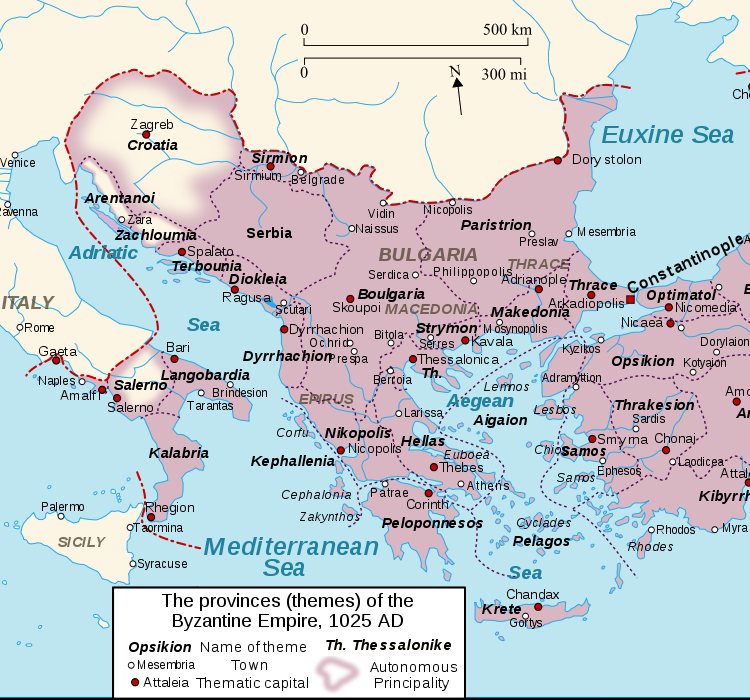
The whole ecclesiastical organization was revised, and the patriarchate abolished.
But the Archbishop of Bulgaria, installed at Ochrida in the Patriarch’s
place, only owed a faint allegiance to the Patriarch of Constantinople; and the
thirty Bulgarian bishops and the 685 ecclesiastics obeyed him alone.
256
We do not know how far these thirty bishoprics instituted by Basil corresponded with the old bishoprics of the Bulgarian Empire; but their seats had all been Bulgarian towns in Samuel’s heyday. Basil so far relied on the loyalty of the Bulgarian Church to the new Government that in several dioceses he increased its jurisdiction at the expense of the dioceses of former Imperial provinces, no doubt in districts chiefly inhabited by Slavs, who would appreciate the Slavonic liturgy. How far he proposed controlling the Church himself, or through the Patriarch of Constantinople, we do not know. He kept on the Bulgarian Patriarch David as Archbishop of Bulgaria; but on David’s death the Imperial Government adopted the custom of appointing Greeks to the Archbishopric — save once when they appointed a converted Jew — thus keeping the whole fabric in close connection with Constantinople. Among the Archbishops thus appointed was Theophylact of Euboea, who occupied his time in that wild country in writing the lives of its martyrs and of its great saint, Clement. [1]
Bulgaria, on the whole, acquiesced in its annexation. The aristocracy, worn out by its resistance, was glad to sink into the luxurious service of the Empire. The merchant classes, such as they were, welcomed peace. Those of the peasantry that held political views were almost all of the Bogomil heresy, equally but passively opposed to all Governments. Twice during the next sixty years the misgovernment of Imperial officials was to provoke the Bulgarians into serious revolt; but both rebellions were soon put down; and, so long as the Government remained competent, Bulgaria was content to rest in peace: till, at the close of the twelfth century, the whole Empire fell into chaos under the rule of the feeble house of Angelus, with Western Europe stabbing it in the back.
1. The ecclesiastical settlement is given in Basil’s ordinances,
published by Gelzer, in vol i., pp. 245 ff., and vol. ii., pp. 2 ff. of the Byzantinische Zeitschrift . The best
complete account of the reorganization of Bulgaria under Basil is given in Schlumberger’s Epopée Byzantine, vol. ii., pp. 418-32,
where the meager information is fully summarized and discussed.
257
As for the actors of the final scenes, the princes and princesses of
Bulgaria and the great generals, they were merged into the functionaries of Byzantium.
They walked before the Emperor on his triumphal entry into Constantinople; then the
men were given Imperial posts and titles and the women husbands from among the aristocracy. Of the fate of Tsar Samuel’s few surviving descendants
nothing is told; but many of John-Vladislav’s family enjoyed a certain eminence. Of his
sons, Prusian, the eldest, created a Magister on his surrender, became the
strategus of the important Bucellarian theme, till he quarreled with his colleagues so
badly that he had to be exiled. Aaron, as Catepan (κατεπάνω, lit. “topmost”) of Vaspurakan, later played a
prominent part in the Armenian campaigns of the Empire. Of Trajan, Radomir, and the
youngest son of all we have no information; but Alusian, the second son, after being
made a Patrician (on his surrender to Basil) and, later, strategus of the theme
of Theodosiopolis, involved himself disgracefully in the Bulgarian rebellion
of 1048 — the rebellion kindled by an impostor who claimed to be Peter Delean, son
of Tsar Gabriel-Radomir and the Princess of Hungary. Alusian first betrayed the
Emperor for him, and then betrayed him to the Emperor. Of John-Vladislav’s six
daughters, one married Romanus Curcuas, who was involved in Prusian’s quarrels and
was blinded; another, the Princess Catherine, sat for a while on the Imperial
throne itself, as the wife of the nervous Emperor, Isaac Comnenus. Of the next
generation, Alusian’s son, the Vestarch Samuel-Alusian, fought with distinction in
the desperate Manzikert campaign of Romanus Diogenes, while his daughter was the first
wife of that unhappy Emperor. Aaron’s son, Theodore, became strategus of the
theme of Taron in Armenia; while Trajan’s daughter, Maria, married Andronicus Ducas. One of their daughters, Irene Ducaena,
became the wife of the Emperor Alexius Comnenus and the ancestress of that great
dynasty.
258
And so, after long journeying, through the Angeli and the Hohenstaufen and the houses of Castile, of Hapsburg and of Bourbon, the blood of the last Tsar of the first Bulgarian Empire flows in the veins of the first Tsar of modern Bulgaria and his present successor. [1]
The First Bulgarian Empire was ended. Its end was not inevitable nor foredoomed — unless it be that everything is foredoomed. But history is so full of accidents improvised by a whimsical providence that it is idle to explore the roads of what might have been. Nevertheless, the First Bulgarian Empire was planned by fate in its grandest, most sweeping scale. There is the small beginning, the nomads entering the Balkan peninsula, and gradually, by the ability of the Khans of the House of Dulo, establishing themselves there with increasing strength: so that even the chaos and disasters that followed the dynasty’s extinction could not remove them thence.
Then we come to Kardam and the swift revival, and the greatness of Krum and his successors, when Bulgaria was numbered among the great Powers of Europe, and wooed and feared by the East and the West, and so to Boris, the Christian Prince, the greatest of them all, who (disastrously lost half of his country and people but instead) outwitted the Pope and used the Patriarch to secure his country the Church that he desired.
1. The fate of John-Vladislav’s descendants can be found in various
passages of Cedrenus — ii., pp. 469, 483, 487, 497 (for Prusian), 469, 470, 531 (Alusian), 469, 573-4
(Aaron), 469 — and Prokic — pp. 34 (Trajan and Radomir), 678 (Samuel-Alusian), 483 (the wife of Romanus
Curcuas), 628, 650 (the Empress Catherine). Psellus, p. 63-4, calls Alusian brother, not son, of
John-Vladislav, but we know that John had no surviving brothers
(We can'tknow for sure). Bryennius (p. 19) calls Catherine
Samuel’s daughter, but dates make it unlikely, and Cedrenus provides circumstantial evidence. See also
Prokic, p. 36. Bryennius also (pp. 106-7) tells of Trajan’s daughter Maria’s marriage, calling
Trajan Samuel’s son. But Prokic, p. 34, shows this to be wrong. Bryennius probably had only heard of Samuel,
and not of John-Vladislav. Aaron’s son, Theodore, is identified by evidence given in Skabalonovitch,
Vizantinskoe Gosudarstvo , p. 198. Attaliates (p. 123) mentions Samuel-Alusian.
259
After Boris was Symeon and the summit. For Symeon was the hero of a Greek tragedy, too
prosperous, too triumphant, too defiant of Nemesis, wearing out Bulgaria with too many
victories and dying in disappointment. The curve swerves downward, in the long afternoon
of Peter’s reign: while Pope Bogomil gave form to the discontent of a disillusioned
people (that has nothing to do with the phantom Pope).
The first shadows of evening were terrible amid the Russian (i.e. Rus)
storms; but the sunset was lit with splendor before the
night came at last. But the tragedy is not perfect. Bulgaria did not bear
within herself all the seeds of her decline and fall (Except
that royal egomaniacs were undermining the backbone of the state for their personal
survival). Bulgarian history must always be read
with Constantinople in sight. It was Byzantium, the Empire, that decided its
destiny. The Bulgars had come into the Balkans at a time when the Empire was weak,
when the Roman world was still shaken by the first sudden blows of Islam; and they
had established themselves there before the Empire had recovered. But since
the middle of the eighth century the Empire had gradually been growing in power
though the growth had been veiled by the development of Bulgaria and by periodical
setbacks, usually more spectacular than really disastrous. It was at the climax of Symeon’s career and of the whole Bulgarian Empire, at Symeon’s interview with
Romanus Lecapenus, that the truth was revealed. The Emperor, for all his armies’
defeats, was the victor. After that, the end was as inevitable as anything in this
world can be; and, though much blood was shed before Bulgaria was extinguished, the length
of the struggle was due rather to Samuel’s genius and Imperial dissensions than
to uncertainty as to the ultimate result.
260
Nor need Bulgaria stand ashamed. It is a tribute rather to the greatness of her rulers that they could, as no other invaders had been able to do, build up a nation at the very gates of the mightiest empire of Christendom (Not counting the Ogur Huns spanning empire from Rome to Siberia, and the Oguz Ottomans who foreclosed the “mightiest empire of Christendom”). Not only was Byzantium supreme amongst her neighbors in material wealth and organization, but, as the heir of Rome, she held unbroken the conception and prestige of the Universal Empire; and her civilization was the highest of its hemisphere (at least as far as savagery is concerned). Sooner or later she would surely absorb the close inhabitants of the Balkan peninsula, for all that a line of brilliant Khans had knit together Slav and Bulgar and all the remnants of races that lingered there into a nation. At times, indeed, great monarchs, lured by the siren call of Constantinople, would attempt to make the absorption of their doing, but in vain — and fortunately so; for that would be the wrong way round, as was proved by the greatest crime in history, the Crusaders’ sack of the Christian city in the year 1204.
And, indeed, the absorption was no bad thing for Bulgaria; for it did not
happen too soon. The Bulgarian monarchs had had time to instill into their country a consciousness that was strong enough to survive. In the meantime, peace
and the penetration of the Imperial civilization came as a boon to the weary
country and taught the Bulgarians more than they could have learnt in a long struggle
for independence (And judging by the parallels of the Bulgarian
and Byzantine organizations, taught Greeks a thing or two). But now they had their memories and, still more, their
Slavonic Church to remind them who they were (Better than that,
they created a Tengrian-Christian movement that spread across Western and Eastern Europe,
and scared the guts out of both Catholic Churches); and not all Pope Bogomil’s teachings
and his followers ever broke that down (The teachings were
massively exterminated on a grandeur Christian scale along with the followers the Church
could get their hands on, but their descendents are still with us, live and kicking). And so, when the time came, and the
Empire no longer was wise and beneficial, Bulgaria was ready to assemble again
round an independent standard raised by the noble House of Asen at Tirnovo.
261
So it had been worth while — and worth while, too, to countries outside of Bulgaria. The Bulgars had brought order to the Slavs and had lifted them out of chaos, setting an example for the whole Slav world to follow. The Serbian tribes could profit by it; and, moreover, had not /261/ Bulgaria lain between, they might never so have freed themselves from the influence of Constantinople, to form a proud nation, until it was too late: while, similarly, the same bulwark preserved the Empire from many harmful barbarous invasions. But the great gift of Bulgaria to Europe lay in her readiness to take over the legacy of Cyril and Methodius, so carelessly thrown away by the Moravians. This work had been initiated in Constantinople and greatly helped by the Patriarch Protius and the Emperor Basil, with that strange mixture of philanthropy and political cunning that characterized Byzantium. But it was Boris of Bulgaria that brought it to completion, and thus put all the Balkan peninsula and all the Russias (Apparently references to White Rus - Byelorussia, Great Rus - Northeastern offshoot of the Kyiv Rus, and Lesser Rus - Ukraine) into his debt. To his lead those countries owe their Churches, Churches well suited to them — Churches that kept their pride alive through all the dark days that they were to endure, at the hands of fierce and infidel barbarian invaders (Fierce and infidel barbarian invaders - apparently reference to the Bulgars' kins Kipchaks aka Tatars, who pacified, organized, and civilized Rus as much as the Bulgars civilized and organized Bulgar Slavs, and in addition prevented institution of brutal slavery that took hold after Russia gained independence).
Though clouds pass at times over the face of Bulgaria, she may well be
content with her history. The First Empire has left her memories rich in glory. It is
a splendid procession that stretches backward into the far-off darkness, past Samuel
and his passionate Court beside the high mountain-lakes of Macedonia; past Symeon
on his golden throne, his silken raiment weighed down with studded pearls; past
Boris, issuing from his aureoled palace with angels to escort him; past Krum,
with bowing rows of concubines, crying ‘Sdravitsa’
to his boyars as he drank from an
Emperor’s skull; past Tervel, riding in to Constantinople by the side of a
slit-nosed Emperor; past Asperuch and his brothers, and his father, King
(Kagan or Kağan) Kubrat (Kurbat), and past the
princes of the Huns, back through dim ages to that wild marriage from which her race
was born, the marriage of the wandering Scythian witches to the demons of the
sands of Turkestan (Citation of the Norse myth).
265