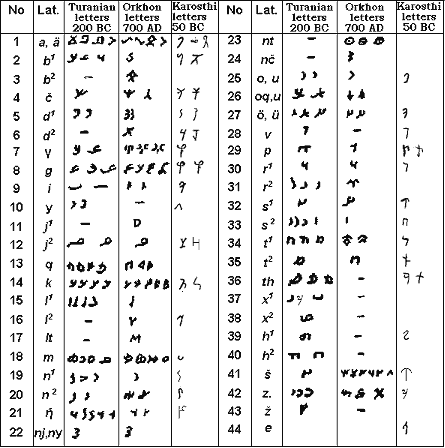
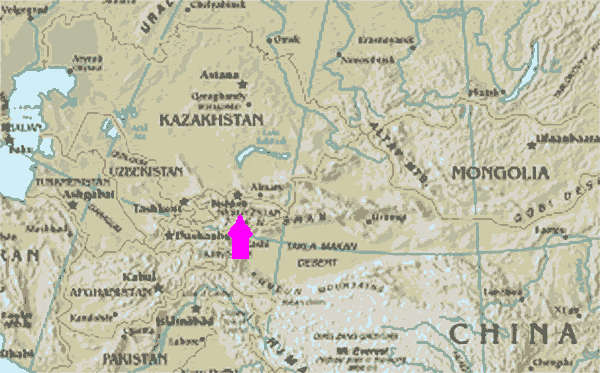
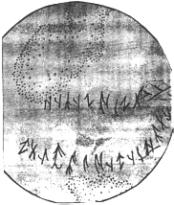
Fifth-century B.C. Issyk Inscription (1) (Pl. 24), written on a flat silver drinking-cup (nowadays called "piala" in the local lingo), was found in 1970 in a royal tomb located within Esik, a small town in Kazakistan near Lake Issyk (Issiq) in Kirgizistan in Central Asia. In the tomb were found a body of a man dressed from head to toe in magnificent attire with his clothes, jacket, pants, socks, and boots all made of attached pieces of pure gold, amounting to 4,800 in numbers, greatest ever found in a tomb excepting that of Pharaoh Tutankhamon. His tall cone-shaped crowning hat extending down to his ears and neck contained golden arrows on top. On his belt he carried a sword on the right side and on the left a knife, both in their shields. Beautiful reliefs of animal design ornamented the shields, the belt and the front of the hat. Radiocarbon tests dated the age of the finds to the fifth century BC. (2)
Issyk drinking-cup (Pl. 24)
Publications:
Amanjolov Altai S., "History of ancient Türkic script", Almaty, "Mektep", 2003
Akishev, Kemal. A., "Issyk Kurgan", Moscow, 1978, Tracing, p. 55
Erçin M., "Esik Yazıtı, Türk Runik Yazısı" (Issyk Inscription, a Turkish Runic Text) in
Harf Devrimi'nin 50. Yılı Sempozyumu
(Symposium of the 50th Anniversary of Alphabetic Revolution), TTK Yayınları, Ankara, 1981 (HD50 S
p. 225)
Diker S., And The Whole Earth Was Of One Language (1996, 1999)
Martynov 1996: 224, figure 8
Mirşan, Kazim, Prototürk Bilginlerine Göre Astrofizik ("Astrophysics According
to the Proto-Turkish Scholars"), 1990, Ankara
Musabayev
Ryabchikov, Sergei V., 1999, A Saka (Scythian) Record Reads in Slavonic
http://public.kubsu.ru/~usr02898/sl6.htm
Süleymеnof O. (Kazakhstan) (Олжас Сулейменов), 1970, Oljas Suleimenov, Issyk Inscription
// Komosolskaya pravda. 31/10/1970 (Иссыкское письмо//Комосольская правда. 1970. 31 октября)
Attempts to read:
Amanjolov Altai.S., 2003, "History of ancient Türkic script", Almaty, "Mektep"
Diker S., 1999, And The Whole Earth Was Of One Language (1996, 1999)
Harmatta J., 1999, An unknown language in an unknown script. Languages and literature
in the Kushan Empire//History of Civilization of Central Asia, Puri B., Etemadi G. (ed.) Vol. 2. Delhi:
Motilal Banarsidass, 1999
Rjabchikov, Sergei V., 1999. A Saka (Scythian) Record Reads in Slavonic
http://public.kubsu.ru/~usr02898/sl6.htm
Erçin M.,, 1981 "Esik Yazıtı, Türk Runik Yazısı" (Issyk
Inscription, a Turkish Runic Text) in Harf
Devrimi'nin 50. Yılı Sempozyumu (Symposium of the 50th Anniversary of Alphabetic Revolution), TTK Yayınları, Ankara, 1981 (HD50 S p. 225)
Mirşan, Kazim, 1990, Prototürk Bilginlerine Göre Astrofizik ("Astrophysics According
to the Proto-Turkish Scholars"), Ankara
Akishev, Kemal A., 1978, "Issyk Kurgan",
Moscow, Tracing, p. 55
Süleymеnof O. (Kazakhstan) (Олжас Сулейменов), 1970, Oljas Suleimenov, Issyk Inscription
// Komosolskaya pravda. 31/10/1970 (Иссыкское письмо//Комосольская правда. 1970. 31 октября)
Musabayev
Cəlilov (Jalilov), Firudin Ağasıoğlu “Issiq Yazisi”.
| No | Author | Language | Pos. Direct. | Transcription | Transliteration | Normalized Transliteration | Translation |
|---|---|---|---|---|---|---|---|
| 1 | Hasanov 2015 | Türkic | Straight LTR |
 |
*Dört *bul Küz Sïnglïyï ïr Uş yüz yïğ anta ïçïr |
– | (Of the)
Four Corners (cardinal directions) (the) tribes Syngly sing (acclaim). Three hundred mourners oath drink (give an oath). |
| 2 | Hamori 2013 | Hungarian | Straight RTL |
.gif) |
I R J Nu A SZ a N N - aK: Y-SZ SZ- A- T - aK: Ti ZH, eSZ T-é Re SZá TO B a J ZS aTa P>Vi SZ >Zé T :: C/S- aK : Tá- R - SHa- S- SZá- G eGé–S-éG Jó? I CAK: |
Eréj(es) nő asszonynak iszátok tiszte(let)ére (az) ös-atya vizét. Csak a társaság jó egészségére iszuk | Drink to the honor of the virtuous-woman (the) queen, (the) water of god. Only for (the) health/wholeness (of the) society/community we drink |
| 3 | Alili 2012 | Türkic | Upside RTL |
 |
OĞA SeN ANg İÇ SaK SöZ eReNg öGüNç SƏS-üNİ eRiR ÜZƏ |
– | Sak (Saka), imbibe your oath in the name of the people! Word would carry voice and glory of praising the Eren to the heavens i.e. Sak (Saka), swear by the name of your people! The solemn word is ascending the voice of praise and Eren's glory to the heaven |
| 4 | Amanjolov 2003 | Türkic | Upside RTL |
аγа sаηa očuq! bäz čök boqun ičr(?)ä uzuq ...i |
Aγa, saηa očuq Bez, čök! Boqun ičrä [r?] azuq! ...i |
Senior brother, (this) hearth is for you! Stranger, kneel! Progenies [shall have] food! |
|
| 5 | Harmatta 1999 | “Hotanese” | ? | ? | ? | za(m)-ri ko-la (m) mi(m)-vam vam -va pa-zam pa-na de-ka mi(m)-ri-to ña-ka mi pa-zam vam -va va-za(m)-na vam |
The vessel should hold wine of grapes, added cooked food, so much, to the mortal, then added cooked fresh butter on. |
| 6 | Diker 1999 | Türkic | Straight (Dir.?) | ? | ? | han o-ng er çarık siz çirik bar gıl er-ni içigig ketir oz gıl |
The King Ong-Er, Charik, You (are) soldiers Set out! Volunteer heroes, rise to the heavens, To reach (the eternal) peace! |
| 7 | Ryabchikov 1999 | IE cumulus | Upside LTR | ? | p(i)-u-r-u v(e) n-r v(e) l-e-sh s-e v(e)-e-r A-n-i p(e)-u-t n-b-e-u |
? | Fairytale horse; in, into, at fury; aspiration Fire, the path though the sky; to turn round and round; this is fire/top; sky i.e. fragment reports about the solar horse |
| 8 | Mirşan 1990 | Türkic | ? | ? | ? | ögün an onuy a öcü ok ub oz uç esitis oz ötü onuy oy ekiç ekil aliz at |
One whose Majesty you praise became an arrow belonging to the cosmos He is Zeus ascending to the leadership like winning a race, (to achieve) cosmic seat (is) the appellation of adopted name |
| 9 | Erçin 1981 | Türkic | ? | ? | ? | Agân er / anga er iç / arak Esiz iç / erik baruk / arakı E iç itkir / az ök |
Single (lone, lonely) man / drink of useless man / arak (milk vodka) Alas, to drink / evil, wild / arack Be obedient to drink / moderately |
| 10 | Suleymеnof O. 1970 | Türkic | ? | ? | ? | Han uya üç otuzu (da) yok boltı, utıgsı tozıltı | ?King's son died (at) twenty-three (thirty-three), (His) name and fame (turned to) dust |
| 11 | Jalilov | Türkic | ? |
 |
? | Koçu añısı ağ ebi Oquz ər içiñ Uqusgü çizib or Koçu añısı ağ ebi Oquz ər içiñ oqu bəgü çizib |
In memory of Koch white house Ugushgu for Oguz chieftain (lit. man) depicted or In memory of Koch white house Bek of clan (or tribe) for the Oguz chieftain (lit. man) depicted |
| 12 | Abilasan | Iranian | ? | ? | ? | ? | Reportedly untranslatable |
| 13 | Bekzhanubiri | Iranian | ? | ? | ? | ? | Reportedly untranslatable |
| 14 | Chudinov | Cyrillic | ? | ? | ? | ? | ? |
| 15 | Gandaburov | Iranian | ? | ? | ? | ? | Albanian zones of sudden invasions: Urartu, Elam, Media, Aria, the Saxons |
| 16 | Hurshudyan 2011 | ||||||
| 17 | Kerimkulov | Iranian | ? | ? | ? | ? | Farewell, tigrahauda, eat this oil, now hunger |
| 18 | Kotova | IE | ? | ? | ? | ? | God is grieving and misses the dead Aksahane |
| 19 | Kuznetsov | Russian | ? | ? | ? | ? | The gods favor war master Peshuru, who protecting our kind, is calm |
| 20 | Musabayev | Türkic | ? | ? | ? | ? | Honestly hold high the banner of a father. Be a worthy ruler. Your horses, your soldiers will bring you fame. Stay healthy |
| 21 | Suleimenov T. | Iranian | ?? | ? | ? | ? | The ruler Ashan, you took the people. There are three thousand one hundred thirty-one of them. Warriors of the two heroes of the thirty-two clans on six ash stay in hundred banners |
Transcription:
Amanjolov Altai.S.

Others - Not available
Transliteration:
Amanjolov Altai.S.: (with translation)
(1) аγа sаηa očuq
= Aγa, saηa očuq!
"Senior brother, (this) hearth is for you!"
(2) bäz
čök boqun ičr(?)ä
uzuq ...i = Bez, čök! Boqun ičrä
[r?] azuq! ...i
"Stranger, kneel! Progenies [shall have]
food!"
Diker S.: (ommited vowels in bold) (In respect to Amanjolov's transcription, text is read upside down)
|
han o-ng er çarık |
or |
Han Ong-Er, Çarık, |
Olças (Oljas) Süleymеnof: (In respect to Amanjolov's transcription, text is read upside down)
Han uya üç otuzu (da) yok boltı, utıgsı tozıltı
M. Erçin, generally based on Akishev's phonemes:
Agân er / anga er iç / arak
Esiz iç / erik baruk / arakı
E iç itkir / az ök
Kazım Mirşan:
ögün an
onuy a
öcü ok .
ub oz
uç esitis
oz ötü
onuy oy ekiç ekil
aliz at
Sergei V. Rjabchikov: (reading left-to-right, presumably using Minoan Linear A alphabet, distorted tracing of the inscription, and Slavono-Indo-Palestinian-Sinaian-Byblian-Indo-Arian-Old Indian etc language)
p(i)-u-r-u v(e) n-r v(e) l-e-sh
s-e v(e)-e-r A-n-i p(e)-u-t n-b-e-u
Translation
Diker S.:
|
literally |
in clearer English |
|
King Ong-Er, Çarık, You soldiers, Do depart! The heroes as willingly-joined volunteers, raise up to heaven, Reach (eternal) peace! |
King Ong-Er, (of) Çarık (Nation), You soldiers, Do depart! Raise up to heaven the heroes who have voluntarily joined you, (and) Reach (eternal) peace! |
Diker S. Translation Dictionary:
-ig Turkish noun-making suffix attached to verbs. See: içigig.
-ni accusative suffix (generally passive case). Some examples: M. Tr. ol erni ök keldür "bring that man himself"; O. Tr. biz-ni "us".
bar- (Mod. Tr. var-) to go, to depart; to reach, to arrive.
bargıl an imperative form of the verb bar-, meaning "do go!; do depart!." See: bar- and -gıl.
Çarık/Çaruk name of the Issyk people, which may be the source of the Turkish clan mentioned in Mahmud Kashgari DLT where Çaruk (Çarık/Çarıg) is mentioned as the name of one of the twenty Turkish clans, who, together with "Kirghiz, Kiptchak, Oghuz, Tokhsi, Yaghma, Çigil and Ughrak, speak only one language, that is, pure Turkish" (DLT I, 30). They lived in the city of Barçuk (DLT I, 381) which Kashgari says was the city of Afrasiyab (Alp Er Tonga), the ancient king of the Turanians (Turks) in the Shahname. This city was located east of Kashgar and south of Aksu in Eastern Turkistan, the region only about 250 miles away from the town of Esik where the inscription was found. Çaruks are also mentioned under the name of Çaruk-lu ("belonging to the Çaruk") as one of the 22 Oghuz tribes (DLT I, 58). Their colonies seem to have lived in Khwarezm, Crimea, and Caucasus under the name of Çagruq/Çıgrak. The name is also mentioned in Uighur texts found by M. A. Stein, Hungarian-born British archaeologist, in Tun-huang in Central Asia, where Çarıg is one of the ten (royal) clans, and one of the five of the Tarduş group (western part) of the Kök-Türk empire. The age of the Uighur texts is accepted to be not later than A.D. 8th century [probably much earlier]
çirik Tr. çerik/çerig "soldier, soldiers, troops, a line of soldiers, army" (UYG; DLT).
er man, men, brave man, hero (DLT I, 468). Example: O. Tr. er (written with single r) "man" (Kt:N12); tokuz erig (active accusative, written as tkuz rg) "the nine man" (Kt:N6).
içigig/içikig (içgg) "(one) joined willingly or voluntarily," used as past participle of the verb içik-, or "(one) who joins voluntarily; [(a) willing (man), volunteer]," used as verbal noun formed with the noun-making suffix -ig/-ik attached to the verb içik-. The word is written, almost exactly, in Bilge Kaghan's inscription where it appears together with its verb. Thus, Kök-Türk expression içkg-me içk-di (içikig-me içikdi), budun boldı "(those) if willing (or being willing), joined (and) became (part of) the nation" (BK:E37), the meaning of the suffix -me being apparently "to be; being," or -me/-ma "if" (UYG). Actually, the Issyk içgg (içigig) conforms better with the Turkish harmony in spoken language than the Kök-Türk içkg (içikig) which is grammatically the correct form in writing.
içik- (içk-) to enter in, to join [voluntarily] (UYG); to surrender willingly or voluntarily (to the other side and then fight in their ranks) (DLT I, 192). O. Turkish example: Han birtim, hanıngın kodup içikding "I gave you (a) king, (but) you have joined (the enemy)".
han king.
kötir-/kötür-/köter- (ktir) to raise, to raise above (CdCum 118.37; UYG).
on-? "to reach a good end"; an alternate word for oz-, assuming the sign for z is a dual letter n/z.
ong (part of the name of the king) "good, safe; abundant, fruitful, fertile; [happy; blessed]"; "freedom; security, safety; soundness [(divine) peace; throne, God?, Heaven?]" (CdCum 113/4 and 119/43, 44). Ong was a Turkish title given to the Nestorian Tughril (Tughrul) Khan, king of the Kerait Turks, and a century before him, was the name of one king, Ong Khan of the infidel (non-muslim) Turks (of Khitai and Khotan) of the East.
Ong-Er name of the king, meaning "Blessed Hero."
oz- to be saved, to find salvation, to reach safety, [to reach peace] (DLT; UYG). The word is a synonym of Tr. on- "to reach a good end; to make secure, safe; to cure, to be well" (UYG).
ozgıl an imperative form of the verb oz-, meaning "do find salvation!; do reach (eternal) peace!." See: oz- and -gıl.
sen? (1) (Normal Turkish) "you" singular, said to people younger and of lower rank; an alternate word for siz, assuming the sign for z is a dual letter n/z.
sen? (2) (Oghuz Turkish) "you" singular, said to elders. See also: siz (3).
siz (1) you (plural).
siz (2) you (singular, said to older people) (This remarkable tradition persevered in the Ukrainian language, which uses Slavic vocabulary to depict a Türkic tradition, in contrast with the Russian custom of using singular as an appellation to the parents, which to the Ukrainian ears sounds rude and inadmissible, Вы vs. ты).
siz (3) (Oghuz Turkish) "you," singular, said to people younger and of lower rank (DLT I, 339, where Kashgari says: "Oghuz Turks do the reverse, they say `sen' to the elders and `siz' to the younger").
M. Erçin:
Lonely person / worthless person drink / arak
Alas drink / evil wild / (the) arak
Do be obedient drink / just a little
Musabayev: (see http://www.lostlanguages.com/saka.htm for Selahi Diker's comments)
Olças (Oljas) Süleymеnof: (see http://www.lostlanguages.com/saka.htm for Selahi Diker's comments)
The son of the king, at twenty
three (three-thirty), died
His name and fame became dust
Kazım Mirşan:
Him whose majesty you are praising
is an arrow which became of the cosmos.
He The Zeus.
by passing to leadership as if winning a race, (to reach) to the seat of the
cosmos
(is) the name taken
Sergei V. Rjabchikov: (interpretation using an aggregate Slavono-Indo-Arian-Minoan Linear A (B)-Türkic etc language, with a major dose of undeclared Türkic borrowings like loshad' 'horse', burya 'storm', Sivka-burka 'fairytale horse'):
|
Reading |
Rjabchikov's Explanation |
| fairytale horse; in, into, at fury; aspiration | fragment reports about the solar horse |
| Fire, the path though the sky; to turn round and round; this is fire/top; sky | No explanation, sorry |
Some more references
1.Suleimenov Oljas, Issyk script//Komosolskaya pravda, 31/10/1970,
(Сулейменов Олжас, Иссыкское письмо//Комосольская правда, 1970 31 октября )
2. Kotova G.G., Silver bowl of Issyk kurgan//Trinitarizm Academy, Moscow, Al № 77-6567,
publ.17663, 21.09.2012
(Котова Г.Г., Серебряная чаша из кургана Иссык//Академия Тринитаризма, М., Эл № 77-6567,
публ.17663, 21.09.2012)
3. Akishev K.A., Issyk script and runic writing//Ancient Turkic Civilization: written monuments,
Proceedings of International conference, Astana, 18-19 May 2001, Almaty, 2001, pp. 389-395
(Акишев К. А. Иссыкское письмо и руническая письменность//Древнетюркская цивилизация: памятники
письменности, Материалы международной научно-теоретической конференции, посвященной 10-летию
независимости Республики Казахстан, г. Астана, 18—19 мая 2001 г., Алматы, 2001, сс. 389—395)
4. Amanjolov A.S. Runiform inscription from Saka burial near Alma-Ata//Journal of Kazakh SSR Academy
of Sciences, 1971, No 12 (320), pp. 64-66
( Аманжолов А.С. Руноподобная надпись из сакского захоронения близ Алма-Аты, Вестник АН КазССР,
1971, No 12 (320), сс. 64-66)
5. Harmatta, Janos. History of Civilization of Central Asia. Volume 2, Motilal
Banarsidass, 1999, ISBN 8120814088, p. 421
6. Hurshudyan E., Inscription on Issyk kurgan bowl//Iran Name, 2011. No 4 (20). p.95 (Хуршудян
Э., Надпись на чаще из Иссыкского кургана//Иран Наме. 2011. №4(20). с.95)